

To define the contours of certain constitutional rights, the Supreme Court has recently turned to explicit appeals to “history and tradition.” For just two leading examples, consider New York State Rifle & Pistol Association, Inc. v. Bruen in 2022, involving the Second Amendment, and Dobbs v. Jackson Women’s Health Organization the same year, concerning the right to bodily autonomy and overturning the 1973 decision in Roe v. Wade. The concept is not altogether new: Judges, including some on the Supreme Court, have been willing to use history and tradition as a rule of decision in First Amendment cases as well. In fact, we already have several examples of this practice in cases upholding intellectual property (IP) rights despite their effects on others’ freedom to speak. What can we learn from these IP/First Amendment cases?
This essay will approach this question as follows. First, it will briefly review the rise of history and tradition as an alternative mode to the approach of “strict scrutiny” in defining the scope of constitutional rights. It will then discuss the IP/First Amendment cases and their use of history to approve new expansions of IP rights, notwithstanding the resulting effects on the freedom of others to speak—including in their reporting, copying, and parodying. It concludes with some reflections about what should come next.
The key point will be that the considerations present in other modes of free-speech reasoning—in particular, the need to tailor regulation to harm—remain necessary even when consulting “history and tradition.”
Strict Scrutiny and the Seemingly New Challenge of History and Tradition
The strict scrutiny test, as Richard Fallon recounted in 2007, “evolved simultaneously in a number of doctrinal areas” by the 1960s and quickly came to “dominat[e] numerous fields of constitutional law,” including First Amendment challenges to government regulation of speech based on content. Strict scrutiny as a standard requires the government to show that its actions are “narrowly tailored” to further a “compelling government interest” and that they are the “least restrictive means” to advance that interest, as set forth in Reed v. Town of Gilbert (2015) and numerous other cases.
Not so long ago, the Roberts Court seemed destined to use strict scrutiny liberally to strike down many government regulations of speech. For example, in United States v. Stevens (2010), the Court held that legislatures can’t identify new categories of low-value and thus unprotected expression; only historically recognized exceptions count. Stevens and similar cases seemed to represent a firm rejection of most new speech regulations.
But the composition of the federal courts has changed, another approach has become visible, and the Supreme Court is clearly open to throwing out decades of precedent. For example, in the Second Amendment and bodily-autonomy context, the Court has appealed to “history and tradition” to distinguish constitutional from unconstitutional regulations. Could it do the same for First Amendment law?
IP/First Amendment Doctrine’s Surprising History And Tradition
In fact, even before the rise of “history and tradition” as an explicit methodology, the Supreme Court evaluated two IP rights for consistency with the First Amendment and approved them on historical grounds, without applying any particular level of “scrutiny.” These are the rights of publicity and copyright.
Right of Publicity
The right of publicity focuses on a person’s interest in controlling commercial exploitation of one’s name, image, or other indicia of identity. Zacchini v Scripps-Howard (1977) involved a circus performer who was shot out of a cannon for audience delight. A TV news station recorded the entire performance and broadcast it as part of a story about the event. The performer sued for violation of his right of publicity, and the Court found that his claim was not barred by the First Amendment, even though the incident was newsworthy. The Supreme Court consistently characterized the conflict in Zacchini as one between the television station’s First Amendment rights and the performer’s interest in his “entire act”—the latter being equivalent to a well-recognized common-law copyright claim. Common-law copyright protected creative works before they were published, and for performances it protected them against unauthorized fixation, including unauthorized recording.
Lower courts then immediately disregarded the Court’s analogy and started approving almost anything called “right of publicity,” including lawsuits based on people “reminding” audiences of a celebrity, despite the effects on speech. So now you can be sued for putting a digital version of Manuel Noriega in a video combat game (even though the plaintiff failed), making a bobblehead doll showing Arnold Schwarzenegger as the “Governator” (plaintiff secured a settlement), using a blonde robot in a wig to imagine “Wheel of Fortune” in the future (plaintiff Vanna White succeeded), or using, in the background of a videogame, the name of a company that also happens to be the name of the company’s owner (the court refused to dismiss the plaintiff’s claim). The California Supreme Court approved liability for an artist who drew pictures of the Three Stooges and sold them, reasoning that he was making art for profit. Two federal courts of appeals have held that creating a digital version of a football player in a football video game violated his publicity rights.
Arguably, the very lack of attention to the Court’s use of history and tradition in Zacchini led subsequent courts to ignore the potential limits on its holding. Some courts eventually began asking about the fit between the right of publicity’s scope and its justifications, at least when celebrities sued over parodies, but such inquiry was too long delayed.
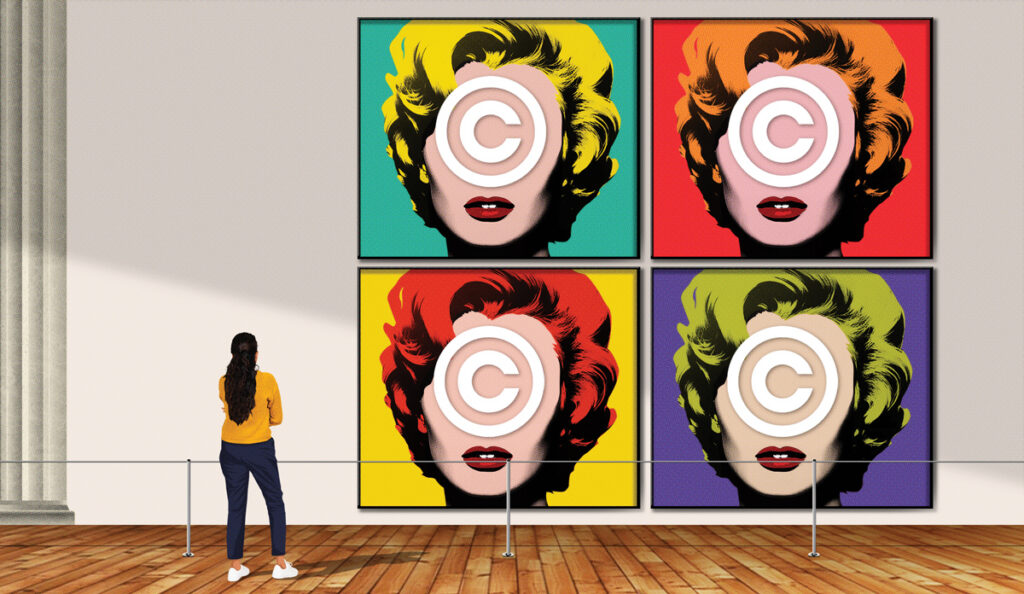
Most of us might not care much about freedom to evoke celebrities in ads, but we should care that the right of publicity now also covers art.
Most of us might not care much about freedom to evoke celebrities in ads, but we should care that the right of publicity now also covers art. Moreover, even for ads, there is no clear doctrinal barrier to Donald Trump asserting a claim against truthful, nonmisleading advertising that compares other Bibles for sale with Trump-branded Bibles, or offers to resell genuine Trump-branded meme coins, even though such ads would have to use his name to make themselves intelligible. We could certainly make up new limits on the right of publicity, but not all lower courts are willing to do so, and, even when such limits are found, they make the doctrine more complicated and thus more likely to chill truthful, nonmisleading speech both in and outside of ads.
Copyright
More recently than Zacchini, the Supreme Court used history and tradition to reject two First Amendment challenges to new copyright legislation. Rather than analyzing whether the changes were speech regulations subject to intermediate or strict scrutiny, the Court reasoned that both extending the copyright term and creating federal copyrights where none had previously existed were things that Congress had done before, so no additional First Amendment analysis was required. These instances are worth recounting.
Congress extended the term of existing copyrights in 1998. The resulting constitutional challenge reached the Supreme Court, and the challenger, Eric Eldred, argued that new copyright restrictions on previously permissible speech required some level of First Amendment analysis. In 2003, in Eldred v. Ashcroft, the Court disagreed. It emphasized that the Constitution’s copyright clause provided a robust foundation for congressional action and that the near-contemporaneous adoption of the Bill of Rights and the first federal copyright act showed their compatibility. Further, it reasoned that copyright includes its own internal safeguards for free speech interests: the fair use defense and the denial of copyright in ideas or facts. Thus, the Court held in Eldred, no further First Amendment analysis was required when Congress added 20 years to the term of existing copyrights, delaying many important works from their scheduled entry into the public domain where they could be freely used by historians, artists, and anyone else.
The Court reprised its historical reasoning in 2012 in Golan v. Holder, which involved a challenge to a different provision of copyright law: one restoring copyright to foreign works, such as those of J.R.R. Tolkien and Igor Stravinsky, that had failed to gain protection in the United States because of noncompliance with U.S. rules requiring certain “formalities.” The Court reasoned that the first Congress had allowed existing works to claim a new federal copyright, even though those works hadn’t been created under a federal regime. So long as Congress acted within the “traditional contours” of copyright, Golan said, its acts required no further scrutiny.
But what are those traditional contours, since we know after Eldred and Golan that those contours don’t include that a work’s term of protection is the term specified when it was created or that a work in the public domain stays in the public domain?
Copyright has changed a lot since the time of the Founding. First, it covers far more kinds of works: copyright originally covered only maps, books, and charts, even though visual art, music, and sculpture were well known to the Founders. Second, copyright as the Founders knew it also only covered copying, as the name suggests, but Congress has extended copyright to allow copyright owners to control many more acts, including public performance and creation of derivative works such as sequels and translations.
Perhaps if Congress got rid of fair use or threw out the idea/expression distinction, this would violate the First Amendment—yet Congress has passed laws that cut sharply back on fair use in the digital context. If the only guideline is “traditional contours” and there is a history of shrinking freedom to use copyrighted works, then it’s difficult to tell when the traditional contours have been exceeded.
Recently, the Court has become even more open to using history and tradition as the guide to constitutionality in trademark cases.
Trademark Today
Recently, the Court has become even more open to using history and tradition as the guide to constitutionality in trademark cases. As in the copyright sphere, it has used history and tradition to approve new restrictions on speech, rather than to strike down new regulations (as has been its tendency in Second Amendment cases).
Jack Daniel’s Properties, Inc. v. VIP Products Inc., a 2023 decision, is instructive. The case involved a parody dog toy that made fun of Jack Daniel’s: it was a plastic bottle, with a label “Bad Spaniels,” that squeaked when squeezed. The federal trademark statute lacks a general, copyright-like “fair use” provision. Courts instead have created special tests for situations where greater scope for unauthorized use of a trademark seems justified—such as comparative advertising, resale of used goods, and artistic references.
In Jack Daniel’s, the Court mostly dodged the question of how to harmonize freedom of speech with trademark law. Ruling for Jack Daniel’s, it held that, when the defendant is using as a trademark a similar term to identify the source of its own goods (here, “Bad Spaniels” dog toys), trademark law’s ordinary multifactor test for consumer confusion “does enough work to account for the interest in free expression.” The Court reasoned that the basic point of trademark law for centuries has been to protect consumers from deception about the source of goods or services. Thus, source-identifying uses that cause deception must not be part of the speech historically protected by the First Amendment.
But, as I have written elsewhere with Mark Lemley,
There is no Trademark Clause and no Founding Era federal trademark statute; indeed, the Court invalidated Congress’s first attempt to pass a trademark statute, nearly a century later, because it could not be justified under the IP clause. Nor would what current courts call “likelihood of confusion” be recognizable to post-Reconstruction courts, or even mid-twentieth century courts, both of which protected trademark owners in far more limited circumstances. Until recently, trademark law applied only in cases of “passing off,” where the defendant’s goods would substitute for purchases of the plaintiff’s goods.
No one, no matter how drunk, would buy a Bad Spaniels dog toy in place of a bottle of Jack Daniel’s, or vice versa. Furthermore, modern courts can be willing to find confusion if 15 percent of consumers, or even fewer, think that a speaker must have had permission from the trademark owner to make jokes about the trademark. Justice Sotomayor’s concurrence in Jack Daniel’s warned against finding confusion too easily, a welcome caution. But this only comes into play in the later stages of an infringement case, while the speech-deterrent effect of trademark threats lies primarily in the ease with which an infringement claim may be asserted.
Then, in Vidal v. Elster (2024), the Court considered the trademark statute’s blanket prohibition, known as Section 2(c), on registering a trademark that includes a living person’s name without that person’s consent. Trademark registration confers substantial procedural and substantive benefits compared to simply using a mark in the marketplace, and the Court had previously held that the government could not withhold registration on viewpoint-based grounds. Following those precedents, which treated a registration refusal like a penalty on speech, the U.S. Court of Appeals for the Federal Circuit had held that Section 2(c) was insufficiently tailored to the relevant interests in preventing confusion. However, the Supreme Court unanimously agreed that Section 2(c) was constitutional even when it barred registration of a completely nonconfusing mark, such as TRUMP TOO SMALL.
Elster said that “trademark rights have always coexisted with the First Amendment, despite the fact that trademark protection necessarily requires content-based distinctions.” Justice Thomas’s opinion for the Court stated that “a tradition of restricting the trademarking of names has coexisted with the First Amendment, and the names clause fits within that tradition. Though the particulars of the doctrine have shifted over time, the consistent through line is that a person generally had a claim only to his own name.”
However, the registration system is not the same thing as allowing a private right of action for name confusion. Justice Thomas didn’t even seem to notice that he was generalizing from individual private infringement suits to a government-run registration system that bars certain registrations even in the absence of private opposition.
Moreover, the common-law history has an obvious link with Section 2(a), which provides for a ban on registering marks that create a false suggestion of a connection with a person. Section 2(c) goes further—its only independent utility is when it applies to a mark that wouldn’t falsely suggest a connection because it is critical. To take a hypothetical but plausible example, barring registration of DEMOCRATS AGAINST ELON MUSK and similar terms doesn’t seem like it’s going to facilitate source identification.
In order to justify the expansion of trademark concerns to cover nonconfusing uses, the Court’s opinion in Elster added that it’s not just fraud that can be banned, but also misappropriation—“piggyback[ing]” off of another’s name. Its historical foundation for that extension, though, comes from 1978, when Congress passed a law giving special rights to the U.S. Olympic Committee—hardly a Founding-era precedent.
This is an expansion of the “reputation” rationale far beyond the deception-based historical foundations of trademark. Reputations can be harmed not just by confusion, but by truthful information. Reputations can also be harmed by nonfactual vibes. (That’s why advertisers spend so much money trying to make you think their products are cooler than the competition.)
Justice Barrett’s concurrence in Elster was attentive to this gap: “[T]he Court’s evidence, consisting of loosely related cases from the late-19th and early-20th centuries, does not establish a historical analogue for the names clause.” The ability to cherry-pick a few cases out of the historical record allows for a lot of manipulation, especially in a common-law nation where there is no such thing as an unbroken, consistent line of cases. Justice Barrett further criticized relying on late-19th and early-20th century evidence at all. This approach has both a timing problem (why is that period important when it was neither the Founding nor immediately around Reconstruction?) and a conceptual problem: “[T]he Court never explains why hunting for historical forebears on the restriction-by-restriction basis is the right way to analyze the constitutional question.” The latter is arguably worse: what judges do once they’ve found their history is even more important, as they try to determine whether the history is sufficiently like the present legislation.
The Founding era had comparatively few laws and more reliance on judicially recognized causes of action than we do now. Even when judges articulated general principles, they were applying them to particular facts, so limiting principles that weren’t relevant to the case at bar were often omitted.
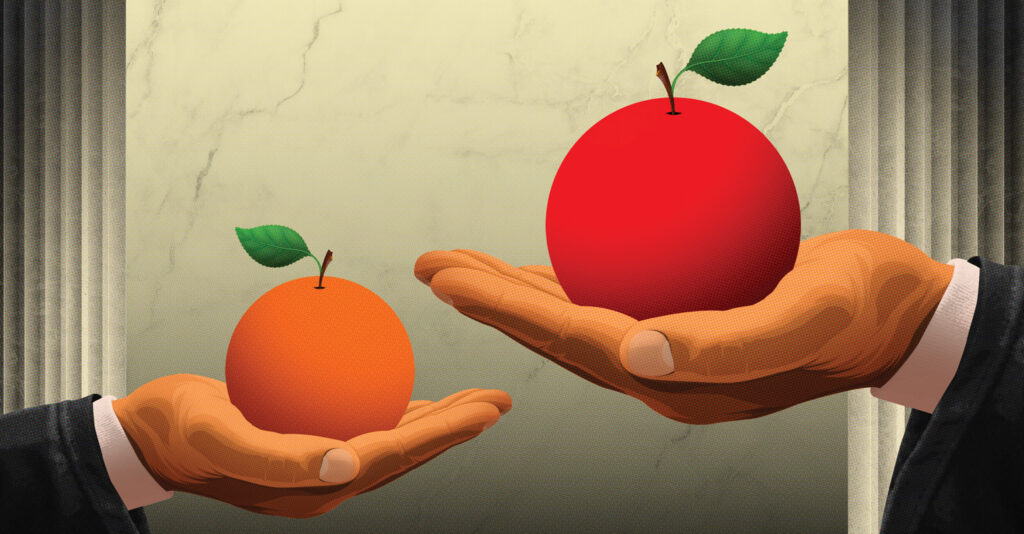
Perhaps more importantly, an analogy between the historical case law and the statute would have to come from identifying the rule emerging from the case law and comparing it to the statute. And any grouping of cases to give a “rule” has to have an underlying theory of what unites these cases: a classic level-of-generality problem. ‘Historical cases were about protecting rights when names were used as source-identifiers’ is one theory, but so is ‘historical cases were about protecting rights when names were used deceptively,’ and the latter creates a different baseline.
The approach of history and tradition leaves key questions unanswered. Even after we identify the appropriate period of historical scrutiny (which turns out to be harder than it seems, since everyone is tempted to reach wherever in history helpful precedents can be found), the job is not over. For things like the bars on registering certain trademarks, we need to decide if the analysis should be at the level of the purpose of the specific restriction at issue, such as protecting personhood interests, or at the level of the trademark system as a whole. And we should be clear about whether—assuming that denying registration to the mark TRUMP TOO SMALL is legitimate because of Elster’s putative free-riding on Trump’s reputation—it is also constitutional to punish the sale of merchandise that bears the message TRUMP TOO SMALL.
What Comes Next?
The defenders of the history and tradition approach primarily argue that it is a more neutral way of evaluating laws, compared to the policy analysis putatively required by tiers of scrutiny. Their record in the First Amendment context so far should not give us confidence.
Free Speech Coalition v. Paxton
In 2025, the Supreme Court upheld a Texas law that required age verification by commercial internet sites whose content was a third or more obscene as to minors. The opinion in Free Speech Coalition v. Paxton, written by Justice Thomas, used a hybrid approach. In order to find a legitimate state interest in identity-verification legislation, the Court relied on a history of legal regulation of minors’ access to such (obscene-for-minors) speech.
Then, in what may well have been a concession to keep a solid majority, Justice Thomas’s opinion proceeded to apply intermediate scrutiny to the regulation whose purpose had been already thus approved. But its scrutiny was basically indistinguishable from rational-basis scrutiny. And, as the dispute between the majority and dissent made clear, in strict or intermediate scrutiny it is not so much the legitimate-state-interest question as the remaining inquiries—fit and tailoring—where most of the tools of judicial scrutiny are really deployed.
As the dissent showed (Justice Kagan for herself and two others), the costs to the speaker of implementing ID verification, as well as the porousness of the ID-verification law, made the law different from past measures in ways that deserved much more consideration than the majority gave them. Website age verification is unlike brick-and-mortar age verification because it can potentially be saved for government review or exposed to hackers (something that just happened with the identity verification for a women-only app, Tea), and it is very expensive, as opposed to the very low marginal cost of checking IDs in a store staffed by humans.
Unreassuringly, the majority opinion also signaled at least some openness to the kinds of unconstrained analogies that the Court previously deployed in the IP cases. For example, a footnote explicitly refused to decide what would happen if Texas decided that a broader range of nonexplicit content were “obscene as to minors”— doubtless looking forward to controversies about drag shows, speech that acknowledges the existence of transgender people, or similar topics. Likewise, the Court did not decide what would happen if Texas decided that access to the whole internet, not just sites with more than one-third sexually explicit content obscene as to minors, should be subject to the same ID-verification requirements (a footnote allowed that a broader law might be unconstitutional as applied but that there was no relevant argument before the Court). Such expansions are different in degree, not in kind, from the rules the Court just approved. And it is difference in degree that “history and tradition” has the least capability to assess.

What History and Tradition Can’t Tell Us
The history and tradition technique doesn’t supply its own analytic framework, and to say that a ‘sufficiently close analogy’ to history is required is not all that helpful. The results can be seen in the sharply different trajectory of history and tradition in First Amendment IP cases compared to Second Amendment cases. That contrast should give us pause in further embracing history and tradition as a guide to the First Amendment more generally.
It turns out that anti-gun-regulation (or “pro-Second-Amendment”) judges can dismiss inconvenient past examples of gun regulation as misunderstandings, as in Bruen’s rejecting various historical gun regulations as “outliers,” rather than precedents supporting modern gun controls. But in IP cases like Elster, as we have seen, the same judges can seize on outlier precedents, or simply use the general justifications for IP rights expressed in past cases, and treat them in isolation from considerations that formerly limited those rights, thus acting as (it is fair in context to say) “anti-First-Amendment” judges.
The expansion of relevant evidence beyond text to any practice (or nonpractice) of legal regulation aids in the project of judicial discretion: With such a vast corpus, who could deny that there must be some errors and misunderstandings in there? At the same time, judges can dismiss inconvenient past limits on IP rights as matters of legislative grace, and can always find at least some expansive descriptions of the private interest at issue, which then justifies further expanding the scope of the IP right, the First Amendment notwithstanding.
Although strict scrutiny and intermediate scrutiny have problems of their own, the concerns they implement will not go away.
Even if a course of history and tradition identifies valid regulatory goals, interpretation and judgment are still required to see whether a particular regulation is a legitimate way of accomplishing a valid goal. Although strict scrutiny and intermediate scrutiny have problems of their own, the concerns they implement will not go away.
In the First Amendment, the animating concerns include worry about suppression by the government of views it doesn’t like, whether by viewpoint-based laws or laws that in practice discriminate against particular viewpoints; related worry about government’s ability to identify when speech actually causes harm rather than just causing upset; and problems of overbreadth and underbreadth, where poor targeting by a regulation may entail unwarranted discrimination against certain kinds of speakers even though other speech causes the same harm but remains unregulated.
Thus, one useful question is whether a speech restriction matches well to the putative harm it addresses. If its harm-prevention claim relies on an extended causal chain that could be interrupted by other factors, or is unpersuasive as a justification for the law at issue because of the amount of harmful speech it leaves untouched or the amount of harmless speech it suppresses, then we should identify a constitutional problem.
That is, considerations of fit—usually considered as part of the second and third prongs of strict or intermediate scrutiny—cannot and should not disappear even if the “compelling government interest” and “substantial government interest” standards are replaced by a test that requires the government interest asserted to be recognized by U.S. history and tradition. Indeed, tailoring concerns are likely the only way to evaluate whether newly enacted laws are consistent with a history and tradition of allowing some speech regulations and not others.
Zacchini, the 1977 right of publicity case, could even offer us a potential model if we took the historical analogy seriously as a limit on what lawmakers can enact, as in the Second Amendment context. After all, there were reasons why common-law copyright in unfixed performances didn’t prevent most reporting about what people said.
Law should not be fundamentally unprincipled or unpredictable, even when some uncertainty is inevitable. Addressing the role of history and tradition in First Amendment doctrine is therefore vital to the project of maintaining the rule of law even in a time of rapid constitutional change.
Rebecca Tushnet is the Frank Stanton Professor of the First Amendment at Harvard Law School. Her work includes a focus on copyright, trademark, and advertising law. This essay is based on Marquette Law School’s Nies Lecture on Intellectual Property, delivered by Professor Tushnet on April 3, 2025. A longer version will appear in the Marquette Intellectual Property & Innovation Law Review.
This article was first featured in the Summer 2026 issue of Marquette Lawyer Magazine.