
Campaigns matter, and a chaotic last month in the Wisconsin Democratic primary is a prime example.
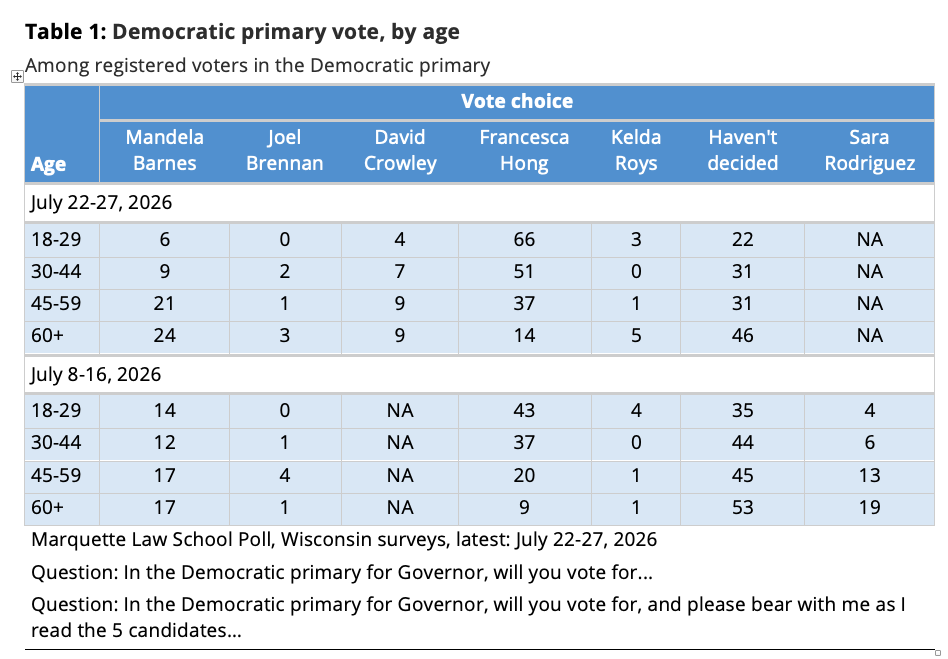
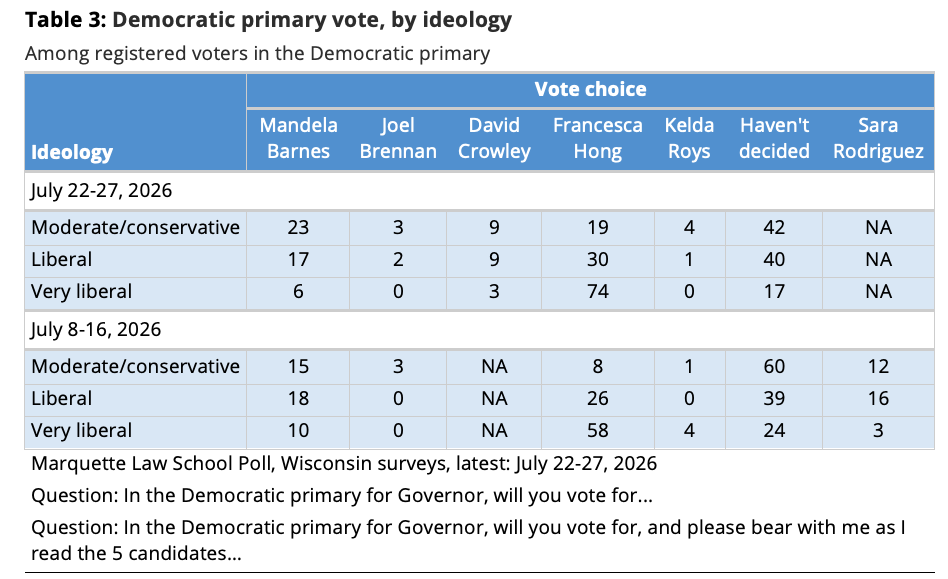
In the Marquette Law School Poll’s final survey of Wisconsin voters, July 22-27, Francesca Hong received 38%. Her unofficial vote total in the Aug. 11 primary election is 39.3%. And 34% said they were undecided. The remarkable difference between poll and outcome was that the poll had David Crowley at 7% and he won with 39.8%. Mandela Barnes, who dropped out three days after the poll was completed, had 16% in the final survey. One clear thing is that the vast majority of late-deciding voters went to Crowley and very few went to Hong.
The race was complicated by three candidates dropping out, and Crowley reentering, in the final month.
On the demographics of the race, older voters were both the least supportive of Hong and the most undecided age group. They also said they were more likely to vote than did younger voters, providing a potential advantage to Crowley, though they had not settled on him at the time of the final poll.
Another unusual aspect of the race was the very late endorsement of Crowley by Gov. Tony Evers. In our final poll, more than one-third (36%) of Democratic primary voters said that this endorsement made them more likely to support Crowley. Evers’ job approval with Democrats was also over 85%.
Non-response bias is always a potential source of error in polls. In this case, the age and ideological makeup of the survey samples of primary voters was similar to the pre-primary makeup of Democrats, suggesting that young, very liberal, Hong supporters were not overrepresented. Those groups strongly supported her but were not an unusually large share of the samples. Older and moderate voters were more undecided and less supportive of Hong in both of our July polls but had not settled on the very newly returned Crowley at the time of the last survey.
And Hong’s actual vote of 39% was barely different from her 38% in the final poll, further demonstrating that her supporters were not overrepresented in the survey.
Turnout was much larger than in recent Democratic primary contests: an unofficial 792,009, compared to 640,247 in the 2024 Senate primary and 538,857 in the 2018 gubernatorial primary. We don’t know the makeup of that surge beyond the polling results, but this turnout was considerably larger than expected.
On the substantive side, Hong’s performance was generally impressive during most of the campaign, but the late shifts from poll to vote suggest the limits of her appeal.
Finally, in our mid-July poll (July 8-16), 80% of Democratic primary voters said that it was extremely or very important to nominate a candidate who could win against the Republican in November, and electability became an increasingly common topic in the closing weeks of the campaign. And in the mid-July poll, Hong trailed Republican Tom Tiffany by 3 percentage points, whereas then-candidate Barnes led Tiffany by 4 points (this poll was conducted while Crowley was out of the race).
The chaotic changes of candidates, plus the governor’s late endorsement and increasing electability concerns, all made for a surprising endgame to the race.
Note: Below are the tables from the July 29 release showing survey results of the vote and percent undecided, by age and by ideology.
This memo was originally published on the Marquette University Law School Faculty Blog