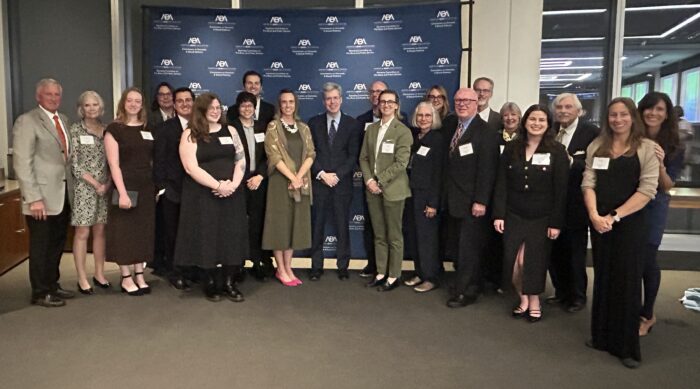
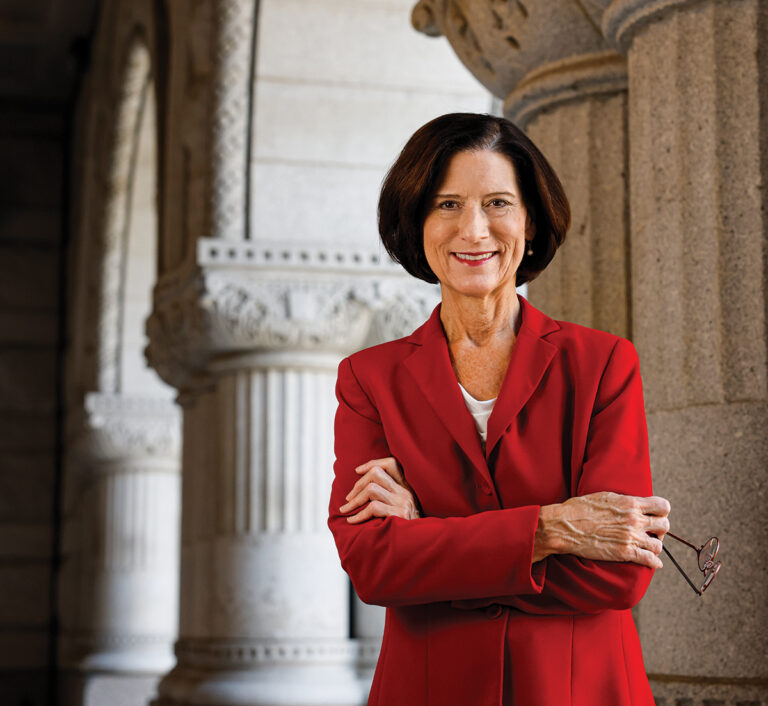
This is an edited text of remarks by Chief Judge Sykes at the Marquette Law Review banquet on March 28, 2025.
One hundred and eighty-eight years ago this month, another newcomer to the profession was—like you—standing at the threshold of a career in the law. He started inauspiciously, but Providence had other ideas in mind. In March 1837, Abraham Lincoln entered his name in the Roll of Attorneys at the Illinois Supreme Court.
Lincoln has always been my favorite president. The historical consensus that he was our greatest president seems right to me; his political life has a lot to teach us. But he was also the president with the most experience in the courtroom, and I think we can also learn from his approach to the practice of law.
I’d like to share a story about a small case Lincoln tried during his more than two decades as a lawyer riding circuit in the state courts of central Illinois. It’s a totally obscure and insignificant case. I stumbled on it by happenstance when I was serving on the Wisconsin Supreme Court and preparing a speech about Lincoln that I was scheduled to give at several events around the state. My interest was to focus on Lincoln the lawyer, not Lincoln the president. I discovered this case in a wonderful book called Herndon’s Informants, a modern compendium of letters, interviews, and testimonials collected by William Herndon, Lincoln’s last law partner, after the president was assassinated.
Lincoln’s law practice, spanning more than two decades, encompassed a wide assortment of clients and cases. Very little of this work was glamorous or exciting. But he was especially good in front of a jury, and his law practice was infused with practical wisdom and a moral dimension that is instructive for us today. The humble case of Case v. Snow Brothers—Herndon’s testimonial no. 605—captures these qualities in a particularly vivid way.
Let me set the stage with another testimonial recorded by William Herndon himself. It memorializes an interview with a Springfield resident who had witnessed a discussion between Lincoln and a prospective client seeking to engage his services in a lawsuit against a local widow. Herndon wrote:
A citizen of Springfield who visited our office on business . . . relates the following:
Mr. Lincoln was Seated at his table listening very attentively to a man who was talking earnestly in a low tone. After the would be Client had stated the facts of his case, Mr. Lincoln replied; Yes, there is no reasonable doubt but that I can gain your case for you; I can set a Whole neighborhood at loggerheads; I can distress a widowed Mother and her six fatherless children, and thereby get for you six hundred Dollars which you seem to have a legal claim to; but which rightfully belongs, it appears to me, as much to the woman and her children as it does to you. You must remember that some things that are legally right are not morally right. I shall not take your case—but I will give you a little advice for which I will charge you nothing. You seem to be a sprightly, energetic man, I would advise you to try your hand at making six hundred dollars in some other way.
With that small window on Lincoln’s approach to the practice of law, now listen to the story of Case v. Snow Brothers, as recorded in the testimonial of a local pastor who served several churches in the Eighth Judicial Circuit in central Illinois, where Lincoln’s law practice was concentrated. Lincoln’s client was the plaintiff, Mr. Case, an old man who had sold several yokes of oxen and a plow to two teenagers, only to have them later renege on the payment. Their counsel asserted that because they were minors, the debt was void under the Illinois Minor Act. Here via Herndon is the story, in the words of the pastor who watched the trial:
In the spring term of the Tazewell County Court in 1847, which at that time was held in the village of Tremont, I was detained as a witness an entire week. Lincoln was employed in several suits, and among them was one of Case vs. Snow Bros. The Snow Bros., as appeared in evidence (who were both minors), had purchased from an old Mr. Case what was then called a “prairie team,” consisting of two or three yoke of oxen and prairie plow, giving therefore their joint note for some two hundred dollars; but when pay-day came refused to pay, pleading the minor act. The note was placed in Lincoln’s hands for collection. The suit was called and a jury impanelled. The Snow Bros. did not deny the note, but pleaded through their counsel that they were minors, and that Mr. Case knew they were at the time of the contract and conveyance. All this was admitted by Mr. Lincoln, with his peculiar phrase, “Yes, gentlemen, I reckon that’s so.” The minor act was read and its validity admitted in the same manner. The counsel of the defendants were permitted without question to state all these things to the jury, and to show by the statute that these minors could not be held responsible for their contract. By this time you may well suppose that I began to be uneasy. “What!” thought I, “this good old man, who confided in these boys, to be wronged in this way, and even his counsel, Mr. Lincoln, to submit in silence!” I looked at the court, Judge Treat, but could read nothing in his calm and dignified demeanor. Just then, Mr. Lincoln slowly got up, and in his strange, half-erect attitude and clear, quiet accent began: “Gentlemen of the Jury, are you willing to allow these boys to begin life with this shame and disgrace attached to their character? If you are, I am not. The best judge of human character that ever wrote has left these immortal words for all of us to ponder:
‘Good name in man or woman, dear my lord,
Is the immediate jewel of their souls:
Who steals my purse steals trash; ’tis something, nothing:
’Twas mine, ’tis his, and has been slave to thousands:
But he that filches from me my good name
Robs me of that which not enriches him
And makes me poor indeed.’Then rising to his full height, and looking upon the defendants with the compassion of a brother, his long right arm extended toward the opposing counsel, he continued: “Gentlemen of the jury, these poor innocent boys would never have attempted this low villainy had it not been for the advice of these lawyers.” Then for a few minutes he showed how even the noble science of law may be prostituted. With a scathing rebuke to those who thus belittle their profession, he concluded: “And now, gentlemen, you have it in your power to set these boys right before the world.” He plead for the young men only; I think he did not mention his client’s name. The jury, without leaving their seats, decided that the defendants must pay the debt; and the latter, after hearing Lincoln, were as willing to pay it as the jury were determined they should. I think the entire argument lasted not above five minutes.
What’s your first reaction to this story? I won’t call on anyone; let’s just have a show of hands. Was this a compelling closing argument? Yes, obviously. Was it an improper closing argument—inviting the jury to nullify the law? Maybe so, when judged from our perspective as 21st-century law students and lawyers accustomed to the prevailing doctrine that the court is the sole judge of the law and that explicit appeals to jury nullification are forbidden. But Lincoln’s argument was comfortably within the legal norms of his time, which generally accepted that the jury’s power extended to the facts and the law. With that in mind, was this a just verdict? An unjust verdict?
My own view is that it was just—and that Lincoln’s argument in Case v. Snow Brothers, together with his advice to that prospective client whose case against the widow he declined to take, has something to teach us about the ethics of everyday law practice. I don’t mean ethics in the sense of the rules contained in the code of professional conduct. The choice to plead the Minor Act on behalf of the Snow brothers was obviously fully ethical in that formal sense. Had this case arisen today and were the statute still on the books, no doubt it would have been resolved in favor of the defendants on summary judgment; the court would have little choice but to void the debt.
But the defense attorneys had another option available to them: they could have counseled their young clients to keep their promise to old Mr. Case and settled the debt in a way that would make it possible for the teenagers to fulfill their obligation notwithstanding their youth. To paraphrase Lincoln’s advice to that would-be client, they could have explained to the Snow brothers that just because you have a legal advantage doesn’t make it right for you to take that legal advantage, especially when more important principles are at stake. The statute that allows the court to void contracts made by minors exists to shield them from predatory adults, not to permit them to take advantage of others. Mr. Case had charged a fair price for his prairie team. (I checked; it was in line with the going rate at the time.) The Minor Act was surely an available legal defense, but invoking it would come at a cost to the character of those young men as they stood on the threshold of adulthood establishing their reputations for honesty. Their lawyers could have counseled them to do the right thing and keep their word. As it was, Abraham Lincoln’s eloquent five-minute closing argument achieved the same thing.
This single, small case from Lincoln’s life as a prairie lawyer reminds us of the human dimension of the practice of law. After Lincoln’s death, White House secretaries discovered a document on which he had recorded some notes for a law lecture apparently intended for an audience of new lawyers. It’s dated July 1, 1850, but historians do not know if that’s accurate or whether he ever delivered the lecture. The notes contain many words of wisdom for new lawyers; I’ll close with just one short passage that reflects his emphasis on the capacity of lawyers to be forces for good within their communities. He advised the young lawyers, “Persuade your neighbors to compromise whenever you can. . . . As a peacemaker the lawyer has a superior opportunity of being a good man. There will still be business enough.”
Compromise in the law is not always the best course and is sometimes impossible. But the larger point remains and speaks an enduring truth. Our law is the just instrument by which we secure and order our freedom and live peacefully together. Lincoln’s challenge to all of us is this: In our daily work in this noble profession, we should try whenever possible to deploy the law in a way that promotes human flourishing and serves the common good.
I’m confident that your time here at Marquette Law School did and will continue to set you on a solid legal and ethical foundation from which to meet this challenge. Congratulations on all your successes on the law review and in law school. I wish you all the best as you continue and conclude your legal education and enter the legal profession.
Read more excerpts from Judge Sykes’ career
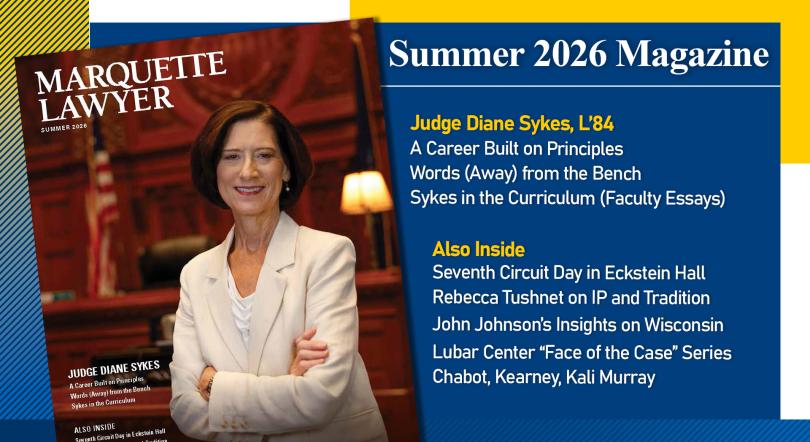
This article was first featured in the Summer 2026 issue of Marquette Lawyer Magazine.