
This an edited text of remarks by Judge Sykes to the Indianapolis Lawyers Chapter of the Federalist Society on December 12, 2012.
One of the important and recurring themes in our perennial debate about constitutional adjudication is the role of judicial restraint. But the issue only rarely breaks through into the public consciousness. The role of judicial restraint was a prominent theme in some of the early analysis of the Supreme Court’s divided decision in the health care case earlier this year, National Federation of Independent Business v. Sebelius.
A new book, Cosmic Constitutional Theory, by Judge J. Harvie Wilkinson III of the U.S. Court of Appeals for the Fourth Circuit, arrives at a pivotal time in our law and politics. Because it comes from one of our nation’s most highly regarded appellate judges, it deserves our most serious reflection.
Before the Supreme Court issued the health care decision in June, my colleague Judge Richard Posner published a very interesting article in the California Law Review, titled “The Rise and Fall of Judicial Self‐Restraint.” He focused on a particular kind of restraint: the judicial policy, premised on respect for the political branches of government, that legislative and executive actions should be upheld against constitutional challenges unless their invalidity is clear beyond doubt. Judge Posner pronounced this kind of judicial restraint dead, at least as a philosophical commitment of today’s Supreme Court, although he suggests that it might continue to function as a “trace element” in the justices’ behavior.
Judge Wilkinson doesn’t go quite that far. For him, judicial restraint is not dead, but it is seriously endangered. His thesis is that the rise of constitutional theory in the post‐New Deal era is displacing the time‐honored practice of judicial deference to the political branches of government, providing intellectual cover for judicial adventurism and threatening to choke off democratic self‐governance. He makes a thoughtful case for restoring restraint as a defining judicial virtue.
Please forgive my generalizations as we proceed here. Judge Wilkinson first takes aim at the theory known as “living constitutionalism,” practiced most prominently by the Warren Court and particularly by Justice William Brennan (and perhaps contrasted most starkly by the jurisprudence of Justice Antonin Scalia, who likes to say that he interprets the “dead Constitution”). The basic idea behind this school of thought is that the Constitution evolves to reflect contemporary understandings of the core principles contained in the majestic provisions of the Bill of Rights and the Fourteenth Amendment.
This evolutionary approach authorizes judges to implement contemporary values and adapt the Constitution’s broad language to modern conditions and problems. In practice, this theory produced the rights revolution of the Warren Court (continuing under the Burger Court) and was aggressively interventionist in implementing liberal social, political, and legal reform by judicial decree. As Judge Wilkinson explains, the results were in some cases a virtue and in others a vice, but in all cases the theory empowered judges to deploy the Constitution as a malleable instrument of social and legal change according to their own lights and at the expense of the democratic process. It produced a conservative counterrevolution.
Originalism and pragmatism are the two main theories of constitutional interpretation currently in use by judges. Let’s take originalism first. Judge Wilkinson briefly discusses the foundational contributions of Chief Justice John Marshall and to a lesser extent Justice Hugo Black but quickly moves to Judge Robert Bork’s exposition of the textualist/originalist theory of constitutional interpretation and explains how it gained acceptance in the legal academy—even among prominent liberal scholars—and then eventually took root at the Supreme Court. Much of this discussion presents originalism in a positive light.
For the uninitiated, the animating principles of originalism arise from the legal justification for judicial review: the judicial duty to decide cases according to law, including the law of the Constitution. On this view, constitutional adjudication begins with an inquiry into the meaning and scope of the provision in question based on its text and the historical evidence of its original meaning.
As Judge Wilkinson explains, “[p]erhaps more than any other theory, originalism focuses on judicial constraints” because it “recogniz[es] that ultimate legal authority stems from sources external to the judge.” But he ultimately concludes that originalist theory has failed to deliver on its initial promise, largely because judges are amateur historians and the textual and historical indicators of original meaning are all too often inconclusive. He concedes that “[t]here is nothing intrinsically wrong with gaps between theory and practice.” “Indeed,” he writes, “they are unavoidable.” What matters is “whether the gap between theory and practice leads to salutary outcomes or detrimental ones.” With originalism, he concludes, “the results are anything but salutary.”
Finally, Judge Wilkinson turns to Judge Posner’s pragmatic approach to judging, which he describes as an antitheoretical response to the various unifying theories of constitutional interpretation that have arisen in the post‐New Deal era. To vastly oversimplify, Judge Posner’s legal pragmatism is a flexible approach to judging that focuses on the consequences of judicial decisions—for the parties and for the broader economic, social, and political systems. The object is to achieve good outcomes.
Not surprisingly, Judge Wilkinson faults pragmatism for its explicit judge‐empowering premises. Whereas originalism tethers judges to constitutional text, structure, and history—“traditional legal materials whose democratic imprimatur cannot be questioned if properly discerned and relevantly applied”—with pragmatism, he writes, there is “no tether at all.”
In his last chapter, Judge Wilkinson argues for an escape from all this theory and a return to judicial restraint to guard against the perils of judicial supremacy and its interference with democratic choice. I detect a nod to originalism here; there’s a sense in his summation that he thinks originalist theory might have a role to play if only it could be trusted to channel restraint. Judge Wilkinson is a traditionalist and a moderate conservative who highly values the institutions of civil society; he sees judicial restraint as a mediating influence between the extremes of the progressive and libertarian visions of the Constitution now contending on the legal battlefield. He closes with an eloquent plea for judicial humility:
[T]heory‐driven judges and scholars have forgotten that wisdom lies simply in knowing the limits of one’s knowledge, that good sense is more often displayed in collective and diverse settings than in a rarefied appellate atmosphere, and that the language, structure, and history of law serve best as mediums of restraint rather than excuses for intrusion.
I share Judge Wilkinson’s view that the responsibility of judicial review is so consequential that it’s best to take the long view of our nation’s history and proceed with a clear‐eyed understanding of the constitutional limits on the judicial role and the prudential limits of judicial competence.
Where I part company with Judge Wilkinson is in his claim that all modern theories of constitutional law are inconsistent with a proper understanding of the judicial role and ought to be resisted in favor of judicial restraint, understood as a general policy of deference to the political branches. Deference is warranted when deference is due, and a default position of judicial nonintervention doesn’t answer the question of when, precisely, it is right to defer. Or to be more specific, it answers the question in a way that invites judges to unduly defer—to relinquish their own constitutional role as a check on unconstitutional exercises of authority by the other branches of government even in the face of ascertainable constitutional limits on that authority. And that is contrary to the essence of judicial duty.
The duty of judicial review requires some method of constitutional interpretation. Precedent will answer many questions but not all, and sometimes precedents are wrong. The Supreme Court regularly decides cases for which there is no controlling precedent; that goes with the territory. At the court of appeals, we decide quite a few cases in this category.
As faithful judicial interpreters, our inquiry into the law of the Constitution ought to be grounded in the principles the Framers and ratifiers fixed in its text and structure. Implementing doctrine has an important role to play, but Judge Wilkinson is entirely right that by anchoring constitutional adjudication in the text, structure, and history of the Constitution, originalism best legitimizes judicial review.
Read more excerpts from Judge Sykes’ career
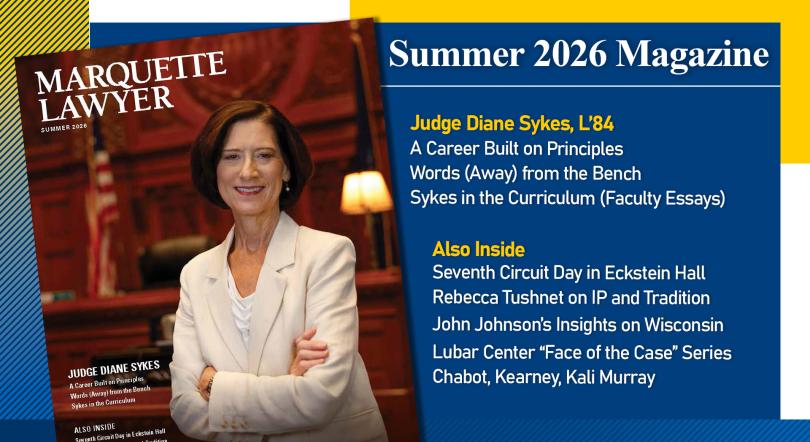
This article was first featured in the Summer 2026 issue of Marquette Lawyer Magazine.