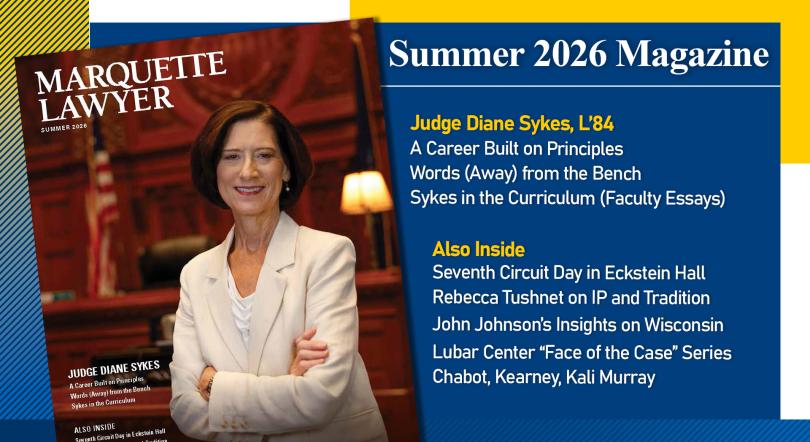

This is an edited text of a speech Judge Sykes gave as the B. Kenneth Simon Lecture in Constitutional Thought at the Cato Institute in Washington, D.C., on September 17, 2014, shortly before the beginning of the Supreme Court’s 10th term during the tenure of Chief Justice John G. Roberts, Jr. The full version can be found at 2015 Cato Sup. Rev. 17 (2015).
From the beginning of his time as chief justice in 2005, John Roberts has been explicit about wanting to foster greater consensus on the Supreme Court. It’s often suggested that the Court’s legitimacy would be enhanced by fewer 5–4 rulings along the usual conservative/liberal fault line. In his confirmation-hearing testimony and more fully in his first major public address, the chief justice articulated his view that although differences among the justices should not be “artificially suppressed,” a greater degree of consensus in the Court’s decisions would bring “clear [jurisprudential] benefits.” He famously set for himself this guiding principle: “If it’s not necessary to decide more to dispose of a case, in my view it is necessary not to decide more. The broader the agreement among the justices, the more likely it is that the decision is on the narrowest possible ground.”
For the first time since the 1940s, almost two-thirds of the Court’s merits opinions during the 2013–2014 term were unanimous on the bottom line, if not necessarily in their reasoning. This is generally thought to be a striking and welcome development. In some key respects it is, although it’s important to note that a significant part of the Court’s docket each term consists of technical statutory or procedural issues that do not engage the philosophical differences among the justices. Still, the uptick in bottom-line agreement is remarkable, especially in cases raising difficult constitutional questions.
I should probably begin with a definition. Modern judicial minimalism as a distinctive theory of decision-making is usually credited to Professor Cass Sunstein of Harvard Law School, who coined the term and is the leading academic proponent of this approach to judging. Sunstein proposes that judges should generally “avoid broad rules and abstract theories, and attempt to focus their attention only on what is necessary to resolve particular disputes.” He advocates the practice of “saying no more than necessary to justify an outcome, and leaving as much as possible undecided.” Minimalist judging of the Sunstein variant proceeds along two dimensions. First, judicial opinions should be narrow rather than wide, deciding the case at hand while avoiding pronouncing rules for resolving future cases. Second, judicial opinions should be shallow rather than deep, avoiding large theoretical controversies and issues of basic principle.
On the surface, the theory sounds as if it’s limited to process values, but it’s not. Substantively, minimalism starts from a presumption of deference to the political branches. It self-consciously avoids invalidating acts of the legislative and executive branches either by upholding them on the merits or by using various techniques for avoiding constitutional questions. Minimalism also advocates a strong version of stare decisis; consistent adherence to precedent promotes stability and predictability, thereby preserving the Court’s institutional interests. On a more philosophical level, modern minimalism promotes itself as a hedge against judicial supremacy. It calls on judges to go slowly and in small steps.
Of course, the Founding generation didn’t need a theory of judicial minimalism. The common-law tradition, as it was understood and practiced at the time, was itself essentially minimalist, and important minimalist features are embedded in our constitutional design. The common law as applied in the courts of the new American states was based on English customary law, and in the Blackstonian tradition it was found, not made.
The philosophical terrain was also different than it is now. The Framers inherited a strong natural-rights tradition, but they also understood that because natural-rights principles are quite general—today we would say “underdetermined”—the judges of the new federal judiciary, like their counterparts in the states, would be called upon to exercise a substantial element of judgment in individual cases. As a constraint on that authority, Article III limits the judicial power to cases or controversies that are explicitly judicial in nature. The Framers rejected a more active political role for judicial review by deciding against a Council of Revision. Beyond the constraining effect of the case-or-controversy limitation, the Framing generation generally understood that federal judges would follow long-established norms of judicial practice. They would be bound down by rules and precedents, to paraphrase The Federalist No. 78. This was thought to be a sufficient check against decisions based on will rather than judgment.
That was the “old” form of judicial minimalism; it was swept away by the legal realism of the 20th century. The “new” judicial minimalism is a response to the realist idea that, inescapably, appellate judges engage in discretionary lawmaking when they decide cases, including (and especially) cases of constitutional interpretation. If judges make constitutional law, then we need some theory or method to guide them.
It may help to place this minimalism in recent historical perspective.
The “living constitution” school of thought held sway in the decades that spanned the Warren Court and the early years of the Burger Court. This evolutionary approach authorized judges to interpret the core principles of the Bill of Rights and the Fourteenth Amendment in a way that reflects contemporary values and allowed them to adapt the Constitution’s broad language to address modern conditions and problems. In practice this theory produced the “rights revolution” of the 1950s and ’60s, which was aggressively interventionist in implementing social, political, and legal reform by judicial decree.
The conservative counterrevolution began in earnest in the 1980s and initially focused on restoring the practice of “restraint,” understood as judicial deference to the policy choices and value judgments of the political branches. In the early years, the primary concern was to stand athwart the jurisprudence of the Warren Court, yelling “Stop!” (Apologies to William F. Buckley, Jr.) But the emphasis on restraint did not address how the Constitution ought to be interpreted and applied. That would come later, as originalism was recovered, developed, and refined.
The animating principles of originalism arise from the legal justification for judicial review—the duty to decide cases according to law, including the law of the Constitution. Briefly stated, the basic theory is this: Because our Constitution is written, unlike the British Constitution, and because it is supreme law adopted by the people as the original sovereign that brought the American government into being, constitutional interpretation ought to be grounded in the public meaning of the text as understood at the time of ratification.
Modern judicial minimalism is flexible about when judges should proceed minimally. It explicitly acknowledges that not every case calls for a minimalist ruling. As Sunstein puts it, “there are times and places in which minimalism is rightly abandoned.” There’s a nonexclusive, multifactor test for determining when it’s best to issue a minimalist decision and when it’s best to go maximalist—but you probably guessed that already.
It should be clear from this discussion that although minimalism is an approach to judging, it’s not a theory of constitutional interpretation. Unlike originalism, it’s not a method for determining the meaning, scope, and application of the Constitution. Instead, it’s a theory of deference.
Judges should defer to the political branches of government and to the decisions of prior courts—except when they shouldn’t. It’s also a theory of avoidance. Judges should not make broad pronouncements on foundational matters of constitutional principle—except when they should. Got that?
As you’ve probably gathered, minimalism can be criticized for offering “no genuine guidance to judges.”
For my part, I tend to side with the critics. A unifying theory of minimalism is both unworkable and unwise. The Article III constraints on judicial power already enforce a degree of minimalism, and all judges respect and reason from precedent. We have well-established doctrines to ensure that judges do not unnecessarily decide constitutional questions, and the norm of analogical reasoning has a natural constraining effect. In other words, minimalism is inherent in standard judicial method. We do not need a heavy theoretical thumb on the scales. What’s important is how the traditional sources of law and legal interpretation—text, structure, history, canons of interpretation, precedent, and other well-established tools of the judicial craft—are prioritized, weighted, and applied.
A noteworthy feature of the Roberts Court at age 10 is its preference for using minimalist techniques to avoid or soften or at least postpone confrontation with the political branches in structurally or politically sensitive cases.
At a time of deep political polarization, the modesty and consensus values claimed by judicial minimalism seem especially attractive. Restraint is indeed a judicial virtue. Judicial mistakes on constitutional questions are extraordinarily difficult to fix. Arrogating too much power to the judiciary distorts our politics and undermines our ability to democratically shape and alter our basic legal, social, and economic institutions. But strong avoidance and deference doctrines are not the answer. They may serve prudential or political concerns, but they are not necessary to enforce the separation of powers and indeed may undermine that critical feature in our constitutional design. The Court’s legitimacy arises from the source of its authority—which is, of course, the Constitution—and is best preserved by adhering to decision methods that neither expand, nor contract, but legitimize the power of judicial review. The Court’s primary duty, in short, is not to minimize its role or avoid friction with the political branches, but to try as best it can to get the Constitution right.
Read more excerpts from Judge Sykes’ career
This article was first featured in the Summer 2026 issue of Marquette Lawyer Magazine.