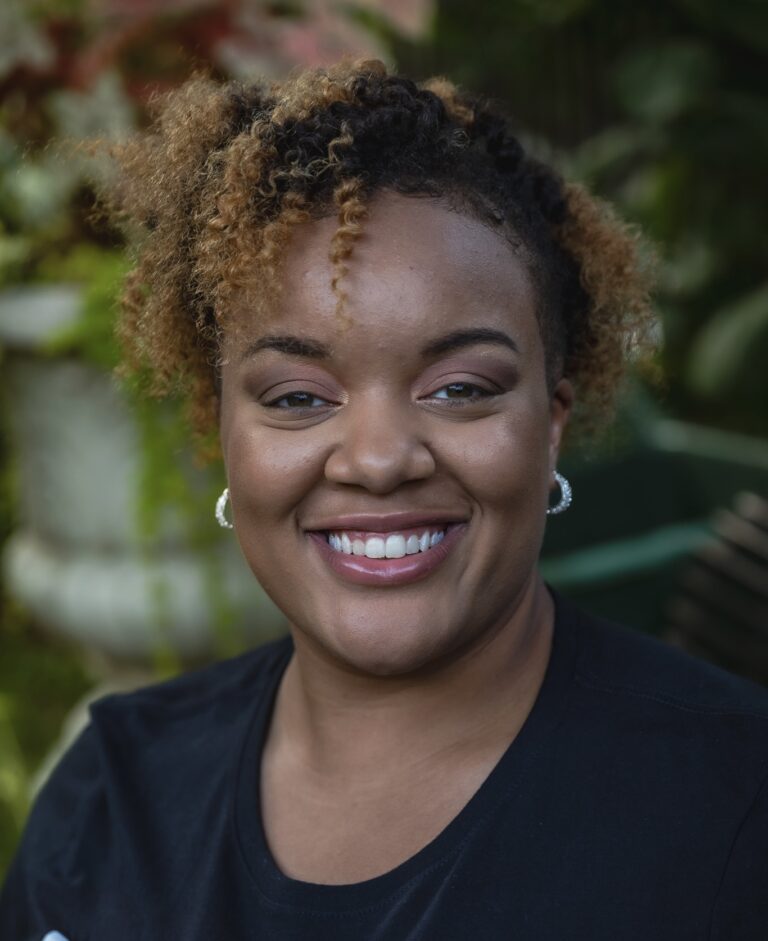
The career path Andreanna Wright had in her mind since she was 13 years old — study hard as an undergraduate, get admitted to medical school, become an obstetrician — changed in an instant one day in church.
“I heard a word from the Holy Spirit instructing me to be a doula,” Wright says. “I had all my plans set and ready to go, and this information startled me. I prayed about it and took a leap of faith.”
That meant quitting studying for the MCAT, which she was set to take in just a few months and signing up for a weekend class to become a doula, a non-medical professional trained to provide support to mothers going through childbirth. She spent two years as a doula prior to going through Marquette’s accelerated Direct Entry Master of Nursing program. Both experiences have been rigorous but rewarding.
“I’ve been in school nonstop since I was six years old, and this program has challenged me in ways that I never even imagined,” Wright says.
As a doula, Wright heard from couples approaching one of the most exciting, yet challenging, moments of their lives. Sometimes she had to drive her clients to the hospital because they didn’t have their own transportation. Some clients came to her unhoused and needed someone to find a place where they could stay with a newborn. She’s been in hospital rooms for 20 hours at a time, helping people navigate the trials of birth.
Those around Wright see someone perfectly suited to both the life of a student and of a doula: conscientious, upbeat and eager to help. Taylor Pamperin, graduate student success adviser, got to know Wright early in her academic career and was impressed.
“Some of my earliest impressions of her was that she had a strong desire to connect with others,” Pamperin says. “She’s thoughtful and a good listener; you can tell that she’s driven by her connection to other people.”
“When I meet with my clients during their prenatal visits, I ask them what the day of their delivery looks like. I ask them to visualize it. Who’s there? Who’s not there? What’s in the room with you? All of that is important,”
Andreanna Wright, DE-MSN student
Fellow DE-MSN student Stephanie Harleston, one of Wright’s closest friends and her companion for many late-night study sessions, sees something similar in Wright.
“She’s always willing to take the time to explain complex concepts and ensure that others feel confident and prepared,” Harleston says.
Doulas exist inside and outside the healthcare system, a vital support for new mothers despite not performing medical interventions. They instead offer emotional aid and techniques for coping with the birthing process that exist in concert with care from doctors and nurses.
For Wright, that means employing a wide variety of techniques. She used music. She used aromatherapy. She has a ball with small spikes on it that directs pain from the pelvis to other parts of the body during the birthing process. Something as small as changing the lighting in the mother’s room has made a difference.
“When I meet with my clients during their prenatal visits, I ask them what the day of their delivery looks like. I ask them to visualize it. Who’s there? Who’s not there? What’s in the room with you? All of that is important,” Wright says. “The goal is not to eliminate the pain. The pain means the baby is coming, and that’s good. The goal is to help the client cope.”
Wright’s caring attitude is also evident at Marquette, where Wright is a DE-MSN student ambassador, talking with prospective students about her experiences in the program. Current students also give Wright rave reviews.
“Even during challenging circumstances, Andreanna makes a conscious effort to encourage and connect with her classmates,” Harleston says. “She frequently checks in on others and offers words of motivation.”
While the accelerated DE-MSN program is a great opportunity, it is also challenging. Students learn in five semesters what a bachelor’s degree might usually spread out over eight. People enter the program with degrees ranging from biology to finance to art history, and must undergo a transformation into a committed, caring nurse.
Wright has almost emerged from the other side — she graduates at the end of the fall 2026 semester. The pride of knowing that she helped others while furthering her own education turns Wright emotional.
“The tears will come when I put on that cap and gown, because I think this is the hardest, most rewarding thing I’ve ever done,” Wright says.