The rapid evolution of AI has formed a consequential path ahead for teacher-scholars in the Opus College of Engineering. Opportunities to accelerate problem-solving and investigate new technologies are combined with changing workforce expectations, growing resource demands and discussions on the value of human ingenuity.
Daunting as it may seem, faculty like Dr. Tony Parolari are invigorated by the opportunity to navigate the future of AI in collaboration with others at Marquette. As a co-lead on the Opus College of Engineering’s AI Sustainability Incubator project, he is part of a cultural groundswell in the college thoughtfully grappling with the benefits and consequences of AI.
“So many ideas and questions around AI have been percolating for me,” Parolari, associate professor of civil, construction and environmental engineering, says. “I knew we needed to be talking about this together.”
Embracing uncertainty in collaboration
Parolari describes himself as an AI skeptic. He is both a user of AI and a careful critic of how it ought to be turned to as a tool. AI has great potential to accelerate Parolari’s research in urban hydrology, a field that relies on vast datasets of rainfall, human behavior, infrastructure use and more. That same work also points Parolari toward the must-solve problems around water and resource stewardship with AI. And as an educator and mentor, he coaches students on developing industry-relevant digital skills while also being judicious about the use of AI.
Parolari knew he was not alone among his colleagues in the balancing act of AI, and so he turned to Drs. Brooke Mayer and Richard Povinelli as collaborators to conceive the Opus College’s AI Sustainability Incubator project. Their aim is to investigate AI and environmental sustainability while also navigating AI’s role in engineering education at Marquette.
Povinelli, professor of electrical and computer engineering, has tracked AI’s growth and potential since the 1980s. He pairs decades of academic research and teaching on the subject with continued part-time work in the natural gas forecasting industry.
Mayer, professor of civil, construction and environmental engineering, is a global expert in environmental engineering. Like Parolari, her expertise draws her to the emerging problems with AI and water resources while also evaluating AI’s potential to help solve those same problems and more.
“It’s important to remember that we can choose the path forward,” Parolari says. “We can assess how AI serves the common good and where it does not serve our mission.”
Seeding ideas for the future
Knowing that three experts cannot drive change alone and that the next generation of engineers are a key to humanity’s future with AI, the faculty team welcomed students to join their work by launching the Opus College’s AI Sustainability Fellowship.
Now in its second year, the Fellowship pairs students and faculty on open-ended projects related to the environmental challenges of AI as well as opportunities to develop environmental solutions with AI as a tool. Projects ranged from socioeconomic analyses of data center locations to optimized sensors for water quality and treatment, with work intersecting at intentional discussion sessions.
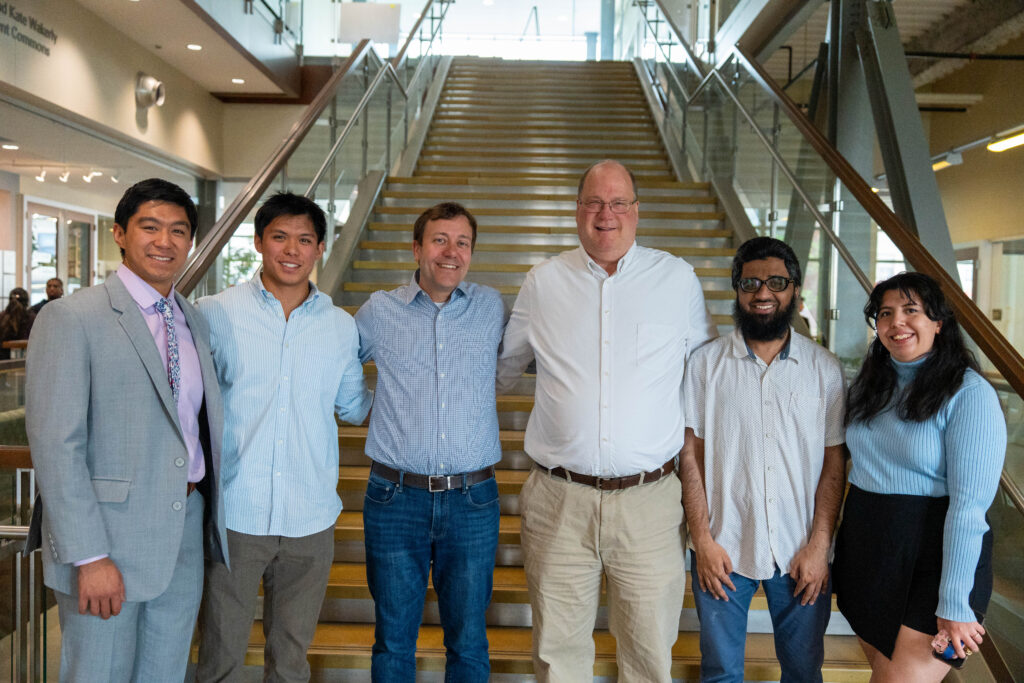
“The best part of the Fellowship is when we gather and allow conversations to wander between the ideas, questions and anxieties that students have,” Parolari says.
The hope is that this same culture of dialogue and inquiry can grow across the college.
Teachers committing to learning
Faculty are also closing their own AI knowledge gap by tapping into the college’s existing pedagogy workshop series. From designing new course activities to improving how they understand the technology themselves, instructors across the college are focusing on experimentation to unearth what feels right.
For Povinelli, thoughtfully integrating AI into his computer programming courses emerged as an essential experiment. He knows from his ongoing industry work that software professionals are increasingly incorporating AI into their workflows and even hiring expectations. He now challenges his students to explore AI’s potential and limitations throughout his courses.
“It’s all about building intentionality with student reflection and critical thinking,” Povinelli says. “Without the foundational understanding of your work, you cannot tell when the AI is wrong. I explain that AI should not take away from their learning and why we’re approaching it this way.”
In Povinelli’s classroom, this looks like AI-on and AI-off tasks, often repeated in sequence so students can reflect on the differences. He says that being transparent with students about his teaching methods invites them to think deeper about their own learning.
For Mayer, she sees AI as weighty but not dissimilar to how she has always approached engineering education at Marquette. She invites classroom discussions on AI and water scarcity and sees it as a familiar opportunity for students to understand their responsibility as engineers.
“We do a lot of teaching about things that do not have singular answers or approaches,” she says. “We are training critical thinkers who can problem solve in complex scenarios, wherein there likely isn’t a single answer, but there are certainly many wrong answers.”
Answering the call at Marquette
Parolari feels like he is in the right place at the right time.
“This is a great place for me to work because my personal values align to the bigger Marquette mission to tackle problems with a centrally caring, human perspective,” he says.
The work ahead is not simple, but he says the colleagues around him give him confidence. Mayer puts their responsibility matter-of-factly: “It is up to Marquette to answer the call about how AI will be used ethically to protect humanity and serve the common good.”
As Marquette engineers always do, the Opus College faculty are seeking solutions with curiosity and creativity together.