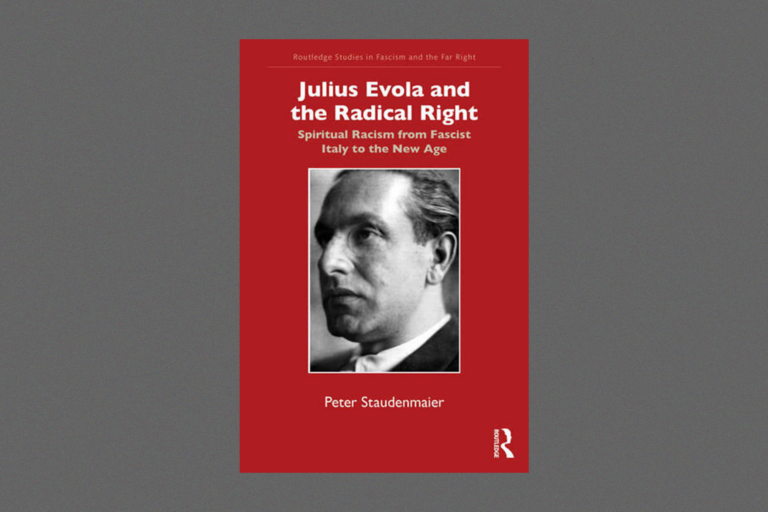

“Julius Evola and the Radical Right” examines the ideas and influence of Italian thinker Julius Evola (1898–1974), an increasingly popular author within the far right and the esoteric milieu alike. An iconic figure for successive generations of the radical right, Evola is both revered and reviled, but his past remains contested. Those seeking information about him are confronted with a fractured and contentious legacy. Drawing on the archival record and texts that Evola left behind, this book reconstructs his intellectual trajectory and examines his activities in Fascist Italy, in Nazi Germany, and in the neo-fascist movement after 1945. It demonstrates that Evola and his circle were not as marginal as sometimes portrayed and cooperated more closely with Fascist and Nazi officials than previously recognized. The book dispels many of the myths surrounding Evola and his “spiritual racism” while tracing Evola’s enduring influence after his death, showing how his ideas continue to inspire contemporary political movements.
Learn more or purchase this book at Routledge
Dr. Staudenmaier answered some questions about his new book, including where the idea for the book came from, what he hopes the book accomplishes, and his favorite part of the writing process.
How would you describe the book in one sentence?
A critical study of Julius Evola (1898–1974), a very influential thinker for the far right and the esoteric milieu.
Where did the idea for this book come from?
It grew slowly out of an earlier research project two decades ago; back then Evola was a marginal figure in my research, but he kept popping up, and I noticed that there wasn’t much critical scholarship about him in English. In recent years he has become increasingly popular on the radical right, though he died half a century ago; in 2022 a journalist dubbed him “the internet’s favorite fascist.” My book examines his activities in Fascist Italy and Nazi Germany, as well as his lengthy career in the postwar neo-fascist movement. Based on research in Italian and German archives, it challenges the many myths that have grown up around Evola.
What do you hope to accomplish with this book?
It isn’t often that my historical work is directly relevant to contemporary concerns, but in this case, unfortunately, the book is all too timely. Because Evola’s influence paradoxically seems to be increasing these days, a critical study of his life and activities, based on careful historical research, can make an important contribution to understanding figures like Evola and the appeal they still hold.
What was your favorite part of the writing/editing process?
All of the surprising finds I made in the archives along the way. That is generally the exciting part for historians, but in this case it was unusually stimulating, because I found so many documents that controverted longstanding myths about Evola.
Is this your first book? What is your publishing history?
This is my fourth book (or maybe fifth, depending on what counts as a book). In my work as a historian I study several fields: Nazi Germany, Fascist Italy, environmental history, the history of esoteric and occult movements, and the history of racial thought. I’ve also published lots of articles and such.
By Dr. Staudenmaier:
- “The Politics of Nature in Nazi Germany: Environmental Ideals and the Myth of Blood and Soil” (Cambridge University Press, 2026)
- “Ecology Contested: Environmental Politics between Left and Right” (New Compass Press, 2021)
- “Between Occultism and Nazism: Anthroposophy and the Politics of Race in the Fascist Era” (Brill, 2014)
How does this book advance or complement your research and/or teaching?
It marks a significant advance in my research, from a focus on German history toward the history of Italian Fascism, as well as a more direct engagement with the history of antisemitism. Because of my background in the history of esotericism and my access to Italian as well as German archives (Evola was Italian but spent considerable time in Nazi Germany), I was in a unique position to examine the full spectrum of his ideas and activities, all within the framework of a critical study of the radical right both before and after 1945.
If you have recently published a book, or if you have one coming out, we would like to feature your publication in an upcoming Marquette Bookshelf feature. More information on the submission process is available online.
Book Details
- Publisher: Routledge (July 23, 2026)
- Language: English
- Print length: 238 pages
- ISBN-10: 0367710668
- ISBN-13: 978-0367710668