
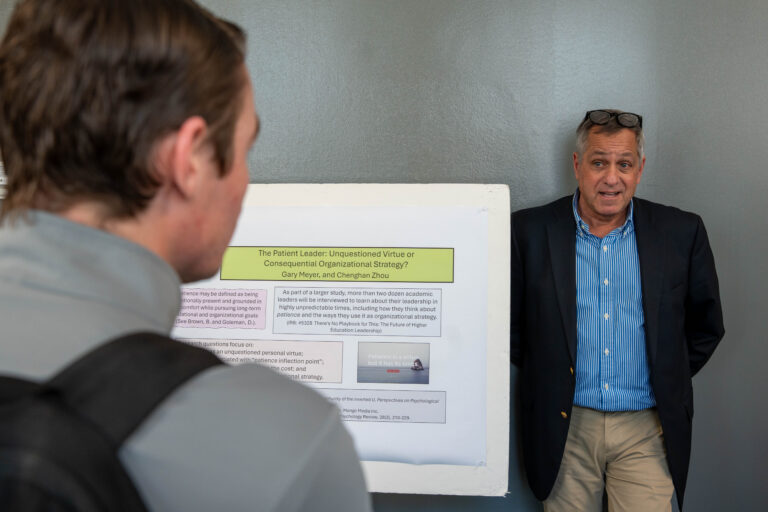
It’s not often that someone returns to a full-time faculty role after ascending to the kinds of job titles that Dr. Gary Meyer has on his resume.
Once the senior vice provost for faculty affairs, Meyer is now across the street from his old office, having returned as a professor in the Diederich College of Communication, teaching leadership and persuasion courses. The connections between the two are not hard for Meyer to see.
“What I did during the 14 years in the provost’s office has a lot of correlation to my time working with students; it’s simply a different audience,” Meyer says. “In Zilber Hall, I always thought of my work as helping faculty be successful across their many roles on campus, including leadership roles. In Johnston Hall, I try to help students be successful both in and out of the classroom.”
Now Meyer’s focus is back where it was when he first arrived at Marquette 30 years ago: squarely on students.
After more than two decades in administration (including seven years as associate dean in the Diederich College of Communication), what made you want to return to the classroom?
When I made the decision, I still had several years until retirement and thought it would be great to go back to teaching students, which was my first love. When I came to Marquette in 1996, I found so much purpose being closely connected with students, and so to have an opportunity to end my career the way it started was very appealing to me.
How has your day-to-day life changed since you started teaching again?
Being a senior vice provost means you have a lot of balls in the air. At any given time, I was probably on 10 or more university committees and working on so many projects that my attention wasn’t singularly focused on anything. That’s a blessing and a curse. That’s plumbing and poetry, to quote James March.
What I loved about coming back is the ability to focus intensely on my classes and especially students, as well as the opportunity to re-engage in scholarly pursuits. Instead of having meeting after meeting and leading multiple initiatives, I can really focus, and that is a real gift.
Tell me a little bit about your teaching philosophy. What do you think is the best way to connect with students?
Fifteen years ago, teaching was still quite didactic with a good deal of faculty lecturing and student notetaking. I’ve tried to flip that on its head to get students to really engage with the material and with each other. I typically request active learning spaces, because they allow me to do more interactive facilitations. I think that type of teaching really fosters meaningful group work, deep learning, and students seem to really enjoy the experiences.
In what ways are students similar to what they were more than a decade ago when you were last a full-time professor? In what ways are they different?
The students are still delightful. They come with a terrific energy and an open mind and heart for learning. They’re polite, they’re attentive and for the most part they’re highly engaged with the material.
The proliferation of cellphones and social media has been a major change. I think of it in terms of attention share, a bit like market share. If what I’m offering can’t beat what’s on their phones, they’re going to jump to their phones. I have to figure out how to be both an entertainer and an educator. I call that edutainment. I think the key is to approach the students with passion and authenticity, and to be a really good storyteller.
One of the other big changes I’ve noticed is students’ desire for certainty. They want very detailed rubrics; they want me to tell them exactly what to do. And on one hand I get that given this generation went through COVID and has dealt with so much uncertainty, and they need some assurance about things. On the other hand, though, I don’t want to provide so much guidance that it takes away their curiosity, exploration and critical thinking, and ultimately those aha moments when it all comes together for them. It’s all about finding a middle ground where they have enough direction but still need to sit in the ambiguity and struggle a bit to figure things out.
If you could talk to the version of yourself that walked into a Marquette classroom on his first day of teaching and give him some advice, what would you say?
Show up with love in your heart for your students and their learning. The rest will take care of itself.