In the throes of the COVID-19 pandemic, Dr. Linda Piacentine came to the glass building on North 12th Street, right across from the Al McGuire Center, for the first time. She was there because a researcher needed someone to perform nasal swabs for COVID-19 testing. With the pandemic stalling her research activities on other fronts, the associate professor in the College of Nursing had some spare time to help.
As the pandemic dragged on and Piacentine saw more people suffering from long COVID, however, her focus quickly changed.
“It became clear to me that we were missing a piece in terms of what we could be learning about helping people suffering from prolonged COVID,” Piacentine says.
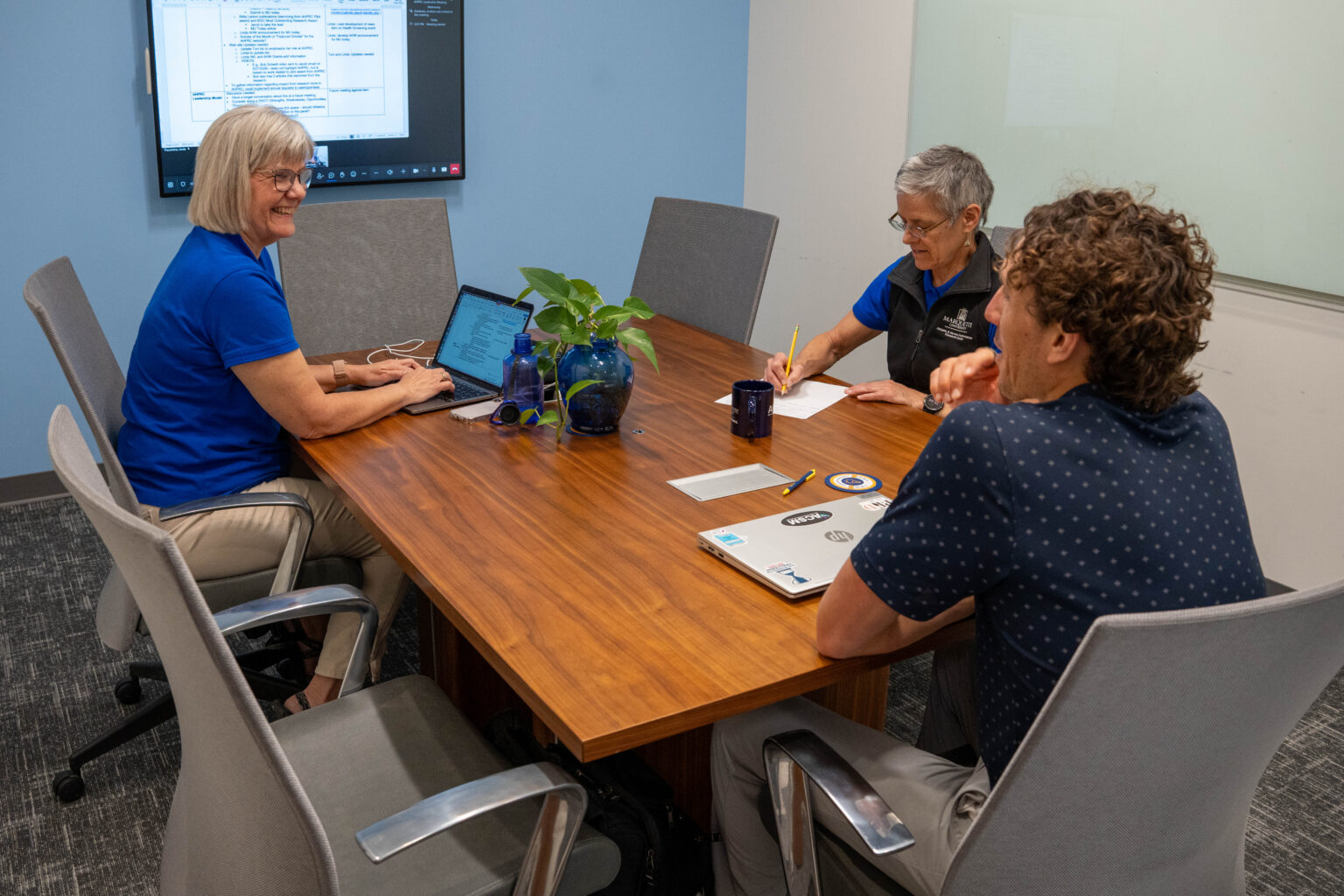
That first study on the life experiences of long COVID sufferers led to Piacentine’s ongoing involvement with the Athletic and Human Performance Research Center. Opened in spring 2019, the AHPRC facilitates collaborative and innovative research in athletic, healthy, and clinical populations to advance knowledge and reach in human performance. It also serves as the primary home for the men’s and women’s lacrosse teams, as well as men’s golf. Piacentine, Dr. Jacob Capin, assistant professor of physical therapy, and Toni Ulrich, clinical assistant professor, lead the AHPRC.
This blending of athletic facility and research laboratory reflects a culture of collaboration that makes Marquette stand out from its peers.
“At many universities, research and athletics are completely separate,” says Capin. “A lot of times, there’s limited discussion between the two and literal walls between them. The combination of things that we have here is incredibly special.”
The focus on crossing boundaries doesn’t just apply to faculty, either. Students are frequently in the facility, honing their skills. Piacentine fondly remembers offering her arm so one of Capin’s students could practice drawing blood. Undergraduate nursing students also learn how to use some of the state-of-the-art exercise testing equipment that the facility offers.
All the practical time that students get is a really great launching point for them. Seeing the qualitative research in real time expands their knowledge base in great ways.
Dr. Linda Piacentine, associate professor in the College of Nursing
Some students are in the AHPRC on a more ongoing basis to help faculty members with their research. Hannah Barbosa, a class of 2022 nursing graduate, worked with Piacentine as a public health and equity fellow in the Office of Research and Innovation. She helped interview long COVID patients about changes in their interpersonal relationships and adaptations they’ve had to make to cope with their illness. Barbosa also played a key role in transcribing and compiling the data and the publication that followed.
“I remember the AHPRC being a really good environment for teamwork,” Barbosa says. “It wasn’t just the nursing students who were working together: you had PT students and health sciences students and that was a really great part of it.”
“All the practical time that students get is a really great launching point for them. Seeing the qualitative research in real time expands their knowledge base in great ways,” Piacentine says.
The long COVID study is far from the only impactful effort to come out of the AHPRC. Capin received a prestigious Early Independence Award from the National Institutes of Health, along with a $1.9 million grant, to study the impacts of prior injury and sedentary behavior on future health outcomes in amateur athletes. While the concept was initially pitched as a purely quantitative study, a reviewer suggested adding a qualitative component. Capin was never trained as a qualitative researcher, but Piacentine is, which made the two natural complements to each other.
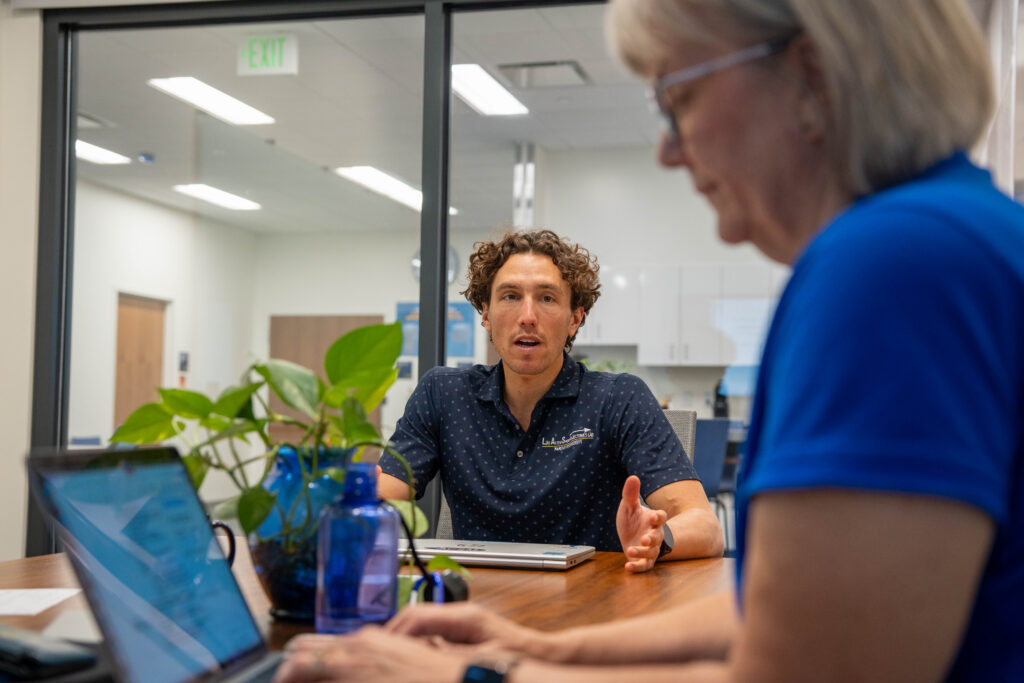
“Linda has been instrumental in helping me learn qualitative research skills,” Capin says. “She helped develop the specific questions that we asked the interviewees and was a major help with the actual interviews. Clinically, we’re both researchers, but we’re coming at this from very different angles, which is hugely important to making sure that different viewpoints are considered and incorporated.”
The AHPRC is just one part of a university-wide commitment to interdisciplinary learning and research. Nursing and dentistry students have taught each other how to take blood pressure readings along with other basic medical skills. Marquette Business collaborates with the Opus College of Engineering on several fronts, including through a new supply chain concentration and a first-of-its-kind real estate institute.
That emphasis on bringing people of different professional backgrounds, skillsets and life experiences together is evident every time Capin steps into the AHPRC.
“It’s a great space to bring in people from across the university, from across our community, and really from around the country to participate in research,” Capin says.
The impact it’s made on Barbosa, who now works on a cancer floor at Froedtert Hospital, is just as apparent.
“One of the most important things I can do is create spaces where people feel comfortable sharing, and I still feel like I’m taking things I learned years ago in the AHPRC and applying them to my life today,” Barbosa says.