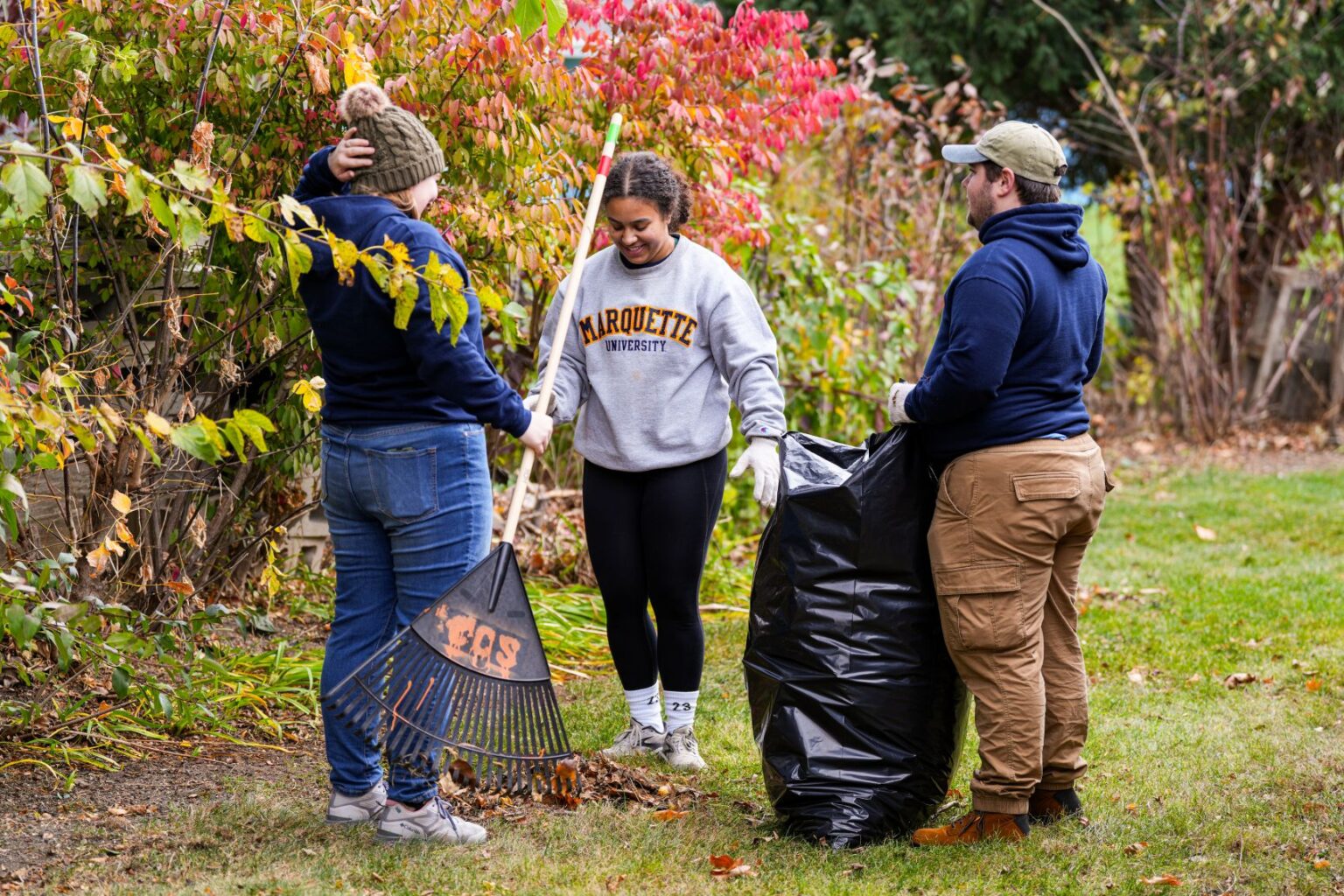
Marquette University once again earned a spot among The Princeton Review’s “Best 391 Colleges,” and for the second consecutive year claimed the No. 1 national ranking for community service, reflecting the university’s deep ties to Milwaukee and its ongoing commitment to Jesuit values in action.

Kelsey Otero, senior director of community engagement, cultivates relationships with communities to advance the university’s mission and vision. For her, service is central to Marquette’s identity.
“Community service is an integral part of the Marquette experience, and it is deeply embedded in the university’s Catholic, Jesuit mission,” Otero says. “Authentic community engagement creates a reciprocal relationship [in which students gain] critical perspective, empathy and real-world problem-solving skills [while community partners benefit from] additional support, new ideas and committed volunteers.”
She adds that this work “extends beyond direct service to the community — it includes embeddedness in academic courses, research collaborations and the allocation of resources that are critical to building trust and making a difference in the community. “

Dr. Carie Hertzberg, assistant vice president of belonging and student affairs, echoes that sentiment, noting how her own path has shaped her work at Marquette.
“Community engagement is a powerful way we cultivate belonging at Marquette,” she says. “Our students see service not as an add-on, but as an essential part of their Marquette experience. Through service, students build relationships, discover purpose and understand their role in a broader community. These experiences are an important part of the co-curricular education we provide and of our commitment to forming students who lead lives of purpose with and for others.”
Fast facts
- Ranked No. 1 nationally two years in a row for community service by The Princeton Review
- 19,846 service hours logged by students through the Arrupe Center for Community Service and Social Responsibility in the 2024-25 academic year
- 1,645 students participated in service learning in AY25 and supported 119 community partners through their academic courses
- 76% of Trinity Fellow alumni work in the nonprofit or public sectors
- 770 credit hours completed in Marquette classes where justice-impacted students, campus-based students, and undergraduates learn together as co-learners
- Marquette dental clinics serve patients in 66 out of 72 Wisconsin counties, providing more than $16 million in dental services to patients in 2024.
- 6,137 clients were provided pro bono legal services in 2024 through Marquette Law School programs.
Serving Milwaukee
From the classroom to co-curricular activities, Marquette students have numerous opportunities to volunteer and connect with local nonprofit organizations. In the 2024–25 academic year, undergraduate students logged over 45,000 hours of service in the Milwaukee community. One way students got involved was through the Arrupe Center for Community Service and Social Responsibility. The Arrupe Center has become a hub for student volunteer engagement, reflection and learning. Signature community service events include Connect + Serve, Make a Difference Day, MLK Connect + Serve and Marquette Community Day of Service.

Marquette students also have the opportunity to deepen their engagement by participating in several semester-long or yearlong service offerings. The Marquette Volunteer Corps connected 25 students with Next Door and Sea Literacy to support literacy services at these local nonprofits. Other longstanding programs like Midnight Run, Marquette’s largest weekly service organization, brought students to food pantries, shelters and meal programs throughout Milwaukee.
Marquette’s award-winning Service Learning Program, celebrated its 30th anniversary in 2024. The program, which deepens student learning through community partnerships offered 110 different course sections last academic year, which were taught by 54 faculty across 16 different disciplines.
The Burke Foundation extended its support of two signature scholarship programs: Burke Scholars and Trinity Fellows. The Burke Scholars Program, which requires undergraduate students to complete 300 hours of service annually, will celebrate its 30th anniversary this year.
“The Burke Scholarship Program embodies Marquette’s Jesuit mission in action,” Hertzberg says. “Students engage deeply with social justice issues while connecting their service to their academic and professional goals. By graduation, Burke Scholars have developed a profound sense of purpose and a lifelong commitment to service.”
At the graduate level, the Trinity Fellows program provides a unique opportunity for 24 Fellows to work on meaningful, substantive projects for a Milwaukee nonprofit over the course of a 21-month study/work program. Fellows provide approximately 22,944 hours of service each year to the Milwaukee community through their placements.
Justice and equity
Several university initiatives furthered Marquette’s mission to promote justice and provide opportunities to underserved people.
The university received a $1.25 million grant in 2024 from the Mellon Foundation to expand its prison education efforts, which are run by the Educational Preparedness Program along with the McNeely Prison Education Consortium, both Center for Urban Research, Teaching and Outreach (CURTO) initiatives. The high-impact program includes traditional campus undergraduate students taking classes and co-learning with justice impacted students. To date, 16 faculty members have taught EPP courses. Justice impacted students have earned approximately 400 student credit hours in these courses. This program continues to create educational pathways to foster dignity, equity and reintegration.
Marquette’s annual Justice in Action conference provided a platform for students to explore their role in addressing social inequities. The 2025 event included a documentary screening and panel discussion. Previous Justice in Action conferences have included storytelling initiatives in partnership with Narrative 4, a global nonprofit that helps participants build empathy through story exchanges.
Marquette Law School’s Andrew Center for Restorative Justice continued leading efforts to reduce harm and support healing across the Milwaukee area. Through restorative justice circles, partnering with organizations like Sojourner Family Peace Center, and encouraging dialogue and discussion at their conference, the center embraced a spirit of justice in action.
Innovation, sustainability and care

Several programs highlighted Marquette’s approach to serving basic needs while advancing sustainability. This year, students grew fresh lettuce, basil and radishes through hydroponic Flex Farms installed in partnership with Fork Farms. These efforts directly supported food-insecure students through the Backpack Program. Food recovery efforts on campus were bolstered by Move Out for Hunger, an initiative that gathers nonperishable donations during residence hall move-out each spring. This year, 3,568 pounds of food was collected during Move Out for Hunger.
New campus sustainability initiatives also flourished this past year. Last fall, Marquette University’s S-Lab co-hosted the first Nexus Sustainability Leaders Summit with the Water Council. Held at the Harley-Davidson Museum, the event brought together experts and leaders to discuss the intersection of technology, energy and environmental resilience. Another conference collaboration is planned for Oct. 14-15.
Jesuit values in action

Marquette continued to put its mission into practice by hosting programs that invite the Milwaukee community to campus. Project Homeless Connect, a longstanding collaboration with United Way of Greater Milwaukee and Waukesha County, engaged hundreds of students, faculty and staff (along with community volunteers) to provide vital services to Milwaukee’s unhoused population during the Thursday of fall break. Nearly 500 people accessed services from 90 providers at the event in 2024.
The Haggerty Museum of Art, which is free and open to the public, offers a number of unique events and exhibits. A $2.4 million grant from Lilly Endowment Inc. is supporting the creation of an exhibition and educational initiative at the museum that explores religion’s role in society. The project is designed to promote understanding, dialogue and inclusiveness.