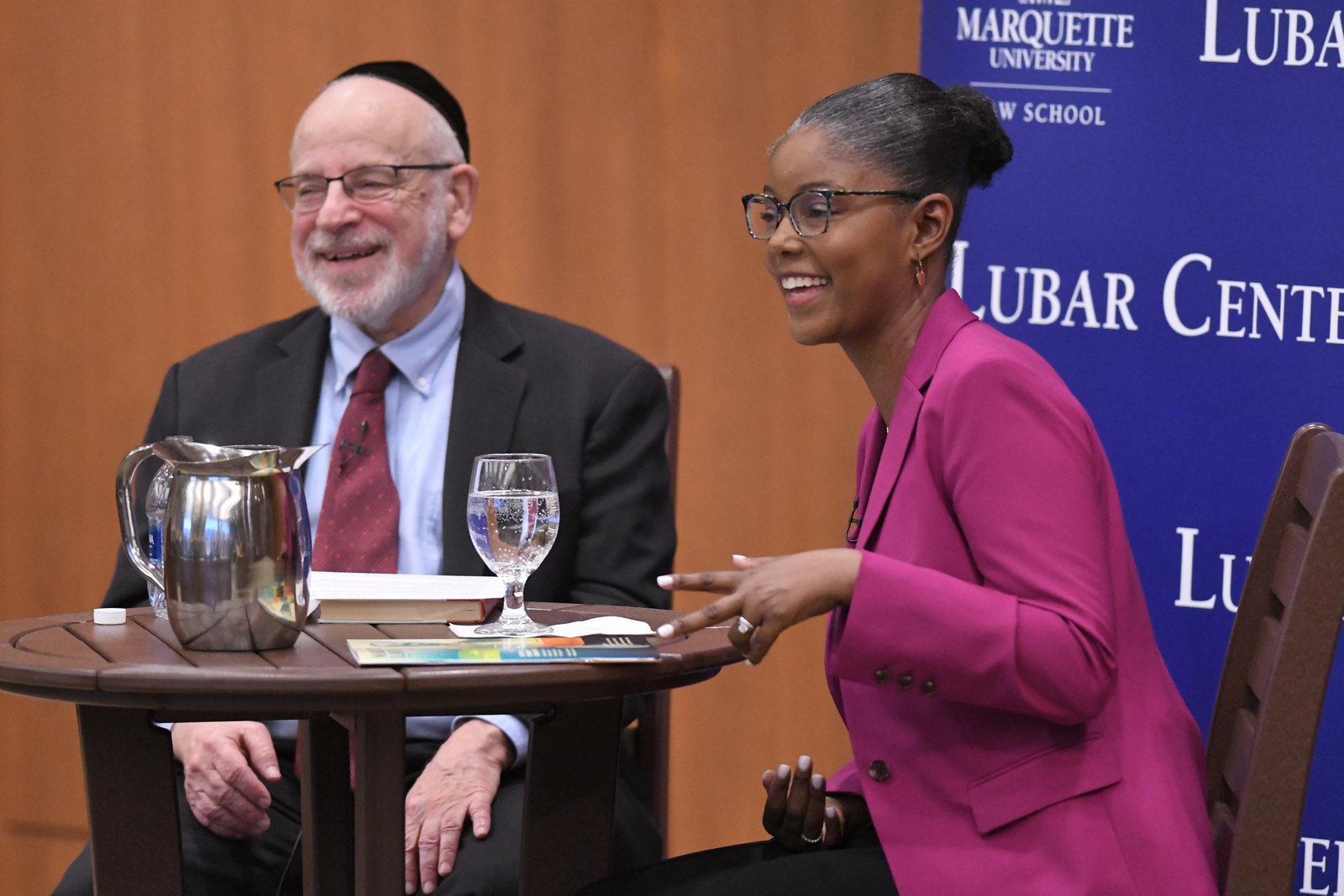
“All hands on deck”—that’s what it will take to succeed in making a lot more children capable readers. This was the message from Maya Payne Smart to an audience in the Lubar Center of Marquette Law School’s Eckstein Hall. “Parents, families, communities, we have to do our part,” along with educators themselves.
The Law School’s Lubar Center for Public Policy Research and Civic Education, partnering with the Marquette University School of Education, is playing a part in that effort as a convener to promote public awareness of and engagement with the problem of too few children learning to read well. Two programs during the 2025–2026 school year continued the longstanding commitment to making education issues one of the focal areas of the Lubar Center’s public policy initiative.
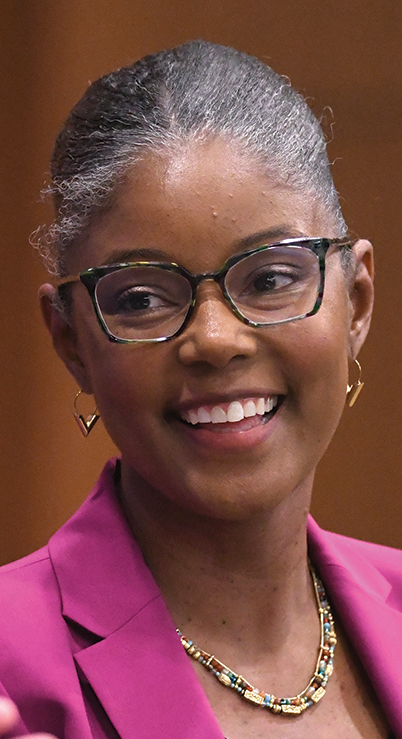
Smart is the author of the 2022 book, Reading for Our Lives: A Literacy Action Plan from Birth to Six. She is an affiliated faculty member of the Marquette University College of Education and the chair of the newly formed Milwaukee Reading Commission. She came to Milwaukee in 2021 when her husband, Shaka Smart, became the Marquette men’s basketball coach.
In a program on November 12, 2025, Smart said that when their daughter was young and Smart was checking out early childhood programs, she paid close attention to what she saw. Did the place look safe, clean, and inviting? Now, Smart said, she urges parents not only to look but to listen. Are the people running the center talking with the children, including babies? Are they doing things that build a child’s intellect? Even more important, are parents engaging in these things at home? These are valuable steps in child development.
“We need to have parents who recognize they are not only providing food and a roof over the heads of their children,” Smart said. “They are really their first teachers and their first educational advocates.” She also encouraged enhanced teacher training. “None of this works if the child arrives in a classroom with a teacher who doesn’t know how to teach them,” Smart said.
Building the skills of teachers was also the theme of a Lubar Center program on December 2, 2025, in which four Wisconsin education leaders described work on implementing a 2023 state law seeking reform in literacy education.
Barb Novak, head of the Wisconsin Department of Public Instruction’s Office of Literacy, said, “My heart wants every single kid to be a competent reader. . . . My brain knows that that happens through building systems.” That process has started, but she said that broad success is going to be expensive, requiring more than the $50 million that the state has appropriated to this point.
Gabriela Bell Jiménez, academic superintendent for literacy for Milwaukee Public Schools (MPS), is at the center of work to improve reading proficiency among Milwaukee children, which, as a whole, is among the weakest in the nation. She compared what it will take to succeed to what it takes to make an ice sculpture from a large block of ice, saying you have to melt the block bit by bit, carefully and patiently. “Change is difficult, but we are making progress,” she said. A recent update of the MPS reading curriculum, she said, was an expensive but important step.
Rep. Robert Wittke (R-Caledonia), a member of the Wisconsin Legislature since 2019 and a former president of the board of education of the Racine Unified School District, said he would have preferred a much larger appropriation—$150 million or $200 million—to support the 2023 reading law. He emphasized professional development for teachers as a priority. “We took a step in the right direction with $50 million,” he said, even as more will be needed.
Carrie Streiff-Stuessy heads a community organization, Forward Scholars, that places trained volunteer tutors in 10 Milwaukee schools. It has seen good results, albeit with a relatively small number of students. Overall, “I do really see that there are changes happening,” she said. But it “can’t happen fast enough without the resources.”
Engagement, commitment, and resources were themes at both Lubar Center programs. Marquette’s commitment includes continuing to put literacy issues in the spotlight.
This article was first featured in the Summer 2026 issue of Marquette Lawyer Magazine.