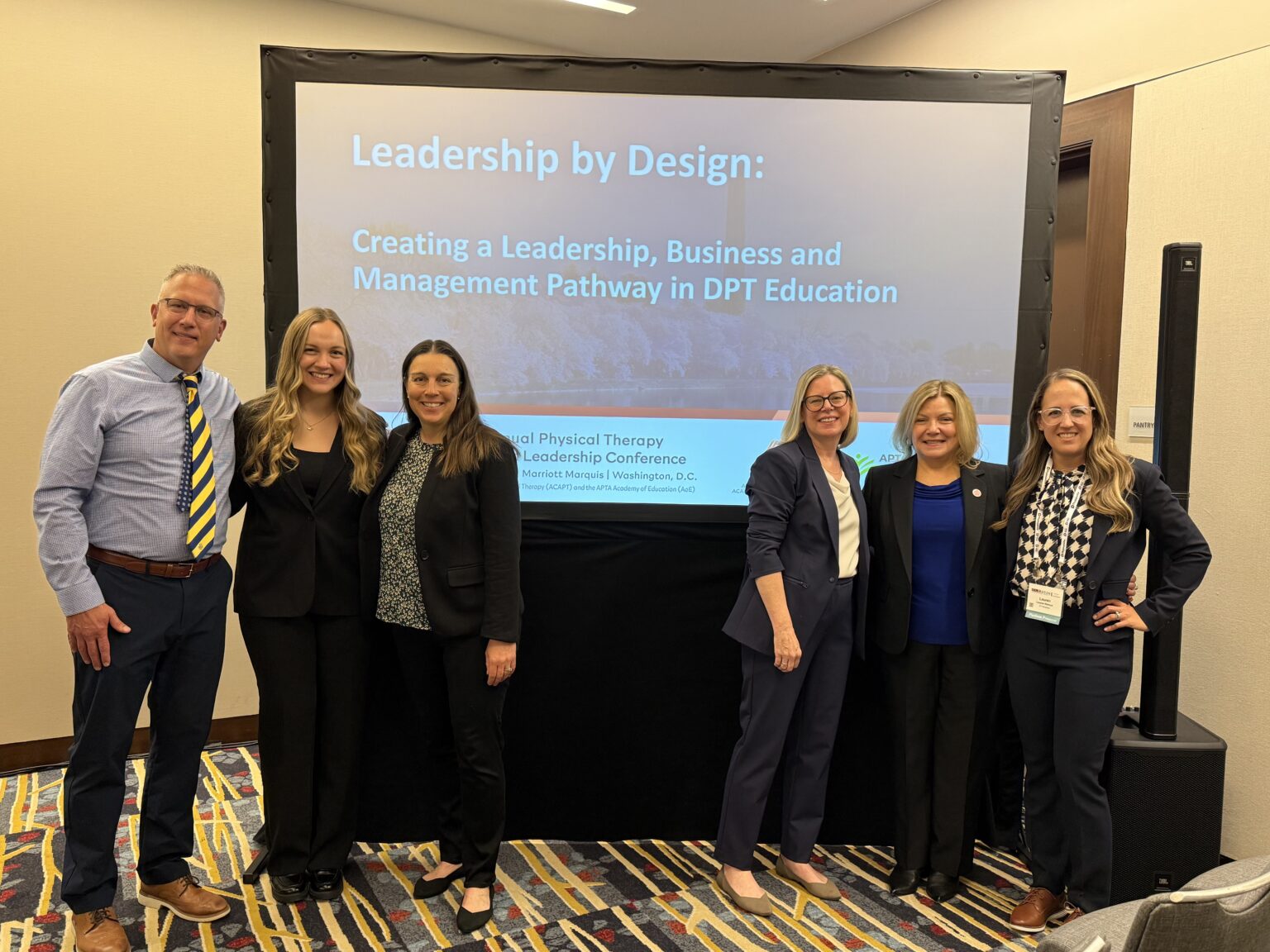
The Department of Physical Therapy recently presented at the Educational Leadership Conference hosted by the American Physical Therapy Association Academy of Education in Washington, D.C. about the success of its business leadership specialization that launched in 2024.
Dr. Allison Hyngstrom, Department of Physical Therapy chair, said the program’s mission already emphasizes developing leaders for the profession, but the faculty had noticed that physical therapists moving into leadership and management roles often had a gap in their instruction.
“PTs may become lead therapists, clinic directors, department managers, practice owners, or other healthcare leaders, but they also need to understand how organizations work, communicate effectively, manage conflict, interpret financial and operational information, and influence change,” Hyngstrom says. “We wanted students to develop those skills alongside their clinical preparation.”
Since its inception, the nine-credit specialization has had 44 students, and Dr. Jeff Wilkens, director of the Physical Therapy Clinic and the Neuro Recovery Clinic, said there had been interest from clinical partners signaling a reciprocal benefit to the industry.
“So many physical therapists are tapped by their leaders/managers to take positions of leadership because we tend to be personable people who get along with others,” Wilkens said. “Yet, to be most effective, intentional leadership development is needed. Physical therapists have the potential to touch and impact so many areas of healthcare and to make a great impact in the future.”
Hyngstrom said the most important part of the specialization is that it spans the curriculum and is applied over time rather than taken as a single elective in a semester. She said students build a foundation in leadership, self-awareness, communication, business, and management, then learn how the business of PT works through topics such as finance, operations, human resources, key performance indicators, strategy, and organizational culture.
“Students in the program also work with experienced organizational leaders and ultimately integrate what they have learned through a real-world capstone project,” Hyngstrom said. “The goal is not simply to gain organizational knowledge but also to practice and apply it in meaningful professional settings.”