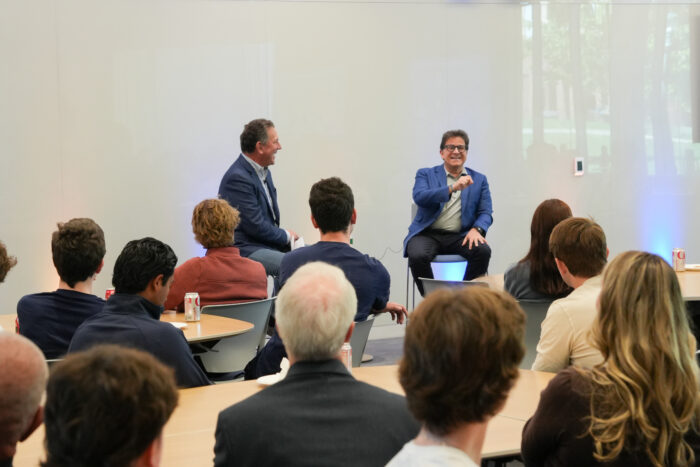
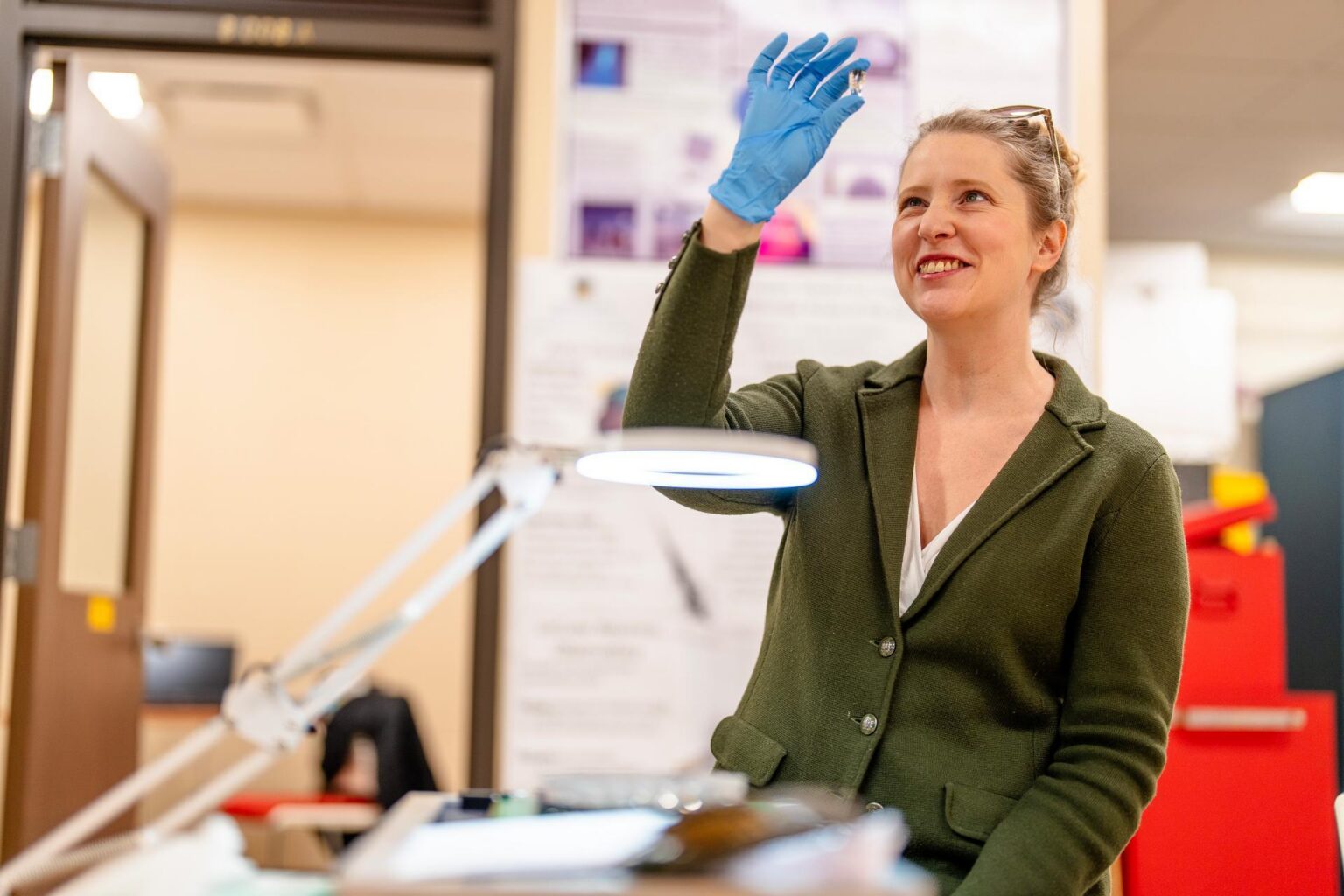
Dr. Karen Andeen, Clare Boothe Luce Associate Professor of Physics in the Klingler College of Arts and Sciences, is a frequent collaborator with the winner of the 2026 Nobel Prize in Physics, Dr. Francis Halzen. Halzen, a professor of physics at the University of Wisconsin-Madison, was recognized by the Royal Swedish Academy of Sciences for his research on neutrinos — tiny, electrically neutral particles that are extremely difficult to detect and about which little is known.
Andeen earned her Ph.D. in Dr. Halzen’s IceCube group at UW-Madison, and helped to build the IceCube Neutrino Observatory, the South Pole research facility which Halzen envisioned. The observatory is a cubic kilometer of ice fitted with advanced sensors. Approximately 450 physicists from 58 institutions in 14 countries make up the IceCube Collaboration, which built and operates the observatory.
“As a team, we worked hard to build this experiment, analyze the data and actually see the first astrophysical neutrinos from outside our solar system,” Andeen said. “I am always very emotional when people who are told ‘it will never be possible’ manage to succeed through hard work and innovation. Dr. Halzen is a great leader who has always fostered a positive culture within our collaboration through his openness and accessibility, and by constantly championing innovative ideas from even the most junior scientists.”
Andeen’s research at IceCube specifically deals with cosmic rays, which are particles produced by violent astronomical events such as supernovas and black holes. When the particles hit Earth’s atmosphere, they shatter into a spray of daughter particles. Using specialized detectors and telescope arrays, scientists can study the spray to deduce what happened inside the initial event that created the cosmic ray. Andeen is currently leading an upgrade for IceCube. Her laboratory at Marquette is building 10 new IceAct telescopes and shipping them to IceCube for deployment. This coming polar season, her postdoc Arun Vaidyanathan will be heading to the Pole to deploy several of those telescopes. Her work earned a National Science Foundation CAREER Award in 2022, which came with $870,000 of funding over five years.
“Marquette is a great place to do this work, and the undergraduate students in my lab have helped to build the telescopes that are being sent to the South Pole,” Andeen said.
“Dr. Andeen’s innovative, cutting-edge research has furthered our understanding of the universe and has been of immense value,” said Dr. Heather Hathaway, acting dean of the Helen Way Klingler College of Arts and Sciences. “She serves as a role model for tomorrow’s physicists and embodies the standard of excellence we strive for every day here at Marquette.”
To learn more about Dr. Andeen, read this Q&A with her that was published in Marquette Today in July 2026.