
Before they were at Marquette University, physicists Dr. Tim Tharp and Dr. Karen Andeen had two plane tickets to Geneva in hand. Andeen was about to start a job at CERN, the European Laboratory for Particle Physics. Tharp, her husband, had just quit an enviable position at the Princeton Plasma Physics Laboratory to follow her, with nothing on his calendar except, he jokes, sailing and skiing. Tharp’s bosses at Princeton were baffled he’d leave. “They didn’t understand why we would put such a high priority on staying together,” Tharp recalls. “In our field, people are often putting the science above everything else.”
As luck would have it, weeks before the move Tharp received a call from a celebrated CERN physicist, the late Dr. Joel Fajans, inviting him for an interview. Tharp got the job. It would later take years of effort and negotiation before Tharp and Andeen both secured faculty jobs at Marquette. “It’s the holy grail to get two tenure-track jobs, that are of equal level, in the same location. It doesn’t happen. But it was the thing we prioritized,” Andeen says.
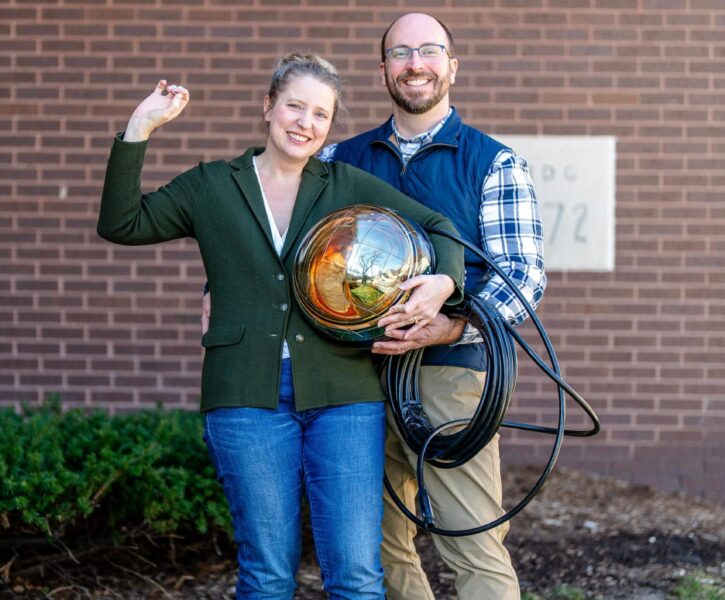
Tharp and Andeen haven’t cared much for convention over the course of their careers. Now associate professors in Marquette’s Department of Physics, they are accomplished researchers who share a habit of challenging the status quo. Andeen is celebrated for her work with the IceCube Neutrino Observatory at the South Pole, while Tharp is renowned for his work with CERN’s project ALPHA, or Antihydrogen Laser Physics Apparatus. Both have used their rigorous research programs and international collaborations for the betterment of their students and are known for creating an inclusive student environment in their labs and department. In Andeen’s words, it’s all about “caring about people and science, not just science.”
Plasma Collider
Tharp studies plasma, the superhot fourth state of matter after solid, liquid and gas. “The sun is a plasma. A flame is a plasma. If it’s a gas so hot it glows, it’s probably a plasma,” Tharp explains. It was this expertise that got him hired at CERN in 2012, and he has continued to collaborate with ALPHA ever since.
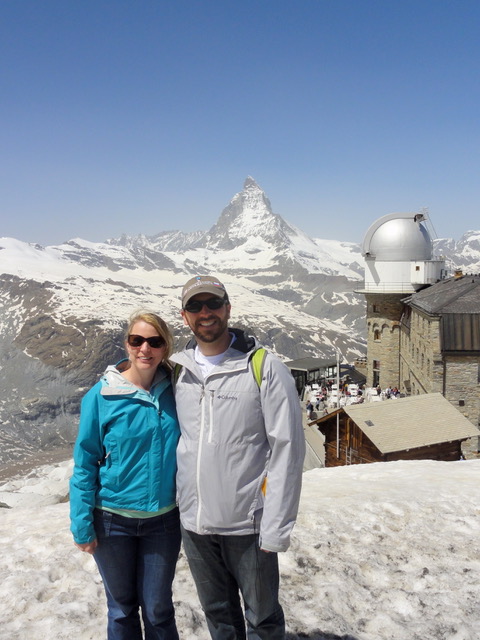
Drs. Karen Andeen and Tim Tharp stand on the Gornergrat observation platform near Zermatt, Switzerland. Behind them is the silver dome of the observatory Stellarium Gornergrat. Behind that rises the famous pyramid-shaped peak of the Matterhorn, one of the tallest peaks in the Alps at 14,692 feet.
The ALPHA team creates antihydrogen by colliding plasmas of antiprotons and positrons, trapping the atoms long enough to study their properties. Antihydrogen is a form of antimatter, matter’s theoretical counterpart, that physicists long predicted existed, but created in the laboratory only in the past few decades.
Tharp has recently added a new investigation to his docket, an NSF-funded collaboration with University of Michigan theorist Dr. Scott Baalrud. Tharp’s team will be testing Baalrud’s mathematical predictions about how plasmas behave — such as how temperature and energy move between particles — against real measurements from ALPHA.
Tharp originally became interested in physics as a way to advance renewable energies, and that passion for protecting the climate has stuck with him. “Going to work on ALPHA is a lot of fun,” he says, “but at the end of the day, climate change is still the elephant in the room. It’s a huge problem that we really need to address.” He teaches Marquette’s climate change course and for the past several years has been researching what it would take to decarbonize campus through adoption of a geothermal heating and cooling system. “I’m spending a significant part of my research effort on decarbonization projects,” he says.
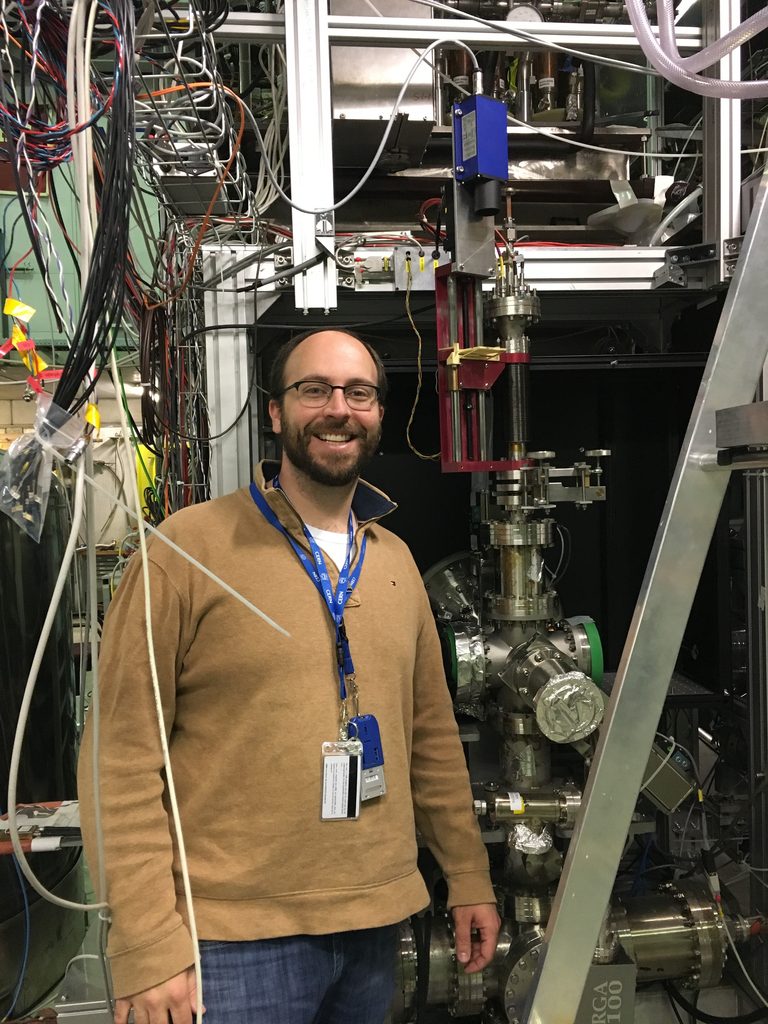
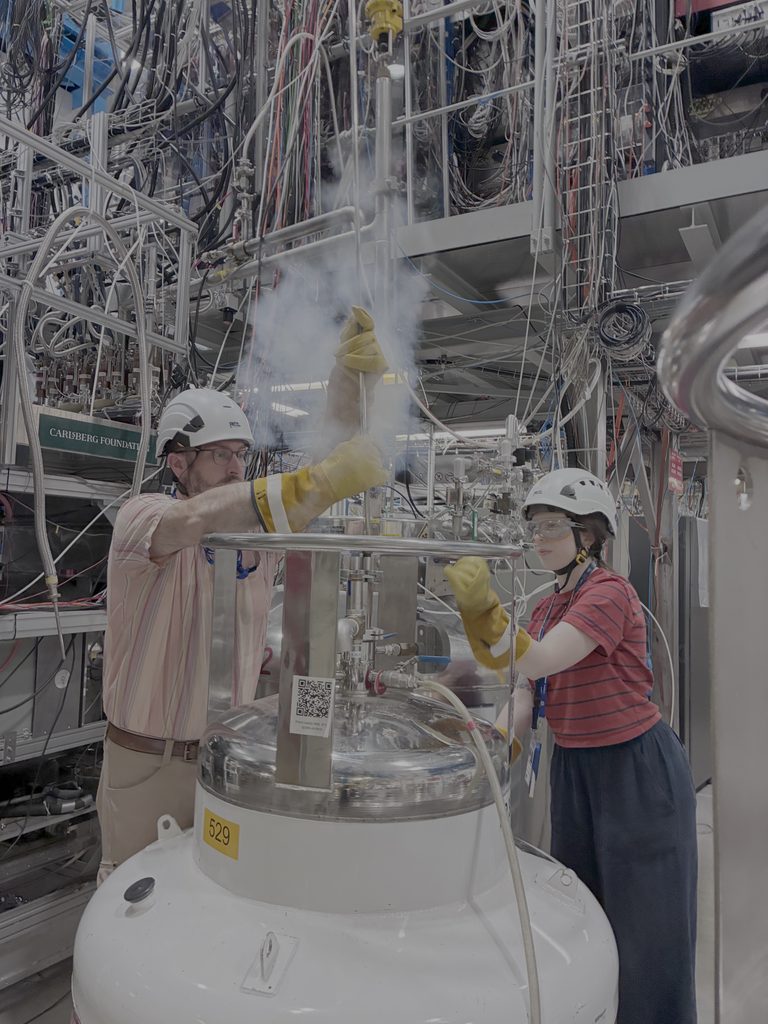
Tharp’s lab contributes to the ALPHA experiment at CERN, where researchers trap antihydrogen atoms to study their properties. Marquette undergraduate students design diagnostics, build vacuum systems, evaluate new materials and develop hardware for experiments at CERN.
Astroforensics
Andeen, meanwhile, studies cosmic rays. They’re produced by astronomical events such as supernovas, black holes and collisions of stars, and when they hit Earth’s atmosphere, they shatter into what’s called a cosmic ray air shower — a spray of daughter particles including neutrinos. By studying that spray, physicists can work backward to learn what’s happening inside the supernovas and the black holes that produced it. “I can’t detect the actual cosmic ray particles. I can only detect the junk that’s left,” Andeen says. “It’s like forensics, like looking at a car accident on the highway and trying to figure out what happened.”
Andeen received a competitive NSF Faculty Early Career Development grant in 2022 for this work. She uses detectors at the South Pole’s IceCube Neutrino Observatory — a cubic kilometer of ice fitted with sensors — along with IceTop, a detector at the surface, and a new array, IceAct, she’s currently building with collaborators at RWTH Aachen University in Germany. Andeen’s lab is building 10 new IceAct telescopes at Marquette and shipping them to Antarctica to be deployed. So far, five of the telescopes are operational on the ice. Andeen’s current postdoctoral researcher, Arun Vaidyanathan, has recently been selected to deploy to the South Pole to help assemble IceAct telescopes for the coming season.
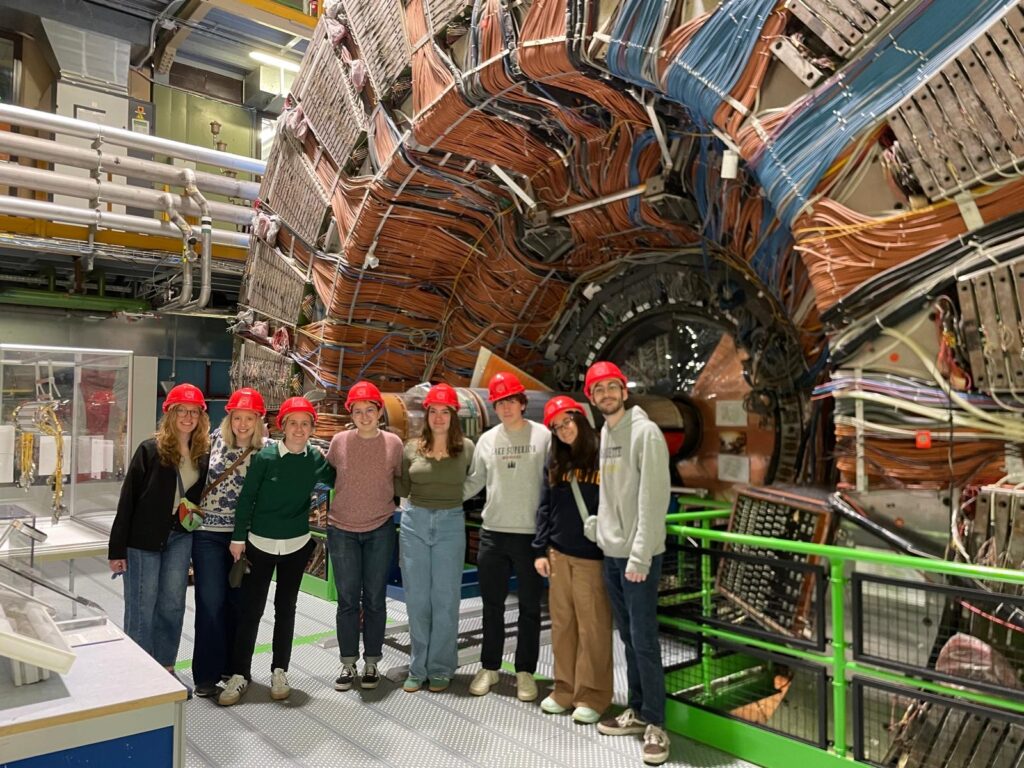
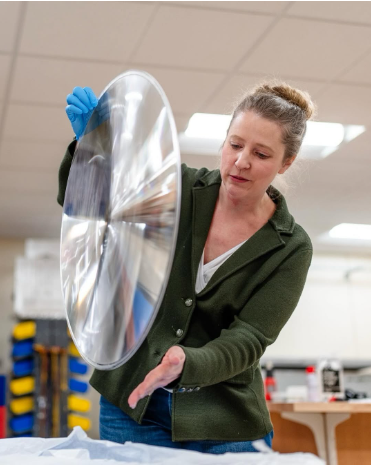
On a 2025 spring break trip led by Andeen, Marquette physics students toured the CERN facility and got up close and personal with the world’s largest and most powerful particle collider, the Large Hadron Collider. The Andeen Lab covers telescope design and testing, detector characterization, South Pole data analysis and the study of high-energy cosmic rays. Students gain hands-on experience in astrophysics, instrumentation and data science.
A Better Place
Andeen has also become a resource for women in her male-dominated field. In 2024, she was co-awarded a grant from the Clare Boothe Luce Program, which funds women in STEM working to change the institutions around them. She’s used it to meet one-on-one with every woman on Marquette’s STEM faculty, host events to bring them together, and work with the provost’s office toward changes. For example, Andeen has advocated for increasing transparency in tenure and promotion decisions, launching a mentoring program, adding sick days for postdoctoral researchers and improving parental leave.
She’s able to draw from her own difficult journey, navigating salary negotiations and even harassment at former positions. “I’d like to channel it all into something good,” she says.
Andeen’s care for people extends to students, too. She’s designed a series of seminars aimed at building community among physics majors, with particular attention to students from underrepresented backgrounds who may arrive without the same built-in support systems as their peers. She’s also brought students to CERN, restructuring her particle physics course around the opportunity to experience the experimental instruments in person.
Tharp takes a similarly hands-on approach with the students in his research program. “The skills and knowledge our undergraduate students gain through working on projects like this really make a difference by helping them succeed in graduate school and industry,” he says. His undergraduates also recently built an interactive plasma physics exhibit for Milwaukee’s Discovery World museum, using interactive displays to teach visitors how plasma shows up in everyday life, from neon signs to lightning and the northern lights. “Tim and I are both the type of people who want to make a difference in a place — not just our university, but also our town,” Andeen says. “Marquette is a place where you can do that. We’re really lucky.”
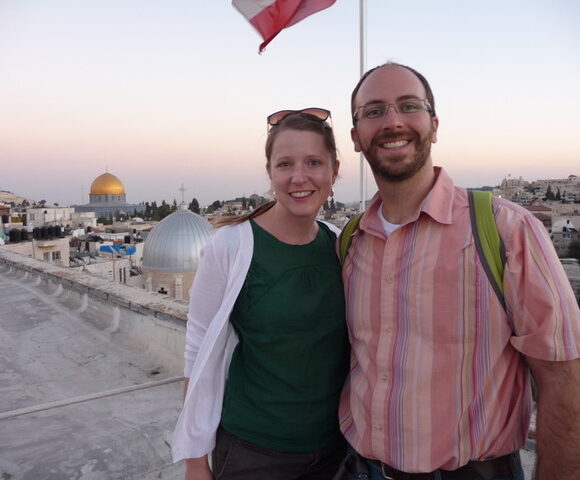 Andeen and Tharp stand on a rooftop in the Old City of Jerusalem, looking toward the Dome of the Rock (the golden dome in the background), an iconic seventh-century Islamic shrine on the Temple Mount compound.