Global companies operate in a constantly evolving landscape: Geopolitical conflicts, tariffs, climate change and countless other factors can throw a wrench in any organization’s intricate supply chain, with effects rippling out to every part of the business. A new Marquette program aims to equip business students in supply chain management and their counterparts in engineering with the skills to navigate these complexities as soon as they enter the workforce.
ASCEnT — short for Applied Supply Chain, Engineering and Technology — is an 11-credit concentration open to students from supply chain and engineering majors. A collaboration of Marquette’s College of Business Administration and the Opus College of Engineering, the interdisciplinary program launches in 2027 and aims to close the talent gap in the industry and ease the burden on many employers to train new hires. It helps students move out of their silos and into a broader understanding of the business ecosystem.
“Supply chain students graduate and go into their jobs, but they find out fairly soon in their careers that they need to interact with engineering or accounting or finance,” says Dr. Marko Bastl, director of the Center of Supply Chain Management and co-founder of ASCEnT. “Same for engineers — they need to interact with procurement, operations, manufacturing, planning. That’s where the gap is: having this cross-functional understanding of the field.”
Dr. Phil Voglewede, professor of mechanical engineering and co-founder of ASCEnT, says most engineering programs focus more on theory than practical, on-the-job skills. “This program gives engineering students a distinctive advantage, something that’s different from other schools, in that they can understand how engineering fits into the bigger picture when you’re dealing with business,” he says.
Supply chains at home and overseas
Over the course of five semesters, ASCEnT students will take courses in AI agility, systems thinking, uncertainty management, technology integration and digital transformation. Each ASCEnT cohort will also take two trips — one domestic and one international — to see business systems in action.
“Beyond explaining to students in class what a supply chain looks like, we want them to walk through the functioning of the supply chain,” Bastl says. On the home front, ASCEnT will partner with local businesses such as GE Healthcare to take students through manufacturing sites and medical centers. They’ll learn how the company’s products move through the supply chain to their final destination.
During their junior year, students will take a trip overseas that will expand their understandings of the global, cultural and geopolitical context affecting transcontinental supply chains. The blueprint for the international trip comes from two previous trips that a cohort of business and engineering students took to Bogota, Colombia, to learn about the coffee supply chain. ASCEnT will also develop a program in Panama in collaboration with Dr. Shital Vora, CEO and co-founder of Global Brigades and a Marquette Business executive-in-residence.
“Students lack the visibility and understanding of supply chain, risk and resilience issues beyond what they’re able to see here at home,” Bastl says. “I want them to see what we call the invisible parts of a supply chain — the parts we don’t necessarily manage directly but we are highly impacted by.”
In its final semester, ASCEnT culminates in a “chaos project” during which Bastl and Voglewede put students’ acumen to the test. The cohort will tackle a project riddled with real-world challenges: think tariffs, weather disasters, political ousters, canal closures or the effects of geopolitical conflicts on supply chains.
“We’re going to do it the way industry does, which is to say to the students, ‘You guys have to figure it out. You have to work together,’” Voglewede says. “You can’t say, ‘That’s an engineering problem,’ or ‘That’s a supply chain issue.’ You have to figure out how to communicate. This program gives them a common vocabulary and a common language to be able to do that.”
Continued collaboration with industry input
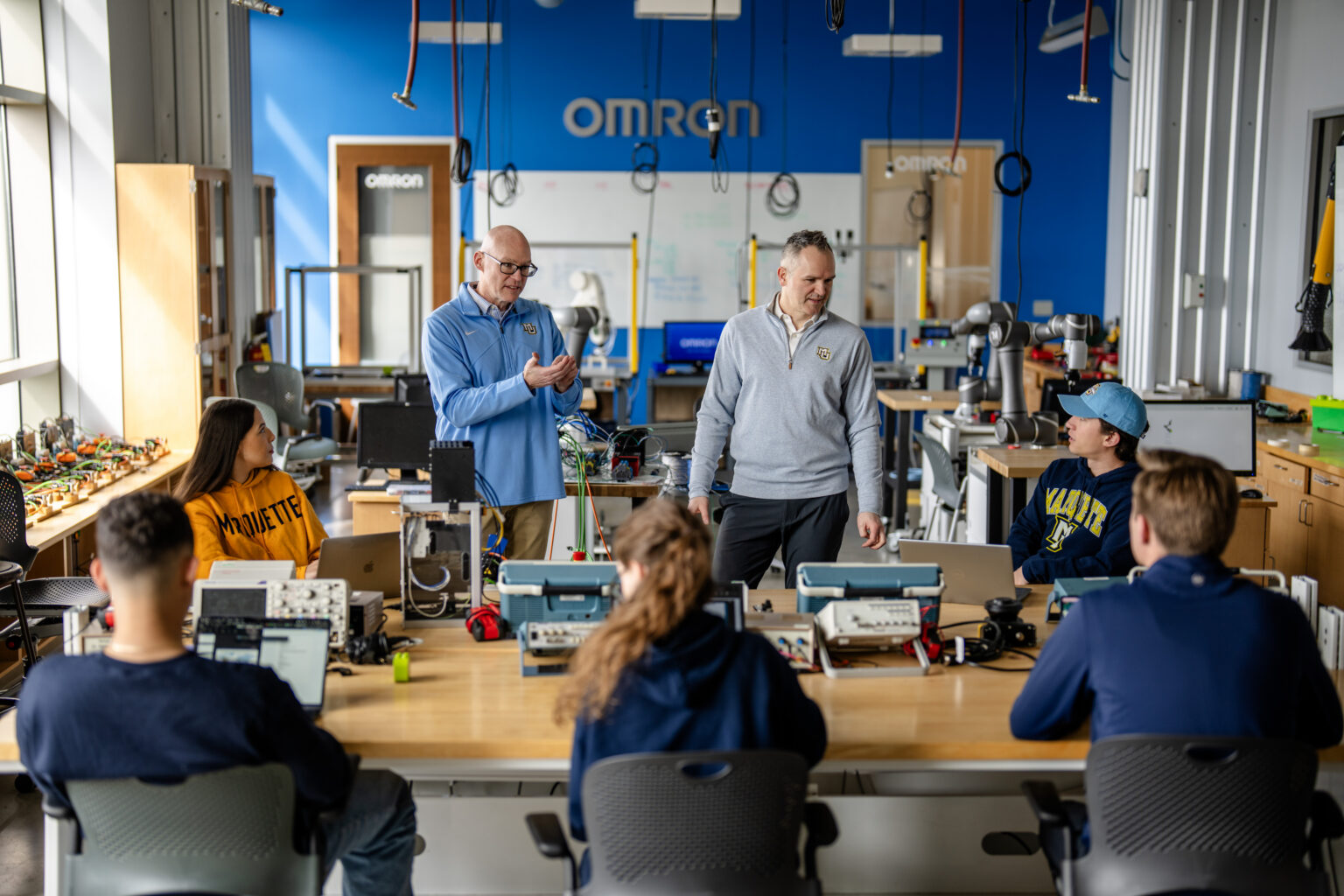
Prior to developing ASCEnT, Bastl and Voglewede began fostering collaboration between supply chain and engineering students through their work in the Omron Advanced Automation Lab, where engineering and business students come together to create automation systems.
As they created ASCEnT, Bastl and Voglewede also relied on input from industry professionals, including those on the university’s Supply Chain Management Advisory Board. “The biggest message from industry on that advisory board has been that we don’t need more siloed talent,” says Craig Schaefer, executive of supply chain capability and talent development at GE Healthcare and chair of Marquette’s Supply Chain Management Advisory Board. “We need graduates that can operate across functions — supply chain, engineering, technology — because that’s how work gets done today.”
ASCEnT applications open this fall to sophomores. Many students attended info sessions in the spring to learn more about the program, including Dominic Rooney, a sophomore studying supply chain management and finance who is eager to apply to and enroll in the program. “I’m excited because I’ll have the opportunity to better understand the span of a complete product journey — from sourcing raw materials, manufacturing goods and managing logistics all the way to delivering the final product to the customer and handling returns,” he says. “The ASCEnT program will well prepare me to be a supply chain professional in a rapidly changing business environment.”
Another attendee, mechanical engineering major Tessa Burke, looks forward to applying to the program and developing her understanding of the supply chain world. “Much of my coursework focuses on design, analysis and problem-solving, but I think it would be beneficial to learn more about the process of making the product exist in the real world,” she says. “I believe this program would help give me a broader perspective.”
That perspective will ultimately give ASCEnT graduates a critical boost in a competitive job market, Schaefer says. “Students don’t need to be experts on everything from day one, but they do need to be comfortable using data, understanding technology and working across those functions,” he says. “We need digitally savvy teams that really start to connect the dots across a pretty complicated landscape. The strongest aspect of ASCEnT is building all of those pieces.”