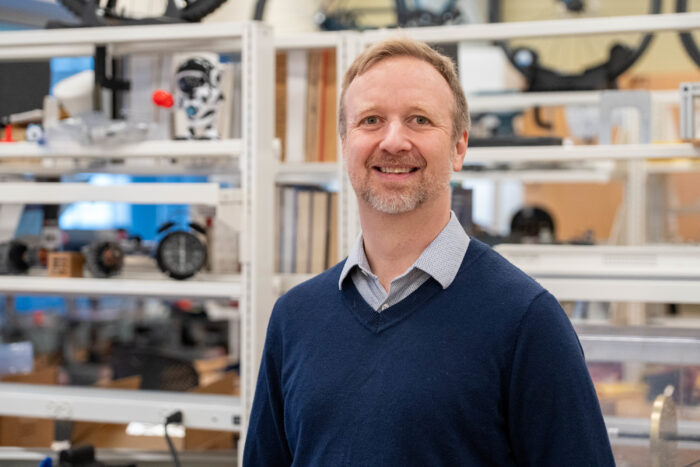

Dr. Allison Hyngstrom, chair and professor of physical therapy in Marquette University’s College of Health Sciences, has been awarded an R01 grant from the National Institutes of Health to study causes and solutions for decreased exercise capacity in stroke survivors.
The project will study the reduced activation of skeletal muscle in the weakened legs of stroke survivors. Researchers hypothesize that this weakening stems from impairments in reflexive blood flow control during exercise, known as the metaboreflex, which limits exercise capacity.
Hyngstrom is a multi-principal investigator on the project titled “Targeting the Muscle Metaboreflex to Optimize Exercise Capacity in Stroke Survivors” along with Dr. Matthew Durand, associate professor of anesthesiology at the Medical College of Wisconsin. The award was issued by the Eunice Kennedy Shriver National Institute of Child Health and Human Development, with an expected $1.69 million earmarked for research at Marquette.
“Stroke survivors are unable to adequately increase and sustain cardiovascular drive during exercise, which limits their capacity to exercise at high intensity,” Hyngstrom said. “This is important because recent studies indicate that high intensity exercise training leads to large gains in motor performance post-stroke. However, a central challenge is getting stroke survivors to achieve and sustain sufficiently high heart rates to exercise at high intensity, and sessions can be limited to short bouts of exercise versus a continuous effort.”
With this award, Hyngstrom and Durand will first establish the relationship between metaboreflex activation and exercise capacity. This will allow their research team to run a clinical trial designed to determine if ischemic conditioning can improve metaboreflex activation in the impaired muscle and whether improvements result in better performance during a high intensity walking task.
“Dr. Hyngstrom’s stroke research continues to push the envelope as she reimagines how to treat stroke survivors with chronic mobility issues,” said Dr. William E. Cullinan, dean of the College of Health Sciences. “She is a world-leader in stroke research who brings considerable expertise to campus every day, whether through her research program or in instructing our students how to be exceptional physical therapists.”
Dr. Brian Schmit, professor and Hammes Family Chair in the Marquette and MCW Joint Department of Biomedical Engineering, serves as a co-investigator on the project, as does Dr. Chris Sundberg, assistant professor of geriatrics and gerontology at the University of Wisconsin School of Medicine and Public Health.
This is the third active R01 for Hyngstrom and Durand involving ischemic conditioning and improved motor function post stroke. Marquette’s “Discover” magazine chronicled their work in September 2024.
The National Institutes of Health’s Research Project Grant (R01) is the original and historically oldest grant mechanism used by the NIH. The R01 provides support for health-related research and development based on the mission of the NIH. R01s can be investigator-initiated or can be solicited. The Eunice Kennedy Shriver National Institute of Child Health and Human Development was founded in 1962 to investigate human development throughout the entire life process, with a focus on understanding disabilities and important events that occur during pregnancy. Since then, research conducted and funded by NICHD has helped save lives, improve wellbeing, and reduce societal costs associated with illness and disability. NICHD’s mission is to lead research and training to understand human development, improve reproductive health, enhance the lives of children and adolescents, and optimize abilities for all.