
On the road to addiction, repeated drug use has long been suspected of disrupting — and even physically changing — connections in the prefrontal cortex, the brain region involved in decision-making and impulse control. It’s also been generally assumed that male and female brains experience these changes similarly.

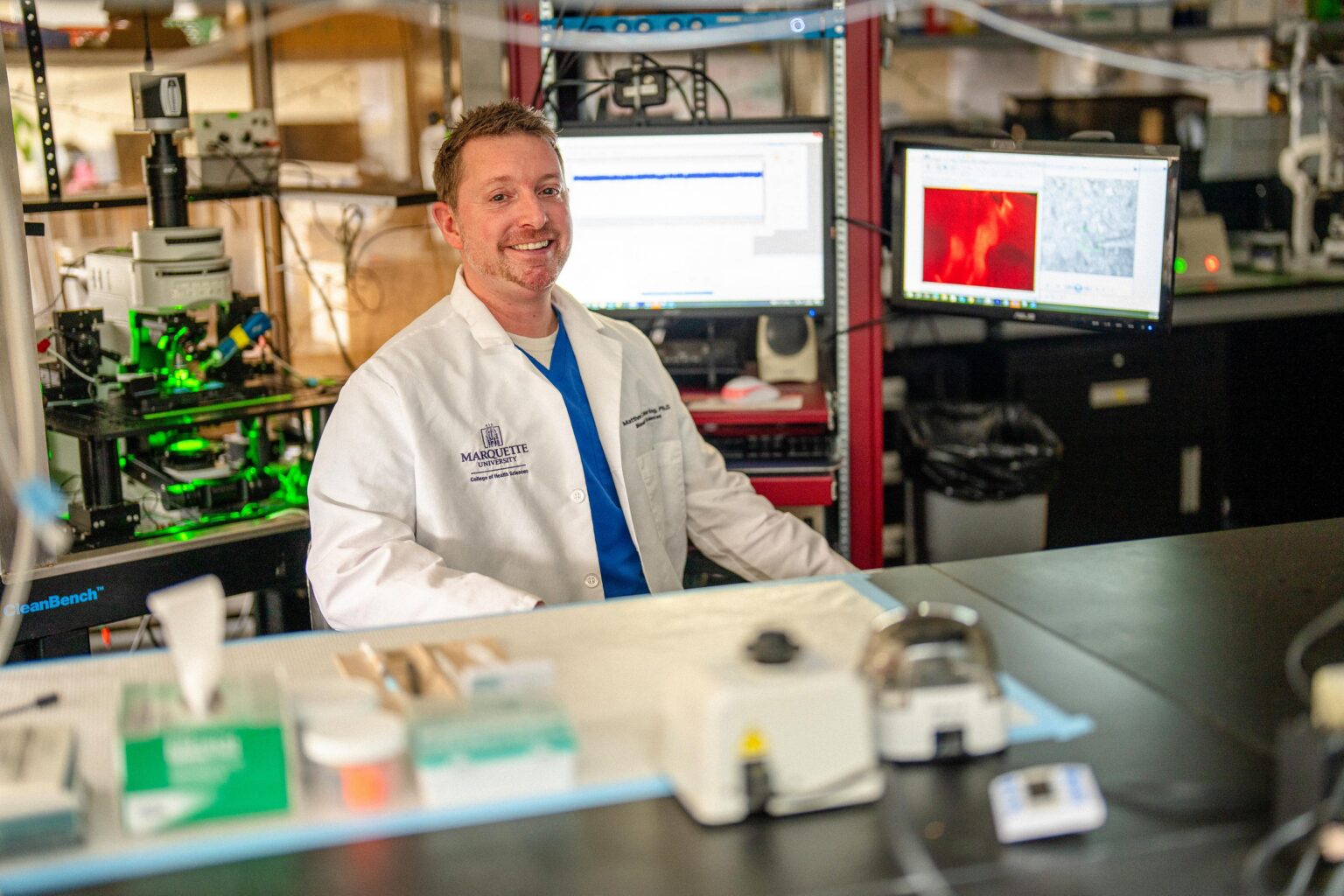
With a $2.07 million R01 grant from the National Institutes of Health, Dr. Matthew Hearing, H Sci ’03, associate professor of biomedical sciences, has created a window into this process and discovered something surprising: Not only do females show neurological impairment from opioid use in half the time as males, but the physiological changes themselves are different.
By better understanding these differences, Hearing and his team hope to find insights on how sex-tailored therapies could ease the grip of these addictions.
The birth of a neuroscientist
As a biomedical sciences undergraduate, Hearing volunteered in the lab of a new faculty member, Dr. David Baker, and found his calling in neuroscience. After earning his doctorate, Hearing returned to the College of Health Sciences “to work with colleagues who shared his enthusiasm for research aimed at uncovering how the brain changes during learning and disease.” Today, Baker is chair of the department, an accomplished researcher on the neurological processes involved in addiction and now a colleague of Hearing.

In the meantime, Marquette has built a reputation for strength in neuroscience research focused on addiction and broader mental health, bolstered by support from the Charles E. Kubly Mental Health Research Center, established in 2015, and ongoing support from the Kubly family and other donors. Hearing’s lab embodies that dual focus: With his second R01 grant, worth $2.4 million, his team is investigating the impact of chronic stress on the brain.
Finding a better fix

In collaboration with Dr. Robert Wheeler, professor of biomedical sciences, Hearing uses advanced imaging technology that allows his team to watch individual neurons “turn on” in real time as mice use a lever to self-administer opioids. To do so, the team uses genetically modified mice with neurons that produce a fluorescent protein that glows whenever the cells fire. A tiny camera implanted in the brain allows them to “film” patterns of brain activity. The researchers can track the same neurons over weeks, allowing them to pinpoint precisely when dysfunction begins and how it aligns with behavioral changes.

By combining this live imaging with analysis of how opioids change neuron physiology, the team revealed that opioids impact female and male brains differently. In females, opioid use reduces glutamate, a neurotransmitter that activates neurons in the prefrontal cortex. In males, it increases GABA, a neurotransmitter that suppresses neuron firing. Both changes disrupt the prefrontal cortex’s ability to control decision-making — but through opposite mechanisms.
“It highlights that we should really consider not treating sexes or even individuals in the same way when we treat substance use disorders,” says Hearing. Pharmaceutical treatments target specific brain mechanisms, so if males and females reach use disorders through different pathways, they’ll need different drugs to reverse them.
With the U.S. experiencing 900,000 deaths from opioid overdoses in the last 25 years, Hearing’s findings, as they unfold, could bring new effectiveness to the way we treat addiction.

Illustration by SHOUT