
For members of the Marquette community with deep ties to New Orleans, their relationship to the Crescent City is often a romantic one.
The city quickly — and enduringly — captured the imagination of Dr. Stephanie Quade, Arts ’84, Grad ’94, filling her head with visions of Tennessee Williams plays.
“A small town in a big city,” Richard Duplantier, Sp ’84, a native son and longtime resident, says approvingly.
Nick Karel visited more than a dozen times before moving there shortly after his years at Marquette in the mid-2000s, convinced it’s where he belonged.
And Stephanie Lumpkin, M.D., H Sci ’10, first discovered the city while “falling in love” with the Loyola New Orleans campus.
“Every six to 12 hours it got more serious. All the airlines started canceling flights and no buses were leaving the city anymore.”
Stephanie Lumpkin, M.D., H Sci ’10
Twenty years ago, Hurricane Katrina ravaged the city these people loved. The events of August 28-30, 2005, and their aftermath created shocks and ripples that extended far beyond the flooded neighborhoods such as Gentilly and the Ninth Ward. For the four alumni, what followed the hurricane created a link between Marquette University and New Orleans that has persisted for two decades.
The looming menace
“We’ve had these before, we’ll lose power for a few days, but we’ll be fine.”
Lumpkin still remembers those words from her resident assistant, delivered soon after she’d arrived at Loyola’s campus for freshman move-in week from her home in Milwaukee. She and friends went to Target to stock up on snacks before the storm’s landfall. The RA told her to fill her bathtub with water so she could flush the toilet if power went out. Hurricane Katrina seemed like nothing more than an inconvenience.
“We bunkered down, and every six to 12 hours it got more serious,” Lumpkin recalls. “All the airlines started canceling flights and there were no buses leaving the city anymore. Nobody could get into the city because they started contraflow on the highways.”
On August 28, the day before the storm hit and shortly after the mayor declared New Orleans’ first-ever mandatory evacuations, Lumpkin found a classmate packing up her van to leave the city. Lumpkin hopped in the van, joining a cascade of vehicles driving north on I-10 away from New Orleans.

A home away from home
Hurricane Katrina claimed more than 1,800 lives, most of them in southeastern Louisiana, with hundreds more missing. Over 1 million people were displaced from their homes, the largest such displacement in American history. Thousands in that diaspora were college students, their lives left in limbo as their universities ceased operations for a semester, sometimes longer.
Quade, then the associate dean of student development at Marquette after starting her career at Loyola University New Orleans, knew that her university had to do something to help. “It just so happened that we had a good amount of residence hall space open, and a lot of other universities did not,” Quade says. “We saw that we had some ability to take students from Loyola, from Tulane and from Xavier University, too.”
“Marquette had opened a whole new way of seeing the world for me. It made me feel like there was something more I could do.”
Stephanie Lumpkin, M.D., H Sci ’10
In the end, Marquette enrolled 69 undergraduate students from New Orleans schools. Some just stayed for a semester, others much longer. The student development staff, including Quade, tackled mountains of paperwork to get their credits transferred and their financial aid secured. Families of Marquette students donated money, helping the university form an emergency fund to buy textbooks and other essentials for the affected students. An alumni group knitted scarves for them.
Amid the despair and the hope sat Lumpkin, a first-year student trying to get her life reassembled. When the spring semester came around, she tried going back to Loyola, but she grappled with survivor’s guilt the entire time. She couldn’t escape feeling that she wasn’t helping a city in need. “Marquette had opened a whole new way of seeing the world for me; it made me feel like there was something more I could do,” Lumpkin says. Recognizing that she loved both universities, she decided to return to Marquette for her sophomore year, in part based on the advantages it offered in pre-med study, but she was still searching for that something more.

“You’re wheeling
my life away”
Two decades later, Nick Karel still remembers wheeling a chest of Warren and Anita Williams’ Mardi Gras beads to the curb. The Williams were the “sweetest older couple you can imagine,” Karel recalls. They lived in the Gentilly neighborhood near Lake Pont- chartrain, the water from which breached the walls of the London Avenue Canal and consumed their home.
As the chest of beads passed Warren, tears welled in his eyes. “You’re wheeling my life away,” Karel recalls him saying.
It was fall of 2006 and Karel, then a freshman from St. Paul, Minnesota, was volunteering on a Marquette Action Program trip to New Orleans. For over three decades, Marquette students working in partnership with Campus Ministry have traveled across the country with M.A.P., performing service projects to alleviate urban poverty, build communities, and improve local health and education.
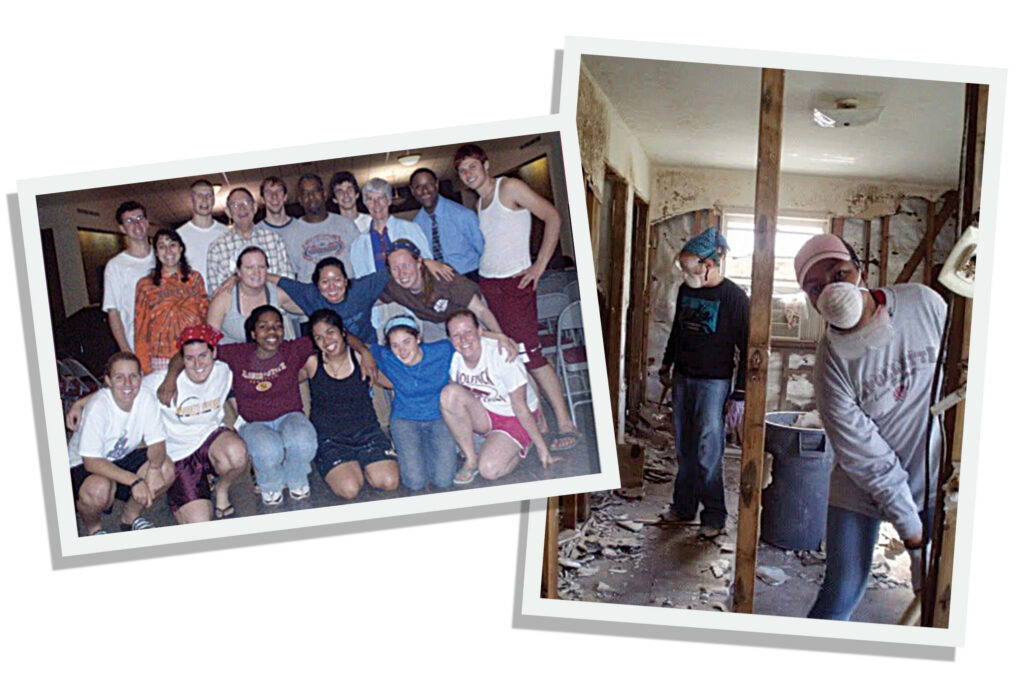
The residents of New Orleans, however, were dealing with a situation significantly more dire than the typical M.A.P. site. Only 60 percent of inhabitable homes had electricity. Half the hospitals in town had not reopened. Conditions for nonwhite residents, who made up 80 percent of the population in the most flooded areas of the city, were even worse.
That fact did not escape Lumpkin’s notice, who joined Karel on that same 2006 trip. “Watching the coverage of Katrina afterward was infuriating because you saw which areas the government seemed to care more about, and people making assumptions about who brought their conditions on themselves. It was infuriating.”
That impulse turned into action, fueling plans she’d been forming with fellow students even before the trip for a new organization dedicated to helping New Orleans get back on its feet and creating enduring support. That organization was Making A Real Difference in the Gulf Region and Areas Surrounding. Marquette’s MARDI GRAS was born.

The long rebuild
Less than 15 months after a van carried Lumpkin away from Loyola and 69 students from New Orleans came to Marquette, a fleet of vans carried an even larger number of Marquette students — 100 — toward the city for the first major MARDI GRAS service trip. MARDI GRAS partnered with Common Ground Relief, a grassroots organization dedicated to rebuilding their city. They were initially wary of the Marquette group.
“Nobody was going to give us an award for showing up; we were going to have to prove that we had some kind of value to add,” Lumpkin says. “That first trip, we stayed in an abandoned elementary school in the Ninth Ward. We proved that we were willing to work no matter what the conditions were and that brought us a lot of street cred.”
MARDI GRAS showed up again and again in New Orleans, gutting house after flood-afflicted house. Once the recovery efforts had shifted toward building from gutting, MARDI GRAS bought drywall and trained student volunteers to properly install it. Each summer, fall, winter and spring break, a caravan of rented vans would make the 32-hour round trip drive from Milwaukee to New Orleans, making a new mark on the city’s rebirth each time.
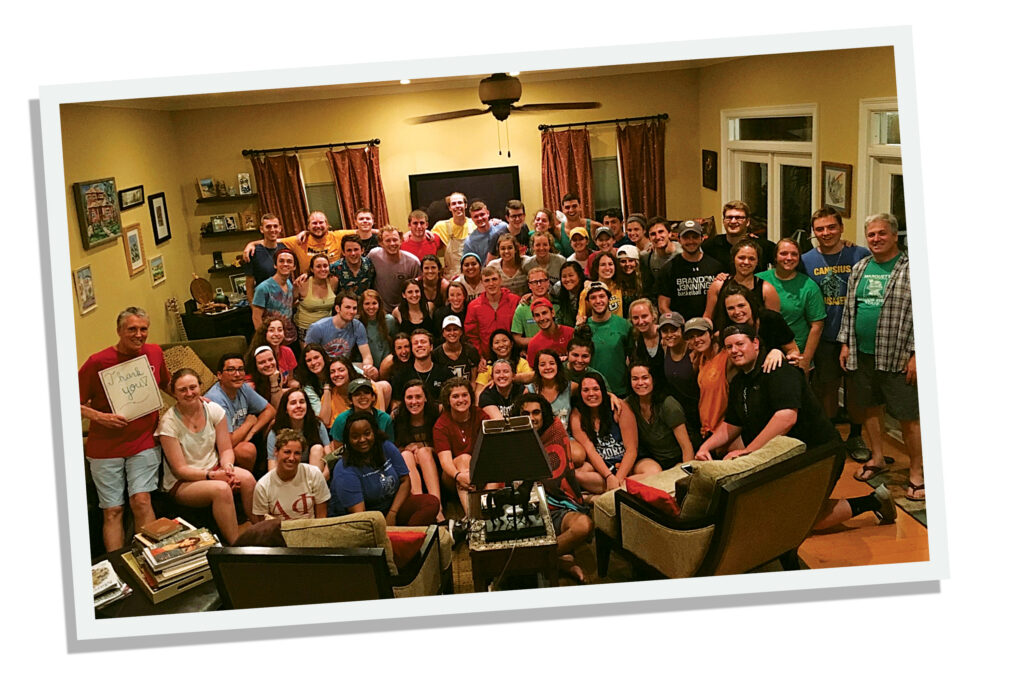
On one such trip, the group connected with Richard Duplantier, a Marquette alum who worked in New Orleans as a lawyer. Duplantier had lost his home in Katrina and was rebuilding on the same spot in Lakeview, a neighborhood 3 miles west of the Williams home. As soon as he heard what MARDI GRAS was doing, he scraped together as much food as he could and sent it over.
“They brought a little bit of hope and shined a light on us when we really needed it,” says Duplantier, Sp ’84. “They were willing to sleep on floors and take showers with a hose to be where they were needed most.”
When Duplantier’s house was rebuilt, he began hosting MARDI GRAS students each year, all 90 to 100 of them at once. They piled into his pool, ate crawfish pasta and jambalaya for dinner, and took the one decent shower of their time in New Orleans in his backyard. Then they packed up and headed back to their original accommodations, ready to continue the work. “Life is all about what you can do to give back and make a difference, whether it’s a small one or a large one. The best footprint you could leave behind is one of service and community,” Duplantier says.
The aftermath
Duplantier still lives in New Orleans, among a rebuilt block of homes that show few hints of Katrina. Karel works in hospitality there and is still involved with Common Ground Relief, even serving a term as board president.
After a career spanning more than three decades, Quade retired from Marquette. She still visits New Orleans regularly.
Lumpkin is now a trauma surgeon in Kansas City, practicing the same principles of servant leadership and reverence for humanity that she cultivated on the streets of those flooded neighborhoods. “I learned through my time in New Orleans that I don’t ever want to be in a situation where I’m unable to contribute,” she says.
MARDI GRAS has sent over 3,500 students to the Gulf region in its 20 years of existence. They’ve taken on natural disaster recovery projects in Florida, Texas and North Carolina, among other locations.
In 2018, Lumpkin returned to Marquette to receive an Alumni National Award from the College of Health Sciences. While in Milwaukee, she got to meet the students carrying on the organization she founded. She was delighted to feel like she was talking to younger versions of herself.
“These students were young kids when Katrina hit, but they were just as passionate about healing the racial divides that the storm uncovered and how social justice shapes your vision of vocation,” Lumpkin says. “They are willing to push their own limits and that’s what has kept this going for so long.”

From the spring 2026 issue of Marquette Magazine. Read more web stories from the magazine or see the entire print issue in a PDF viewer.