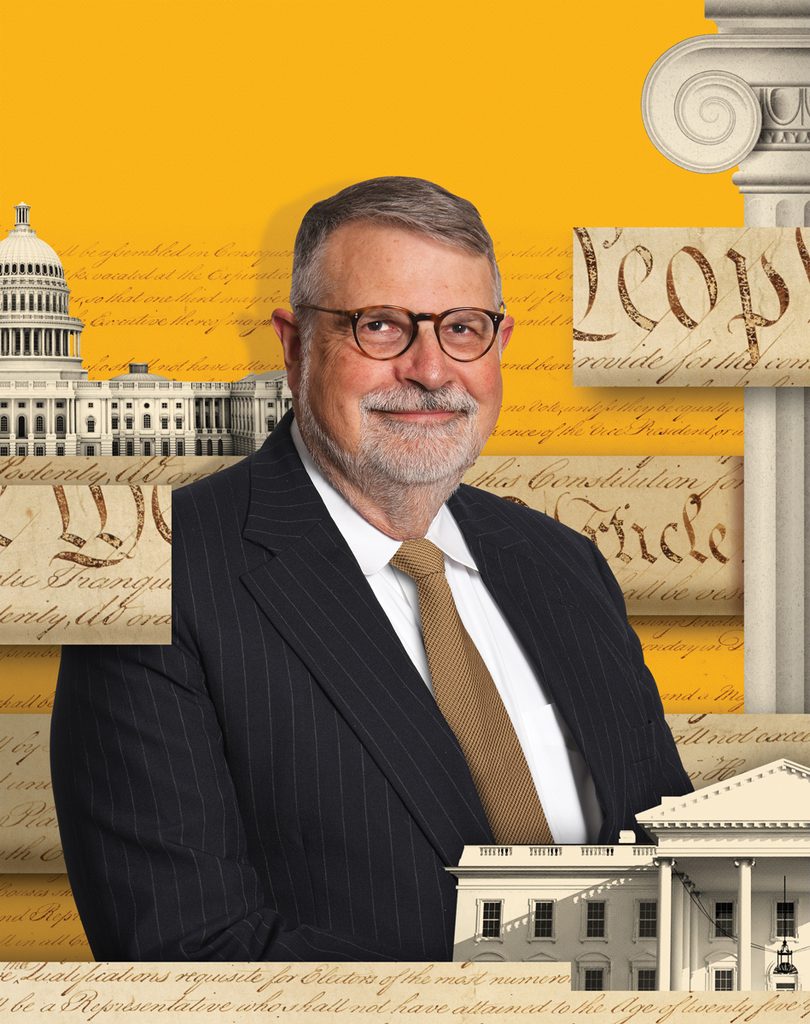
Thomas W. Merrill is the Charles Evans Hughes Professor of Law at Columbia University. This is a lightly edited version of the E. Harold Hallows Lecture, delivered at Marquette University Law School, on March 2, 2026. The lecture will appear as a longer article in the Marquette Law Review.
For several decades, we have been witnessing a Congress in long decline and a corresponding ascent of the President and the courts. I see this as a fundamental deformation of the Constitution—a deviation from its original and better design—and this deformation is the subject of my lecture today.
Congress has long been regarded as the keystone of the federal government. James Madison, in The Federalist No. 51, thought it self-evident that “[i]n republican government, the legislative authority necessarily predominates.” Under the Constitution, only the Congress is given the power to enact laws, levy taxes, and appropriate monies for the government.
The President, by contrast, is given a short list of powers and duties, some rather inconsequential, such as the duty to receive ambassadors, presumably in a reception at the White House or the like. Over time, the President’s power has tended to wax during times of war and wane in times of peace. But at least in matters of domestic policy, the President has been subordinate to Congress.
As for the third branch: The federal courts have always been small in number relative to state courts, and historically they have largely directed themselves to questions that state courts cannot effectively or appropriately decide.
Today, Congress passes relatively few laws, follows the President’s lead on taxes, and stands by while the President reallocates appropriations without sanction. Meanwhile, the President issues a blizzard of executive orders, in the manner of an elected monarch. And the Supreme Court is expected to issue blockbuster decisions on a routine basis, informing the country what it can and cannot do with respect to gun control, abortion, affirmative action, religious freedom, takings of property, and myriad other issues.
The deformation of the Constitution by this new distribution of authority has immense consequences. When Congress passes few laws, new problems tend to be addressed by federal agencies or, worse, by presidential executive orders, which are inherently impermanent. When Congress becomes inactive, the healthy back and forth between the legislature and the courts breaks down. Courts benefit from feedback from Congress, whether in the form of revisions to statutes that have been interpreted by courts, or in the form of threats to strip away the courts’ jurisdiction when they interpret the Constitution in a way that stirs up popular discontent.
There are a number of plausible reasons why Congress has been sidelined relative to the Executive and the courts. One is simply a matter of numbers. We have one president, nine Supreme Court justices, and 535 members of Congress. In a rapidly changing world, it is no surprise that it is easier for one person to act, or for a majority of nine persons to act, than for majorities (or more) of both houses of Congress to agree on the solution to emerging problems, especially when Congress is deeply divided.
Other factors are also plausibly relevant. The enormous costs of seeking reelection require that members of Congress spend more time fundraising than legislating. The invention of the jet airplane means that members of Congress can spend four days out of every week in their home district rather than hanging around Washington getting to know their colleagues. The emergence of the internet and social media means that members of Congress, like other elected politicians, prefer appearing in tweets and videos rather than studying white papers devoted to serious policy analyses.
I am not competent to discourse on the effects of these factors. Instead, I propose to discuss three legal ideas that have contributed to the decline of Congress and the concomitant transfer of power to the President and the courts.
I call these “unstated ideas,” because, remarkably, they have emerged without any debate about whether they are sound. They are just assumed to be correct by relevant actors.
I call these “unstated ideas,” because, remarkably, they have emerged without any debate about whether they are sound. They are just assumed to be correct by relevant actors.
My objective is to make these ideas explicit and to raise questions about whether they are sound. As I have briefly indicated, there are other plausible reasons for the relative decline of Congress and the rise of the Executive and the courts. So debunking ideas quite likely will not result in correcting the deformation of the Constitution that we are witnessing. But to the extent that these unstated ideas serve to legitimize the transformation taking place, exposing them to the light of day may encourage greater pushback against it.
The Three Buckets Picture
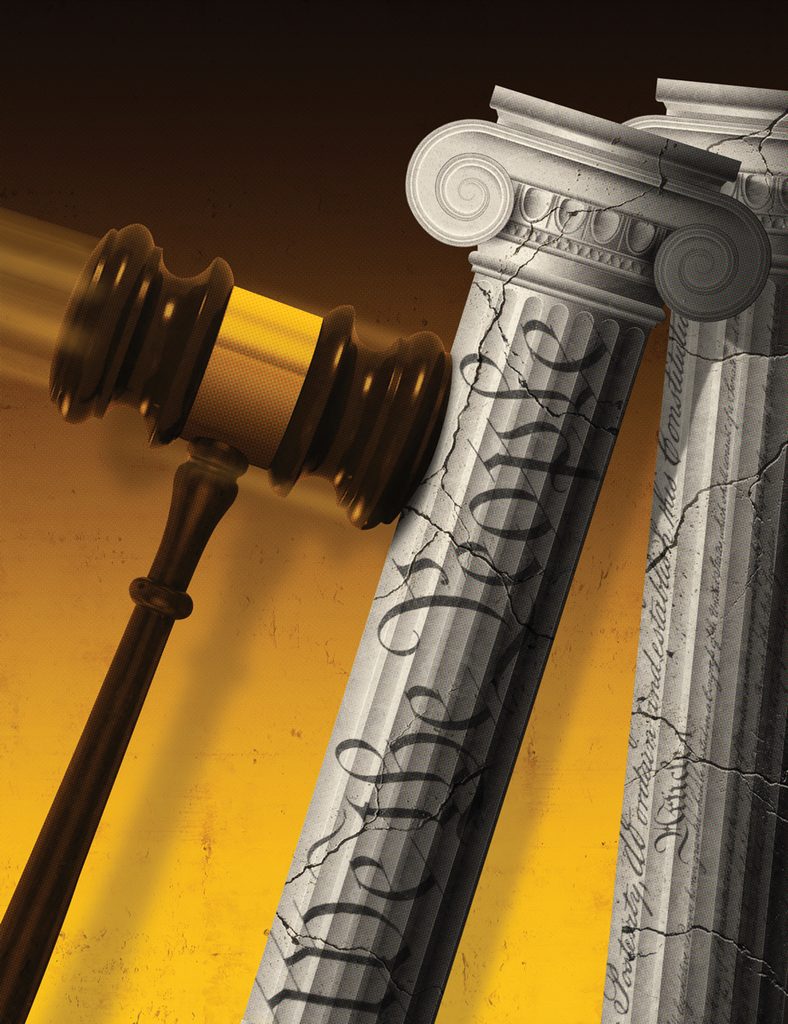
The first of the unstated ideas I call the “three buckets” picture of the federal government’s structure. We usually speak of the three major divisions of the government—legislative, executive, and judicial—as the three “branches.” This is an attractive metaphor, suggesting that each of the divisions emanates from a single tree.
My claim is that the three branches have silently morphed into three buckets, with the further implication that every agency, commission, or chartered federal corporation must be located “in” one of the buckets. The unstated idea that every federal entity must be “in” one of the three branches is why I call this the “three buckets” idea: Everything must go in one bucket or another.
Why has the three buckets picture contributed to the deformation of the Constitution? The reason is that we have a pretty clear notion of the basic function of two of the three buckets. The basic function of the legislature is to enact federal statutes—the laws of the United States. The basic function of the judiciary is to resolve cases and controversies between adverse parties. The basic function of the Executive is . . . much less certain.
As Michael McConnell shows in his recent book, The President Who Would Not Be King, the Framers had no clear conception of what is entailed by the “executive power.” They basically took Blackstone’s list of the prerogatives of the King of England and gave some to Congress, some to the President, and eliminated others altogether. Over time, some aspects of the executive power have come into focus. We have come to regard the President as the “sole organ” who speaks for the United States in matters of international relations, even though the text of the Constitution sends mixed signals about this.
But in domestic affairs, the exact role of the President has remained contested. A key dilemma is what the Framers had in mind by imposing a duty on the President to “take Care that the Laws be faithfully executed.” Does this mean (for one, very current example) that the President must be able to fire any employee in the federal government (a workforce more than 2 million in number) whom he deems to be “unfaithful”? Or does it mean simply that the President must make do with his power to appoint principal officers of the government (subject to confirmation by the Senate) and otherwise abide by whatever provisions regarding removal from office Congress has enacted?
What is the upshot of the uncertainty about what is included in the executive power, once we have embraced the three buckets picture of the federal government? It is quite simple. If some federal entity is not part of Congress, or is not part of the judiciary, then under the “three buckets” idea, it inevitably follows that it must be in the executive branch. The executive bucket becomes a kind of residual container into which everything pours that cannot be clearly located in one of the other two buckets, which are much more clearly delineated.
This picture of the three buckets becomes deformative when combined with another idea that is explicitly and repeatedly asserted by the President’s lawyers—the idea of the “unitary executive.” Ever since the Reagan administration, lawyers working in the executive branch have asserted that the President must have the authority to control everything that happens in the executive branch. This advocacy has paid off: The Supreme Court has embraced the idea nearly in full—from the 2024 Trump immunity decision to a series of decisions giving the President the authority to remove the heads of administrative entities.
The justification for the unitary executive idea is the vesting clause of Article II of the Constitution, which says that “[t]he executive Power shall be vested in a President of the United States of America.” The unitarians argue that this means all executive power must be subject to the control of a single person—the President. This is a lot of weight to put on the use of a singular indefinite article—“a”—in an introductory clause of an Article of the Constitution, but let that pass.
The point is this: Once the legal system encompasses an unstated idea—that the executive branch is a residual bucket into which all government activity flows that cannot be ascribed to the legislative or the judicial buckets—and this is combined with an expressly stated idea that everything in the executive bucket must be controlled by the President, what do you get? You get a federal government in which the President exercises enormous power.
Perhaps if we had a fairly narrow conception of the executive power—as, say, the power to determine when to initiate enforcement actions by the federal government—the unitary executive thesis would not be so destabilizing. Maybe the Federal Trade Commission, which has the power to sue to enjoin certain mergers, should lose its ability to perform this function without presidential control. But once the unstated idea of three buckets takes hold, and is combined with a zealous faith in the notion of a unitary executive, then everything in a very large and residual bucket falls within the discretionary control of the President.
But wait, you may be thinking, the Constitution mentions only three branches of government. If that is the foundation of the three buckets idea, what is the alternative? The answer may be “departments.”
The Constitution mentions “departments” several times, but it does not consistently indicate that they must be subordinate to the President. At one point, it refers to “executive Departments”: The President has the authority to request the opinion in writing of “the principal Officer in each of the executive Departments, upon any Subject relating to the Duties of their respective Offices.” Conceivably, this betrays an assumption that all “Departments” are in the executive branch. But if the unitary executive proponents are correct, it is puzzling, to say the least, why the Framers felt that it was necessary to give the President explicit authority to request the opinion in writing of the heads of executive departments. According to the unitarians, the President can fire any principal officer in the executive branch at any time for any reason; if so, then there would obviously be no need to authorize the President to request this person’s opinion in writing. (The President could just say, “Your opinion, please, or you are fired.”)
In other places, the Constitution simply refers to “Departments” without the qualifier “executive.” Congress has the power to make all laws necessary and proper for carrying into execution the powers vested “in any Department.” And appointments of inferior officers may by law be vested in the “Heads of Departments.” The fact that references to “Departments” in these instances are not qualified by the modifier “executive” suggests that the Framers did not rule out the creation of “Departments” having no specific location within the three principal branches.
[As] to other federal institutions that may be created by Congress . . . , the Constitution does not mandate any particular “location” of the entity in terms of the three named branches.
All of which suggests another way to picture the structure of the federal government established by the Constitution: The Constitution clearly spells out the powers of what can be called, in Professor Peter Strauss’s term, the three “apex” institutions—the Congress, the President, and the Supreme Court. But as to other federal institutions that may be created by Congress, pursuant to its powers under the Necessary and Proper Clause, the Constitution does not mandate any particular “location” of the entity in terms of the three named branches. To be sure, these lesser entities must be established by law, and they have only the power given to them by the laws that create them. And if Congress is wise, it will provide for judicial review of the exercise of power by these entities to assure that they do not exceed the powers given them by law.
There is reason to believe that this alternative picture of the architecture of the federal government is the one that has prevailed through most of our history. Consider the creation of the Interstate Commerce Commission (ICC) in 1887. Congress created the ICC in response to a practical problem. The Supreme Court had held that state railroad commissions could not constitutionally regulate the rates charged by railroads on interstate movements. So unless these rates were to remain unregulated, it was necessary to create a federal regulator.
Congress responded by establishing a five-member commission, with members appointed by the President subject to Senate confirmation, serving for staggered six-year terms. No more than three commissioners could be from the same political party, and commissioners could be dismissed only for “inefficiency, neglect of duty, or malfeasance in office.” Complaints about railroad rates were filed by aggrieved shippers. The commission’s resolution of these complaints was subject to review by the federal courts, which had exclusive authority to enforce the commission’s orders.
Was this an unaccountable “fourth branch” of government, whose very existence violated the Constitution? No, the ICC was “multiply” accountable. Its powers and duties were established by law, enacted by Congress with the President’s approval. Its commissioners were appointed by the President, with the advice and consent of the Senate. Its decisions and orders were reviewed by the federal courts, to assure that they complied with the law.
No one at the time agonized over whether this was an entity located in the executive branch, the legislative branch, the judicial branch, or no branch at all. If anything, it was regarded as a kind of specialized court, whose orders could only be enforced by an Article III court. As a practical solution to a pressing problem, the ICC served as the model used by Congress in creating a slew of federal regulatory agencies, including the Federal Reserve Board, the Federal Trade Commission, the Federal Communications Commission, the Securities and Exchange Commission, the National Labor Relations Board, and the Federal Energy Regulatory Commission.
The Supreme Court has concluded this year that “for cause” limitations on removal of the members of most of these independent commissions are unconstitutional, because under the three buckets picture of the structure of the federal government, they all belong in the executive branch, and under the unitary executive theory, all such commissioners must be removable at the will of the President. This ruling means these specialized regulatory bodies have become, effectively, departments of the executive branch.
The Court is uncomfortable, as it should be, with the idea that this means the independence of the Federal Reserve Board will be destroyed and the President will henceforth be in charge of setting interest rates. But the Court should be worried about much more. Most of these commissions make decisions that have profound implications for economic actors who need some assurance of stability in government policy. However imperfectly, commissions composed of multiple members from both political parties serving staggered terms are designed to promote stability in policy relative to what one would get under a regime of presidential executive orders.
Moreover, consider that the model of three buckets has resulted in extravagant claims of presidential authority over other types of government activities such as remodeling the White House and the reflecting pool on the National Mall in Washington, D.C., modifying the captions on exhibits in the Smithsonian Institution, and renaming the John F. Kennedy Center for the Performing Arts (as the Trump-Kennedy Center). By the same logic, the three buckets model would seem to allow the President to dictate the routes served by Amtrak, a federal corporation, or the rates for electricity charged by the Tennessee Valley Authority, another specialized federal entity.
If all this seems like extremism, it is, and we can thank President Trump for revealing the ultimate implications of the unstated three buckets model of the federal government.
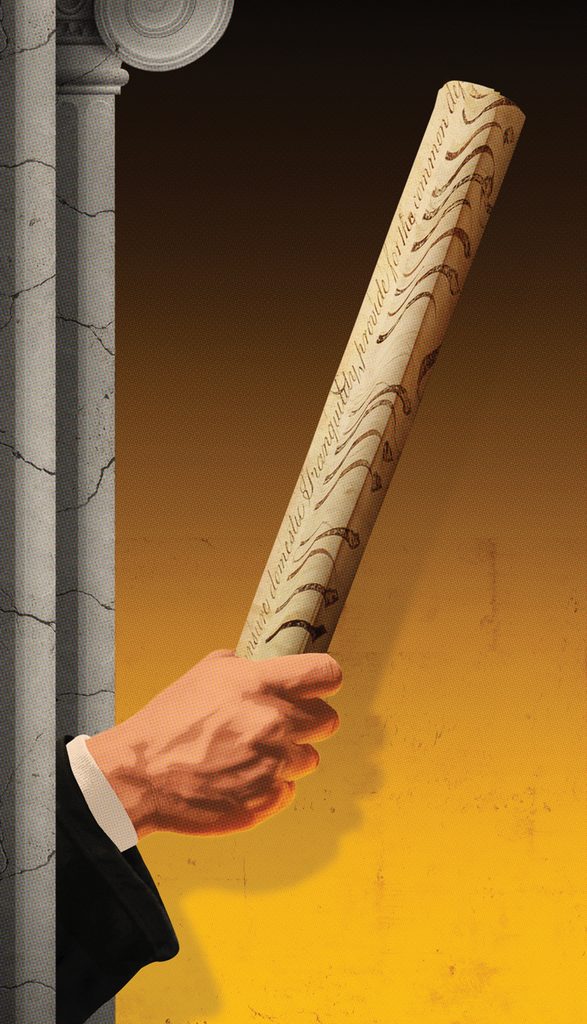
The Framers of the Constitution were clearly influenced by the idea of separation of powers, and they followed Montesquieu in organizing the federal government into three major branches. But they also rejected any notion that the three branches should be strictly confined to the performance of a single function. Instead, the Constitution was designed so as to “divide and arrange the several offices in such a manner as that each may be a check on the other” (again, Madison in The Federalist No. 51). Or as Madison wrote in another essay (The Federalist No. 48), quoting his friend Thomas Jefferson, “the powers of government should be so divided and balanced among several bodies of magistracy, as that no one could transcend their legal limits, without being effectually checked and restrained by the others.”
The three buckets picture of the government represents an unstated reversion to the concept of a strict separation of powers, with each branch performing its designated function, except that one branch—the executive, originally thought to be inconsequential relative to the legislature—can now perform any function. The more important idea of checks and balances has evidently been forgotten.
One-Way Delegation by Congress
The second “unstated idea” concerns the delegation of authority by Congress. There is, of course, the longstanding complaint that delegations by Congress should be reined in, so as to force Congress to legislate with greater specificity. This has given us agitation, most prominently by Justice Gorsuch, to overturn the longstanding doctrine that delegations are permissible so long as they include an “intelligible principle” guiding the exercise of discretion (the oft-quoted phrase comes from a 1928 case). The claim is that a more restrictive doctrine is required. More recently, it has given us the “major questions doctrine,” which says that far-reaching and controversial exercises of delegated authority will be set aside by the courts absent clear authorization by Congress. These are not unstated ideas—they are quite vigorously asserted and debated.
Rather, I am concerned with two other aspects of congressional delegation that are unstated but have contributed greatly to the deformation of our constitutional structure.
The first concerns an extremely casual attitude to certain types of delegation to the President or one of the many administrative agencies. The case against delegation rests on the proposition that the Constitution, in the first sentence of Article I, gives “[a]ll legislative Powers” to Congress.
One would therefore assume that sensitivity to delegation would be at its height when the President or some regulatory agency claims the power to issue so-called “legislative rules”—regulations that have a force and effect similar to a statute’s. At one time, the courts were very cautious about such delegations, and said they would refuse to recognize agency rules having the force of law unless Congress explicitly authorized them.
In more recent decades, however, the Court has adopted something of the opposite presumption: that any statute that mentions “rules” or “regulations”—even if this could plausibly mean housekeeping or procedural rules—also includes the authority to issue legislative regulations, i.e., rules that are functionally equivalent to mini-statutes. This newer presumption, which has never been justified by the Court in any considered decision, has the effect of permitting the transfer of lawmaking authority from Congress (whether this was intended or not) to administrative actors and the President. To make the obvious point explicit: The unstated assumption that any reference to rules means authority to make binding legislative regulations has resulted in a very large transfer of legal authority from Congress to the Executive.
The other aspect of delegation that remains unstated works in the opposite direction: the assumption that Congress cannot delegate legislative authority to itself or to any entity that Congress controls. The starting point for this development is the famous 1983 case, Immigration and Naturalization Service v. Chadha, that held that the so-called legislative veto is unconstitutional. The decision includes an elaborate discussion of the Constitution’s provisions for enacting a law: A bill must be adopted by both houses of Congress in identical form and must then be presented to the President for signature or veto. The statute at issue in Chadha had followed these procedures; it passed both houses and was signed by the President. The statute delegated broad authority to the attorney general to withhold the deportation of undocumented immigrants if certain equitable conditions were met.
But there was a condition: the decision to withhold deportation had to be communicated to the relevant committees of Congress with an explanation, and if either the Senate or the House committee disagreed with the decision, it would be disapproved. The Court held that the provision allowing a committee to disapprove the decision to withhold deportation was a “legislative act,” because it changed the legal status of persons outside the legislative branch. As such, it violated the provisions of the Constitution spelling out how Congress can enact a statute.
But what about the delegation to the attorney general? This, too, changed the legal status of persons outside the legislative branch. In a footnote, the Court said that the delegation to the attorney general to withhold deportation was not a legislative act because . . . well, because this was a decision by the Executive, and each branch is presumed to act in accordance with its designated constitutional authority.
Justice White, dissenting in Chadha, pointed out the question-begging nature of the Court’s analysis. What the decision amounted to, as would be confirmed by later decisions, is that Congress may delegate legislative authority to the executive branch, but may not delegate similar authority to itself, a subunit of itself, or a legislative agent.
Maybe there were sound reasons for the distinction between delegations of legislative powers to executive agencies and delegations to congressional agents. But if so, they were basically unstated.
The proposition that a principal, in an otherwise proper act of delegation, can delegate only to a stranger and not to a subordinate with express authority is not reflected in general agency law. The Court in Chadha held that the “single, finely wrought” procedure for enacting a law binds Congress but does not bind the Executive. Maybe there were sound reasons for the distinction between delegations of legislative powers to executive agencies and delegations to congressional agents. But if so, they were basically unstated.
To make matters worse, Chadha and follow-on decisions declared that any legislative veto could be severed from the statute and the remainder of the act upheld without it. The effect was to declare unconstitutional legislative vetoes that had been enacted by Congress in nearly 200 statutes as a condition of delegating authority to various executive authorities. Rather than giving Congress an opportunity to reconsider these delegations, the Court decided that the provision for the veto could be struck from the acts, leaving an unconstrained delegation to the Executive.
Finally, the Court extended the principle of Chadha beyond units of Congress itself to officers and agents of Congress insofar as they can be characterized as “executing” the law. In particular, in Bowsher v. Synar (1986), the Court found major legislation designed to reduce chronic deficit spending unconstitutional, because it called for the participation of the comptroller general, deemed a “legislative” officer, in certifying the magnitude of the needed cuts in spending. The Court held that the Constitution permits no sharing of the executive power with a congressional agent; by placing responsibility for executing the law partly in the hands of an officer responsible to the legislature, “Congress in effect has retained control over the execution of the Act and has intruded into the executive function.”
Cumulatively, these decisions—invalidating the legislative veto, declaring such vetoes severable from the underlying delegations to the Executive, and barring congressional agents from participating in any execution of law—transferred enormous power from the Congress to the Executive.
The policy impact has been considerable. Starting in 1929, Congress enacted a series of
statutes delegating broad authority to the President to reorganize the federal government, subject to disapproval. Over the years, Justice White explained in his Chadha dissent, “Presidents submitted 115 Reorganization Plans to Congress of which 23 were disapproved by Congress pursuant to legislative veto provisions.” In the wake of Chadha, Congress allowed these authorities to lapse. The result has been to make it much more difficult to improve the efficiency of the federal government.
Two justices, in the recent argument and decision concerning President Trump’s effort to impose tariffs under the International Economic Emergency Powers Act or IEEPA, have belatedly recognized that the Chadha decision has created a one-way ratchet transferring unchecked power to the President. Broad emergency powers like those given in IEEPA were delegated to the President in statutes passed before the Chadha decision—the expectation being that the power would be exercised reasonably, and if not, Congress could override the President’s action with a legislative veto. Now, the only way to rescind these broad delegations is by new legislation, which the President would almost certainly veto. Chadha’s unstated principle that Congress cannot delegate to itself or to a legislative agent has resulted in an enormous transfer of power to the Executive, and a corresponding deformation of the Constitution.
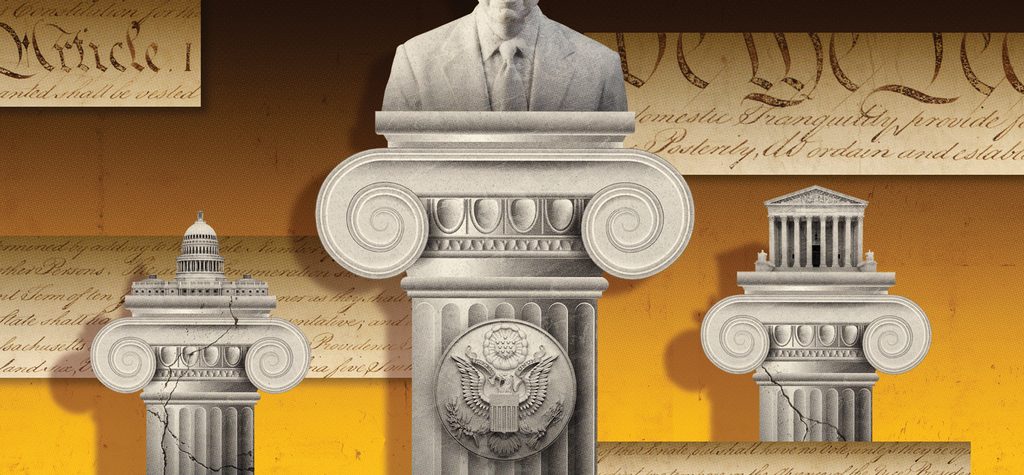
The Rise of Law Declaration by the Supreme Court
My third and last unstated idea concerns the Supreme Court’s conception of its role. Students of the Court have identified two polar ideas about how the Court conceives of its role.
One, which should be familiar, is called “dispute resolution.” The Court conceives of its job as resolving disputes between adverse parties, especially when the lower courts have disagreed about the proper disposition of the matter.
The other, which commentators have labeled “law declaration,” conceives of the Court’s role as identifying certain important legal issues and resolving those issues without actually deciding disputes between adverse parties. Instead, the Court concentrates on clarifying contested questions about the law and lets the lower courts sort out how to apply the law in the case at hand.
The Court’s conception of its role in its recent opinions must be regarded as mixed; one in an uncharitable mood might call it schizophrenic.
For one thing, the Court insists that the authority of federal courts must be confined to resolving actual disputes. This is encapsulated in the law of standing. Federal courts, including the Supreme Court, can only hear actual cases and controversies between adverse parties. The plaintiff must show that it has suffered an injury that is concrete and particularized and actual or imminent, the defendant’s action caused the injury, and a ruling for the plaintiff would make the injury go away. Every term, the Court declines to decide one or more cases for failing to qualify for standing under this elaborate matrix of factors.
I will not say much about this aspect of the Court’s jurisprudence, other than to note that the law of standing has become so complex and unpredictable that, for the Court itself, it serves primarily as a docket-control device. One day the Court decides that it wants to decide whether the government can cancel student loans. Another day it decides that it does not want to decide whether government pressure on social media firms to censor speech violates the First Amendment. And so forth.
The Court also operates in a dispute-resolution mode in an increasingly important part of its work, variously called the shadow or interim or emergency docket. This often involves cases in which federal district courts have granted injunctions against various executive actions, whereupon stays are sought on an accelerated timetable from the appeals courts and ultimately the Supreme Court. It is common for the Court either to grant or to deny a stay in a one-line judgment with no explanation. Sometimes one can figure out the rationale from reading opinions concurring in or dissenting from the judgment; other times the Court will hastily draft an opinion explaining its action. Frequently, however, the Court enters judgments—stay or no stay—without any substantial explanation.
Let us turn more squarely to the plenary docket, the mainland of the Court’s work, even if it has been steadily shrinking the past several decades. Here the Court increasingly operates in the law-declaration mode. Frequently, the Court grants full review only in cases presenting questions of general importance; concentrates on resolving those questions, often in lengthy opinions with multiple concurrences and dissents; and then sends the case back to the lower courts to apply the new or clarified understanding of the law to the facts presented by the case.
In effect, the Court proceeds in the dispute-resolution mode when discussing the law of standing and resolving applications for stays on its emergency docket and then shifts to the law-declaration mode in deciding cases on the merits on its plenary docket. To overstate the matter in a deliberately provocative way, the Court either issues judgments without opinions or opinions without judgments. That this is the proper way for the Court to proceed is an unstated idea that it has never expressly addressed or defended.
As to the law-declaration mode that increasingly prevails on the shrinking plenary docket, there are several reasons for concern. One is that it encourages the Court to make broad pronouncements about the law, in a way that may overlook certain nuances or complications that would be revealed if the Court actually undertook, well, to decide the case.
A good example might be Loper Bright Enterprises v. Raimondo, the 2024 case that overruled the Chevron doctrine. The doctrine was named after the Court’s 1984 decision in Chevron U.S.A. Inc. v. Natural Resources Defense Council, Inc., which gave rise to a presumption that courts should defer to agency interpretations of ambiguities in their authorizing legislation.
The Court’s opinion offered a detailed exposition of the dispute that gave rise to Loper Bright, but it then proceeded to ignore that dispute and discoursed in very broad terms about the proper relationship between courts and agencies in resolving questions of law. The broad holding was that courts must exercise independent judgment about the meaning of the law in every case and should not defer to agency interpretations except in limited circumstances.
The Court then remanded to the lower courts to apply the new understanding. It did not concern itself at all in its legal analysis with the substance of the regulation by the National Marine Fisheries Service requiring herring fishing ships in the Atlantic to provide on-board monitors in order to ensure compliance with rules against overfishing. The statute sent conflicting signals about whether the ships could be required to pay for the monitors at their own expense, Congress having appropriated insufficient funds for this purpose.
If the Court had actually applied the new regime to the dispute, it would have had to struggle with a knotty legal problem and grapple with serious practical considerations. Who knows? Perhaps this might have produced a more qualified ruling. In all events, it would have been more illustrative.
A weightier concern is that the law-declaration mode casts the Court in the role of lawmaker. To be sure, the Court generally frames its exercises in lawmaking as interpretations of enacted laws. But as these enactments become more infrequent and increasingly remote in time, the Court inevitably relies on cobbling together pronouncements appearing in its own past decisions. In so doing, the Court increasingly takes on the aspect of a Council of Revision, something the Framers of the Constitution specifically rejected.
Flexing its law-declaration muscles, the Court becomes an ever-more consequential policymaker, occupying territory previously belonging to Congress or the states. Not across the board: For the most part, the Court leaves foreign and military policy to the President, as well as economic regulation, and confines itself to domestic affairs, especially questions of social policy. But it is not too far-fetched to see where this might be headed: foreign, military, and economic policy run by an imperial presidency, and social policy run by a Council of Revision called the Supreme Court. Whether or not this makes sense as a division of governmental authority, it bears little resemblance to the framework established by the Constitution.
Perhaps the greatest risk posed by the Court’s turn to the law-declaration mode is that a powerful president may someday call its bluff. Over the years, a number of thoughtful observers, including Abraham Lincoln, have concluded that the Executive has an unyielding duty to obey judgments rendered by courts but is free to disagree with the explanations for those judgments given in the courts’ opinions. By adopting the law-declaration mode in its plenary docket, the Supreme Court has implicitly decided that it does not do judgments. What matters is the view of the law expressed in its opinions. Indeed, the Court has come to regard its opinions as a type of law, binding on lower courts and other government and nongovernment actors alike.
This raises the danger that some self-confident president will simply refuse to comply with the Court’s view of the law as expressed in its opinions. It is not even clear that the President would be wrong to do so. The United States Marshals Service has a statutory duty to enforce not opinions but judgments (“all lawful writs, process, and orders”). Indeed, it is possible—I have no proof of this—that the Court is already sufficiently anxious about this happening that it has gone out of its way to avoid crossing the President. If so, there goes another possible constraint on the President, and here comes another deformation of the Constitution.
*****
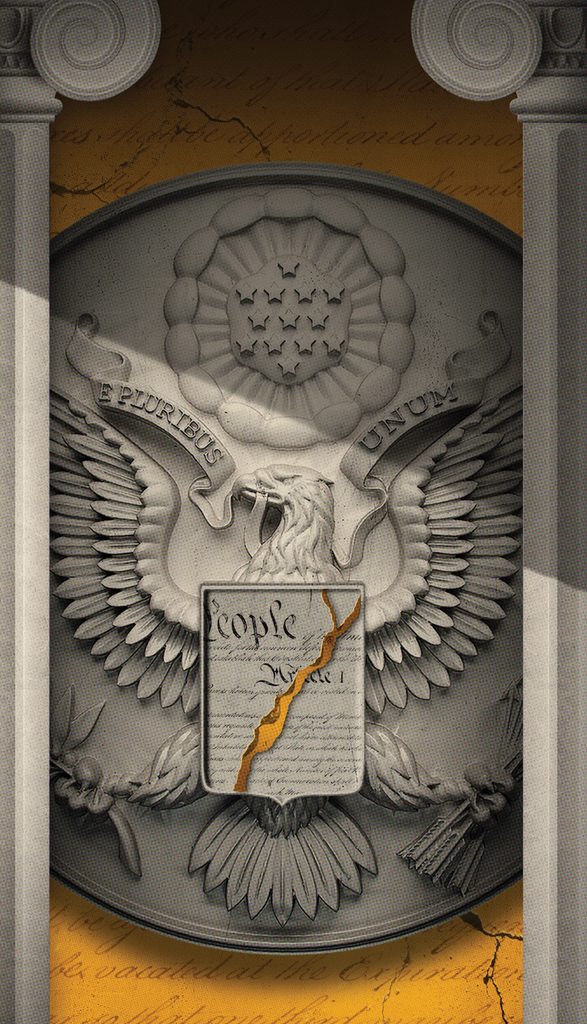
As I said at the outset, there are many possible explanations for the decline of Congress and the rise of the President and the courts. Perhaps the unstated legal ideas I have discussed are merely rationalizations for the deformation of the Constitution brought about by these other forces. But I think ideas have consequences.
The three buckets idea has resulted in the assumption that the President must be in charge of everything not given to Congress or the courts, and has been invoked repeatedly to augment the power of the presidency.
The unstated idea that legislative power can be delegated to the Executive, but not to a subpart or agent of Congress to provide a check on the Executive, has created a one-way ratchet expanding the power of the President and sidelining the role of Congress in constraining the President.
The Supreme Court’s turn to the law-declaration mode in deciding cases has given it authority over matters of social policy formerly enjoyed by the people or the legislatures, but in so doing has rendered the authority of the Court itself precarious.
It is quite important that these ideas be exposed and debated. Otherwise, we have no realistic hope of restoring the oldest continuing constitution in the world to its recognized form.
This article was first featured in the Fall 2026 issue of Marquette Lawyer Magazine.