Dr. Dan Scholz knows firsthand the difference one teacher can make in a student’s life. He vividly remembers feeling defeated while struggling to spell the word “cotton” during a fourth-grade spelling bee. Instead of criticism, his teacher, Mrs. Cunningham, offered kindness and understanding.

“I know it was over 50 years ago, but I remember feeling overwhelmed — all I wanted to do was go outside for recess, so I started crying, and Mrs. Cunningham pulled up her chair right next to me and said, ‘Danny, what’s wrong? Danny, look at me.’ I looked at her, and she said, ‘Go to recess,’” Scholz recalls. “Mrs. Cunningham was the first teacher that I ever looked at in the eyes. That day changed my life. It helped me understand what it means to be a really good teacher. You’re not going to be a good teacher unless you love your students.”
That interaction reshaped how Scholz saw himself and ultimately defined his philosophy of teaching and leadership.
Now, as the director of the Catholic Schools and Parishes Initiative at Marquette, Scholz uses the Jesuit principle, cura personalis (or “care for the whole person”), in his daily life, the same way Mrs. Cunningham did decades earlier.
Closing a gap and building new partnerships
Since joining Marquette in 2024, Scholz has focused on expanding the Catholic Schools and Parishes Initiative — a program designed to offer professional development and formation for parish leaders and Catholic school educators, a gap left by the closing of Cardinal Stritch University in 2023.
Drawing on his 40 years of experience in Catholic education, Scholz works closely with the Archdiocese of Milwaukee to connect Marquette’s resources directly with the practical needs of area Catholic schools and parishes. Now in its third academic year, the initiative relies on an advisory council of Marquette and archdiocesan leaders to strengthen these community partnerships and advance shared educational goals.
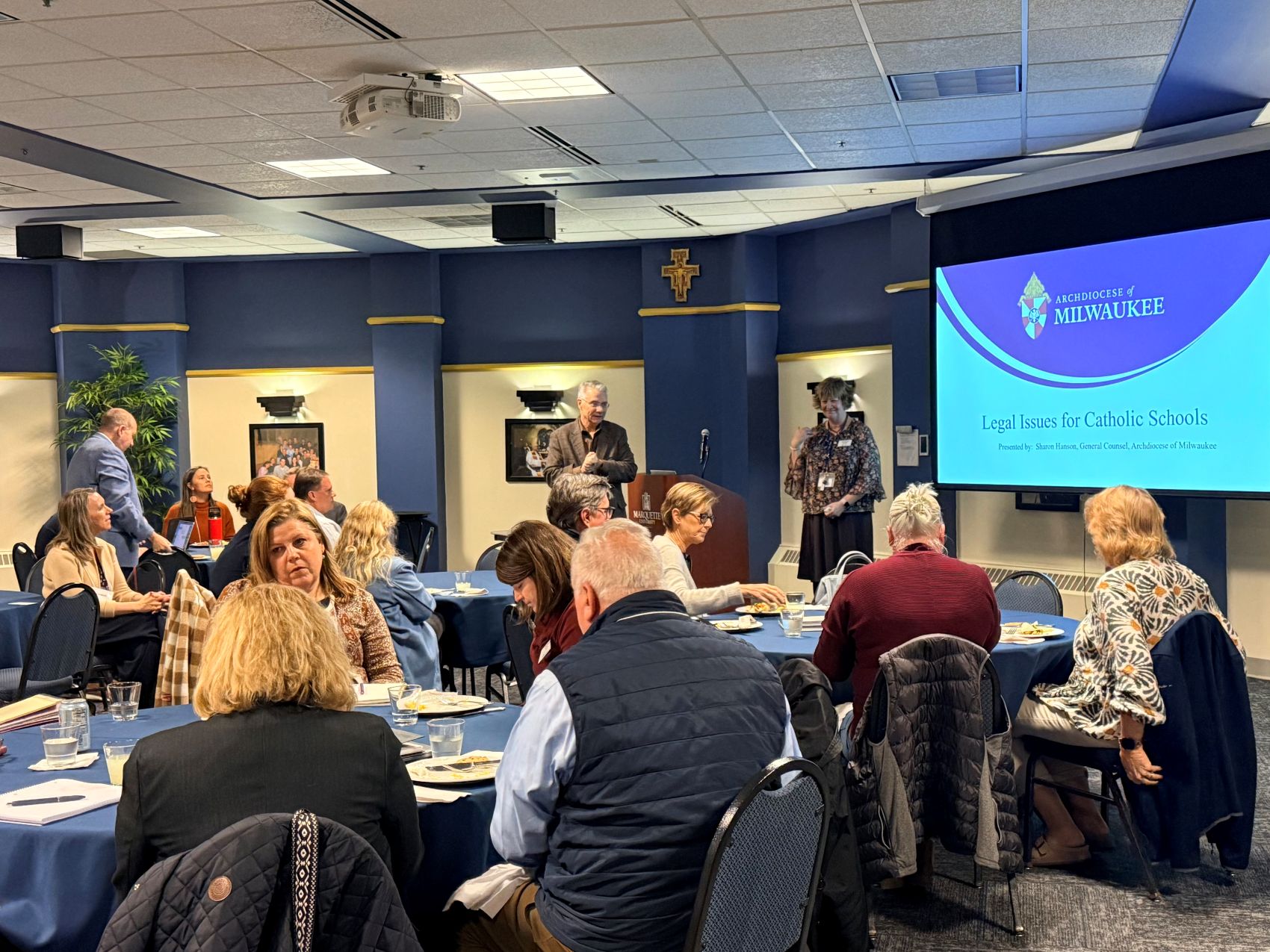
“On the school side of programming, we have worked with about 10 schools a year on strategic planning,” Scholz explains. “I tap into either current or recently retired Catholic principals and Catholic school leaders within the Milwaukee Archdiocese to help us facilitate strategic planning with schools. We are also involved in special education programming. Dr. Leigh van den Kieboom, associate dean and professor at the School of Education, spearheaded an annual conference on inclusive education and a special education licensure for our Catholic schools. We currently have 102 Catholic schools in the Milwaukee Archdiocese.”
Ed Foy, superintendent of Catholic Schools with the Archdiocese of Milwaukee, is on Scholz’s advisory council and works closely with him. Foy says the partnership has already been a positive collaboration.
“We have supported conferences to advance special needs inclusion in Catholic schools, individual schools have been guided through data-driven strategic planning, and Catholic school leaders are having in-depth critical conversation with Marquette staff about the most critical challenges facing educators,” Foy says. “As the partnership grows, I want every Catholic school leader to naturally identify Marquette as their partner for driving excellence in our schools.”
Initial pilot school
St. Robert School in Shorewood was part of the initial pilot to test whether strategic planning methods used in higher education could apply to Catholic elementary schools. By creating templates aligned with the national Catholic school standards used by the archdiocese, Scholz helped implement the fourfold framework of Catholic identity and mission, academic excellence, operational vitality, and governance and leadership.
Lucas Stangler, principal at St. Robert School, says the initiative has helped strengthen their Catholic identity by helping students better understand the virtues of the Catholic faith.
“This wasn’t just a strategic plan created for our community — it was a strategic plan developed with our community,” Stangler emphasized. “That sense of shared ownership is what makes the process so meaningful and gives the plan the potential to have a lasting impact. Ultimately, the process helped us move beyond simply identifying areas for improvement and toward establishing a more intentional, organized approach to addressing them. It provided a framework for guiding our decisions, prioritizing our efforts and continually working toward becoming a stronger Catholic school community.”
The initiative also supports parishes by training pastoral staff across the Milwaukee Archdiocese. Through its “Formed for the Call” workshop series, the initiative strives to serve the over 600 lay employees serving in pastoral roles across more than 170 parishes.
Brenda Cline, executive director of the Department of Parish and Diocesan Life at the Milwaukee Archdiocese, serves on Scholz’s task force for lay leadership and on the advisory council for the initiative.
“As an archdiocese, one of our goals is to support priests and their lay professional staff in the leadership and formation of their parishes,” Cline says. “By partnering with Marquette, we are able to co-sponsor professional development programs for parish leaders.”
In addition to the “Formed for the Call” workshop series, the initiative also offers an annual Advent and Lenten Retreat days for pastors and their pastoral staff to foster effective teamwork and recharge their spiritual batteries.
Stangler says working with Scholz has been one of the most valuable professional experiences as a principal.
“What excites me most is knowing that the work we began together at St. Robert has the potential to benefit so many other Catholic schools and parishes in the years ahead,” Stangler says. “I truly believe this initiative can have a lasting impact on Catholic education, and so much of that potential comes from Dan’s vision, dedication and the exceptional person he is. I cannot speak highly enough of him or the work he is doing.”