
Professor Alan Jenkins of Harvard Law School delivered the annual Robert F. Boden Lecture, titled “Why Stories Matter: Narrative, Law, and Justice,” on May 12, 2026, at Marquette Law School. Marquette Lawyer also engaged him in a written exchange, and we excerpt his comments here.
The Value of “Compelling Narrative”
I’ve been fortunate to have had a diverse career spanning litigation, philanthropy, strategic communications, writing, and now teaching. What connects those choices are the themes of storytelling, law, and justice. I’ve tried through my work to defend human rights and expand opportunity for all, and I’ve come to understand that the power of storytelling is an essential element in that endeavor.
In one of my first legal jobs, as associate counsel at the NAACP Legal Defense and Educational Fund (long called the “Inc. Fund” and now known simply as LDF), I represented a Black community in the South Carolina Sea Islands that was facing both racial discrimination and economic exploitation. Working with colleagues, I developed a legal case and also a communications strategy designed to advance our position in the court of public opinion. The case settled quickly and relatively favorably for my clients, in contrast to civil rights cases that I’d seen take years or even decades to resolve. The outcome reinforced my intuitive sense that the law is a more powerful tool when paired with a resonant public story.
My time in the Office of the Solicitor General in the U.S. Department of Justice further bolstered that conclusion, but from a much different perspective. In working on dozens of Supreme Court cases and arguing four during my time there, I saw that storytelling is important in that rarified context as well. Mastery of the relevant law and facts is crucial and primary. But even a strong legal and factual case can fail without a compelling narrative rooted in values that at least five justices share. In my experience, narrative is often the “secret sauce” to effective brief-writing and oral argument.
In my next job, at the Ford Foundation, I was able to pursue these ideas with more intentionality. As a program officer and then the director of human rights at Ford, I was exposed to hundreds of advocacy organizations and dozens of legal systems around the world. I saw that some of the most effective nongovernmental organizations or NGOs—especially outside of the United States—seamlessly integrated legal and policy advocacy with public education and cultural engagement. I’m reminded, for example, of an organization that we supported in Uruguay devoted to fighting racial discrimination and upholding the human rights of people of African descent. The group investigated rights violations, submitted reports to international bodies, and assisted displaced communities. It also maintained a book repository, an Afro-descendant music program, and an exhibition of Black culture. The organization’s leaders recognized that communicating the history, struggle, and humanity of Black communities was vital to securing full and equal rights under the law.
I wanted to learn more. So I obtained a master’s degree in media studies while working at Ford and began supporting communications and cultural interventions in the United States as well as abroad. That work ranged from building the communications capacity of human rights organizations, to supporting independent investigative journalism, to underwriting documentary and fictional film and television shows exploring issues of rights and justice. Many of those projects proved to be game changers over time, moving hearts, minds, and policy on issues such as the death penalty, marriage equality, and racial profiling. And, for me, they were critical sources of learning about the theory and practice of narrative change.
Artists and Entertainers as Social Change Agents
I eventually left the Ford Foundation to cofound The Opportunity Agenda, a social justice communication lab. Working with cofounders Phoebe Eng, Brian Smedley, and Bill Lann Lee, we built an organization that collaborated with social justice leaders on media campaigns, while building the communications capacity and coherence of the sector. Our work traversed tough issues such as immigration, housing, criminal justice, racial equality, and poverty, and our partners included advocates, organizers, faith leaders, labor and business leaders, and others. Over the course of a dozen years, we helped score important victories at the federal, state, and local levels.
Over time, moreover, we found that artists and entertainers were important—and often neglected—social change agents. Research and experience show that art and culture can engage and persuade people who might be resistant to traditional argumentation. They can inspire even cynical audiences and build empathy across lines of difference. And, crucially, artists can depict not only the world as it is, but also the world as it could be—what John Paul Lederach calls “the moral imagination.”
With that insight in mind, we hosted an annual “Creative Change” retreat that brought together artists, entertainers, advocates, and donors around the shared values of opportunity, human rights, and the common good. Those convenings, in turn, hatched a steady stream of cultural interventions that moved the needle on critical policies and mass behavior. A great example is The Climate Ribbon, a public art installation first displayed in New York City, described by its creators as “an arts ritual to grieve what each of us stands to lose to Climate Chaos, and affirm our solidarity as we unite to fight against it.” Born during one of our Creative Change retreats and carried out by a coalition of artists and advocates, The Climate Ribbon has since engaged hundreds of thousands of people around the world through a unique form of storytelling and cultural exchange.
At The Opportunity Agenda, we also amplified traditional legal advocacy through strategic communications. We filed Supreme Court amicus briefs on questions of fair housing, voting rights, language discrimination, and other civil rights issues, while building support for our position in the court of public opinion. We also combined policy advocacy with narrative change efforts to, among other things, improve the executive branch’s response to the economic recession, foster investment in fair and affordable housing, and recognize a state-based right to health care.
My position at Harvard Law School since 2019 gives me the privilege of sharing these insights with students and colleagues while learning from them in return. It’s been inspiring to see my students take these principles in new directions on the issues that they care about.
A large body of research across disciplines and over several decades shows that the way in which we communicate information influences how audiences receive, process, and act upon that information.
Teaching Storytelling to Law Students
In my course on narrative and Supreme Court jurisprudence, for example, we begin with the social science and theory of framing and narrative for persuasion. A large body of research across disciplines and over several decades shows that the way in which we communicate information influences how audiences receive, process, and act upon that information.
A striking study that I described during my Boden Lecture at Marquette was conducted by Lera Boroditsky and Paul Thibodeaux in 2011. They shared with two groups of randomly selected people a set of facts about crime in the fictional city of Addison. The facts were the same for each group, but in one group they used the metaphor of crime as a virus infecting Addison, and in the other group they used the metaphor of crime as a beast preying on the city’s residents. They then asked members of each group to suggest solutions to Addison’s crime problem.
Members of the “virus” metaphor group were significantly more likely to suggest addressing root causes and investing in prevention strategies such as reducing poverty and improving education, whereas members of the “beast” group were more likely to propose incarcerating perpetrators and enacting harsher punishment. The researchers found that placing the operative metaphors near the beginning of the story had a greater effect on participants’ proposed solutions, suggesting that the metaphors shaped how respondents “heard” and processed the information that followed. In fact, the choice of metaphor had a stronger predictive effect than did participants’ stated party affiliation (though that mattered, too). And, importantly, participants were largely unaware that the prevailing metaphor had influenced their thinking; when asked why they proposed particular solutions, they typically responded that it was based on facts and logic.
The influence of metaphors is only one of the “framing effects” that researchers in linguistics, sociology, political science, economics, and other disciplines have identified. Others that we explore in my classes include leading with shared values, using episodic versus thematic fact patterns, and choices about what information to include, exclude, or emphasize.
We then explore the broader question of how storytelling or “narrative” influences understanding and decision making. Narratives inevitably include framing selections, but they also often include heroes, villains, and victims; defining character choices; a clear beginning, middle, and end; and an explicit or implicit moral. Taken together, they inevitably convey unstated assumptions about how the world works, or how it should—what literary scholar Peter Brooks has called “doxa.” When they work, narratives help to establish the accepted “common sense.”
Story structure is a particularly important part of narrative. Effective stories move from an initial state of balance to a state of imbalance or “trouble,” following an inciting incident, to a restored or new balance. Consider, for example, the classic 1939 film The Wizard of Oz. In her initial balance, Dorothy Gale lives at home with her Aunt Em and “family” of farmhands in Kansas, but is deeply dissatisfied, desiring to go “over the rainbow.” There is an inciting incident—a tornado—that ostensibly grants her wish, taking her to the land of Oz. But there is trouble in this new state of affairs, including a threatening Wicked Witch of the West, news of Aunt Em’s illness back home—and lions, tigers, and bears, oh my! After defeating the witch, finding the wizard, and learning that she (and the other characters) had what they sought inside them all along, she returns to Kansas and her family. Although she is physically back where she started, it is an entirely new balance because she now understands that “there’s no place like home.”
The moral, of course, is that we already have what we need—love, smarts, courage—if only we can recognize and claim it. The film also possesses some attendant “doxa” or implicit worldviews, including that a teenage girl’s proper moral center is the home rather than exciting but dangerous adventures and that authority figures (embodied by the wizard) can be fraudulent but still socially useful.
The Power of Storytelling in the Supreme Court
Reading Supreme Court opinions through a narratological lens can tell us much about justices’ unstated assumptions, worldviews, intended audiences, and long-term agendas.
Reading Supreme Court opinions through a narratological lens can tell us much about justices’ unstated assumptions, worldviews, intended audiences, and long-term agendas. Decoding legal narrative, it turns out, is invaluable to understanding, practicing, and making the law.
An interesting example is Justice Neil Gorsuch’s concurrence in Loper Bright Enterprises v. Raimondo (2024). The Court in Loper Bright abandoned the interpretive principle of “Chevron deference,” under which federal courts had deferred to agencies’ reasonable interpretations of ambiguous statutes. Justice Gorsuch, who has emerged as a leader in the Roberts Court’s remaking of administrative law, tells us the story of the rise and fall of Chevron deference succinctly in the first paragraph of his opinion:
In disputes between individuals and the government about the meaning of a federal law, federal courts have traditionally sought to offer independent judgments about “what the law is” without favor to either side. Marbury v. Madison, 1 Cranch 137, 177 (1803). Beginning in the mid-1980s, however, this Court experimented with a radically different approach. Applying Chevron deference, judges began deferring to the views of executive agency officials about the meaning of federal statutes. See Chevron U. S. A. Inc. v. Natural Resources Defense Council, Inc., 467 U. S. 837 (1984). With time, the error of this approach became widely appreciated. So much so that this Court has refused to apply Chevron deference since 2016. Today, the Court places a tombstone on Chevron no one can miss. In doing so, the Court returns judges to interpretive rules that have guided federal courts since the Nation’s founding. I write separately to address why the proper application of the doctrine of stare decisis supports that course.
Consider the rhetorical choices that Justice Gorsuch makes in this brief introduction to his opinion. He describes an original steady state of independent judicial interpretation of statutes; an inciting incident (Chevron) and troubled disequilibrium of ill-advised judicial deference to executive agencies on such matters; and, in the Loper Bright case now before the Court, a restoration of the original balance with the demise of Chevron and a return to (in his view) the proper role of the judiciary. (I’m describing, not endorsing.) Along the way, he invokes the words of Chief Justice John Marshall (the original and, in a sense, ultimate narrator of the federal judiciary’s role); describes Chevron as a “radical” kind of “experiment”; and gives us the powerful metaphor of a “tombstone” to confirm the death of the old regime. In the body of his opinion, he identifies not only the Chevron precedent, but also executive agencies as powerful villains, “ordinary people” as victims of “the worst kind of regulatory whiplash,” and the Loper Bright majority as the vindicating heroes of the story.
None of these rhetorical choices are doctrinally necessary to Justice Gorsuch’s opinion. But together they tell a powerful and informative story. It’s a story that conveys volumes about the justice’s underlying factual assumptions, moral suppositions, and worldview regarding the administrative state and the Court’s role in it. For students of the law, perceiving and deconstructing that story will help immeasurably in understanding what the Court’s recent administrative law jurisprudence is about. For advocates, it provides crucial intelligence on how to choose and present future cases—and which cases to avoid bringing to the High Court. And for stakeholders in administrative law, it offers valuable insights into where the law may be headed, at least under the Court’s current composition.
Framing the Narratives of the Brown and Obergefell Decisions
Not all decisions are as “narratively rich” as Justice Gorsuch’s Loper Bright concurrence. But once we know what to look for, most opinions contain an informative and useful story. This is especially true of high-profile cases where the justices have an interest in public acceptance of their opinion as legitimate and correct.
Not surprisingly, Brown v. Board of Education in 1954 was such a case, in which a unanimous Court struck down school segregation in an opinion that at times reads more like an op-ed than a traditional judicial opinion. For similar reasons, Obergefell v. Hodges (2015), in holding that the Constitution requires marriage equality, employs a wealth of narrative tools. We spend a lot of time on Obergefell in my class, dissecting the framing and storytelling choices made by the justices on different sides of the decision.
A framing question is at the heart of Obergefell: Were the plaintiff couples seeking to join the institution of marriage in the face of state exclusion, or were they seeking to change marriage from an inherently opposite-sex institution to one that also embraces same-sex couples? Chief Justice John Roberts raised this framing choice explicitly during oral argument, asserting to the plaintiffs’ counsel, “[Y]ou’re not seeking to join the institution, you’re seeking to change what the institution is. The fundamental core of the institution is the oppositesex relationship and you want to introduce into it a same-sex relationship.” Justice Anthony Kennedy’s opinion for the Court rejects that framing. Saying that “[t]he history of marriage is one of both continuity and change,” he tells us that “[i]t demeans gays and lesbians for the State to lock them out of a central institution of the Nation’s society.” (Emphasis added.)
Attending to story structure and characters also helps us to fully understand Obergefell. Justice Kennedy’s opinion describes how each of the plaintiff couples fell in love (the initial balance), were denied the right to marry or have their marriage recognized by their state of residence (the trouble or imbalance), and must be allowed to honor their love through equal access to civil marriage (the new balance)—an institution that he describes as “intimate to the degree of being sacred.” The heroes of Justice Kennedy’s story are the plaintiff couples, but also the LGBTQ+ community and other activists, who through “pleas or protests,” have changed public perception and the constitutional understanding of the equal dignity of their community and their equal claim to marriage.
Notably, however, there are no villains in Justice Kennedy’s story. He tells us, instead, that “[t]he nature of injustice is that we may not always see it in our own times” and that “changed understandings of marriage are characteristic of a Nation where new dimensions of freedom become apparent to new generations.” In other words, as petitioners’ counsel Mary Bonauto said during oral argument, “times can blind,” and the states that denied marriage equality were among those so blinded.
In this respect, Obergefell is again similar narratologically to Brown, where the Court avoided any normative judgements about segregationists in its storytelling. But it is a stark contrast with Loving v. Virginia, the 1967 decision, 13 years after Brown, in which the Court invalidated anti-miscegenation laws as violative of the Fourteenth Amendment. In Loving, a unanimous Supreme Court asserted that “[t]here is patently no legitimate overriding purpose independent of invidious racial discrimination which justifies this classification” and that “the racial classifications must stand on their own justification, as measures designed to maintain White Supremacy.”
In contrast to Justice Kennedy’s Obergefell opinion, Chief Justice Roberts’s dissent identifies clear villains (the Court majority) and victims (“the people” of the various states with differing marriage laws). “Five lawyers have closed the debate and enacted their own vision of marriage as a matter of constitutional law,” he tells us, thereby “[s]tealing this issue from the people.” Of course, every 5–4 Supreme Court decision is determined by “five lawyers,” but the Chief Justice’s labels, including the metaphor of “stealing,” perform both normative and descriptive narrative functions.
Here, as in so many cases, reading opinions as narratives conveys insights and information that extend far beyond the facts and holding of the case.
How Public Narratives Can Influence Court Decisions—from Same-Sex Marriage to the Second Amendment
Social movements sometimes engage in public narrative change that can affect Supreme Court jurisprudence. Many of the most powerful examples of this come from the Civil Rights Movement of the 1950s and ’60s . . . .
Social movements sometimes engage in public narrative change that can affect Supreme Court jurisprudence. Many of the most powerful examples of this come from the Civil Rights Movement of the 1950s and ’60s, where ordinary people put their lives on the line to change both public and judicial understanding of our Constitution’s Reconstruction Amendments. The protest, direct action, litigation, and skilled communication all came together to tell a new story about the meaning of those amendments and, more fundamentally, what it means to be an American.
In upholding the constitutionality of the Voting Rights Act for the first time in South Carolina v. Katzenbach (1966), for example, the Supreme Court’s majority opinion noted that “[a]ny possibility that [depressed Black voter registration] figures were attributable to political apathy was dispelled by the protest demonstrations in Selma in the early months of 1965.” The nation had watched, spellbound, on the relatively new medium of television, as Alabama state troopers savagely beat peaceful voting rights demonstrators marching from Selma to Montgomery on “Bloody Sunday,” March 7, 1965. Civil rights leaders carefully planned the Selma campaign to highlight the true, but underreported, story of everyday Americans righteously demanding equal democracy in the face of white supremacist violence. Katzenbach was decided one year later, to the day.
The road to Obergefell also included narrative-shifting tactics by social movements outside of the courtroom. Marriage-equality activists closely studied Americans’ conscious and subconscious attitudes toward marriage, LGBTQ+ couples, and rights. That research, in turn, informed their organizing and communications, as well as their litigation strategy. A turning point in the movement’s efforts, for example, was research showing that most straight voters believed gay and lesbian couples wanted to get married for rights and benefits, whereas straight couples wanted to marry for love and commitment. Understanding this misperception enabled the movement to tell a new, more accurate, and more compelling story—“Love is Love”—that quickly began to move hearts, minds, and policy toward its goal. By the time the Supreme Court considered the issue, a majority of Americans supported marriage equality.
Justice Kennedy’s eventual opinion in Obergefell adopted this framing, including using the words love or loving a half-dozen times and commitment or committed even more frequently. The Court was certainly aware, moreover, of growing public support for equal access to marriage. In the words of my colleague Cass Sunstein, the shift in public perception provided the Court with a “permission slip”: assurance that the majority’s decision would be accepted by most Americans.
Movement-based narrative change strategies also contributed, albeit over a longer period of time, to judicial transformation of the Second Amendment from a seemingly archaic, collective, state-militia precept to a modern individual right to bear firearms. Starting in the mid-1970s, gun rights activists took over the National Rifle Association—previously a group focused on hunting and target practice—and began a decades-long communication, organizing, legal, and political campaign to transform public and judicial understanding. The organization funded law review articles and speakers, supported pro-gun politicians, and used the media of the day to craft and promote its new narrative. By 2008, when the Supreme Court recognized an individual right to bear firearms in District of Columbia v. Heller, a majority of Americans believed this to be the meaning of the Second Amendment as well.
A fascinating study by Professor Jessica Dawson identified an additional NRA narrative change strategy that has proven impactful. She found that, between 1975 and 2019, the NRA increasingly used Christian nationalist metaphors, imagery, and vocabulary to tell the story of a God-given right to bear arms that transcends law and politics. “Drawing on the New Christian Right’s belief in moral decay, distrust of the government, and belief in evil,” she explained, “the NRA used shared metaphors to link the Second Amendment to religious nationalism, moving clearly toward Second Amendment absolutism.” And so it was distinctly “on brand” when, in 1998, the organization picked as its president actor Charlton Heston, who had famously portrayed Moses in the classic 1956 film The Ten Commandments. Christian nationalist narratology is easily detectable in today’s public discourse on firearms, with the slogan “God, guns, and guts made America free” occupying a prominent role among supporters of gun rights.
The point is that while facts, law, and logic are crucial to legal victories, competing narratives inside and outside of the courtroom also play an important role, especially when it comes to high-profile social issues.
Turning to Comic Books to Reach Audiences
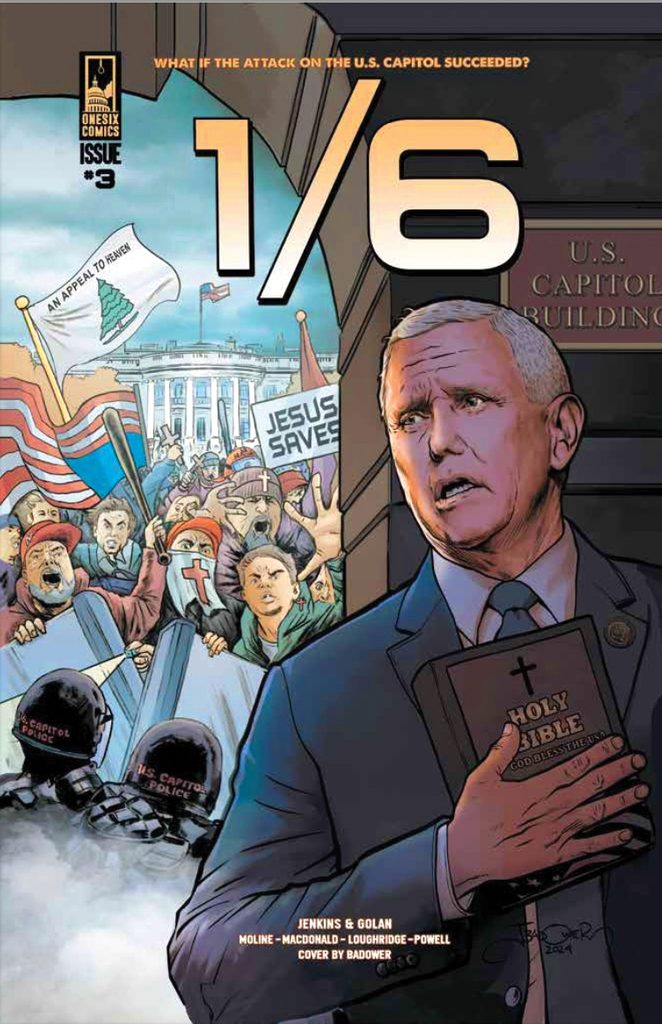
Like many Americans, on January 6, 2021, I was shaken when hundreds of insurrectionists stormed the U.S. Capitol and attempted to overturn the results of a free and fair presidential election. We also quickly learned that, in addition to the physical attack on the Capitol, President Donald Trump and his supporters intimidated election workers, threatened Vice President Mike Pence, and sent fraudulent electors to battleground states as part of a larger scheme to subvert the election results. But just as quickly, we saw an attempt by supporters of the then-ex-president to deny that the insurrection had happened, while praising the violent mob that carried it out. More ominous for me was the rise of authoritarianism and sanctioned bigotry that, in my view, pose an even greater threat to our democracy.
. . . I know that mass media vehicles such as comics can reach and move large, new audiences . . . .
I wrote and spoke out about these challenges in a variety of professional venues, but I also wanted to reach everyday Americans who care about our democracy but might not be closely following political news—much less reading the 814-page report of the House Select Committee to Investigate the January 6th Attack on the United States Capitol. And as a lifelong pop culture junkie and comic book nerd, I know that mass media vehicles such as comics can reach and move large, new audiences—so long as they are genuinely entertaining. I recruited New York Times bestselling graphic novelist Gan Golan, with whom I’d worked on several past projects, and we embarked on the journey that became 1/6: The Graphic Novel, asking the question “What if the January 6th Insurrection had succeeded?” We chose speculative, dystopian fiction because of its capacity to offer cautionary tales about our current reality—think of George Orwell’s 1984 or Margaret Atwood’s The Handmaid’s Tale—as well as brighter alternatives. We tapped veteran Marvel and DC Comics artists to make sure that the art was top-notch. And we teamed up with the pro-democracy organization Western States Center and educators at San Diego State University to create a guide for activists and a lesson plan for teachers, respectively.
The four-issue series has now been read by thousands of pop culture fans, received broad media coverage, been used by teachers and activists around the country, and sparked conversations with new audiences about our Constitution and democracy under stress. That’s definitely what we had in mind when we chose the comic book vehicle for our story.
Bringing More Voices into Telling the Nation’s Story
The 250th anniversary of the Declaration of Independence offers a rare opportunity to reflect as a nation on our origin story and what it means for us today. My latest scholarship focuses on how courts tell that story and, particularly, whom they choose as “narrators” when it comes to interpreting our Constitution. I’ve been fortunate, in pursuing this research, to serve as a Steven M. Polan Fellow in Constitutional Law and History with the Brennan Center for Justice.
As one would imagine, in discerning the meaning of the Constitution, courts frequently quote the men who drafted, debated, and signed the document. In addition, though, they often look to a range of other figures, many of them Europeans who were neither present nor even alive when the Constitution was adopted. I’ve been particularly struck by judicial reliance on Alexis de Tocqueville, a French aristocrat who was 26 years old when he toured America for nine months in 1831–1832. This was four decades after the U.S. Constitution was adopted. Federal and state court judges have quoted de Tocqueville more than 300 times in their opinions, mostly as evidence of our national character.
Here’s my assertion: Alongside de Tocqueville and other mostly European thinkers such as Locke, Rousseau, and Montesquieu, we should also be consulting American “outsider” voices from the Founding Era—prominent figures who were excluded from power, yet eloquently articulated the early American spirit of freedom and independence.
I’m exploring, for example, the “history and tradition” of human rights as articulated by Phillis Wheatley, an enslaved poet. Wheatley, abducted from her family in West Africa at about age 7 and held in bondage in Boston, nonetheless became a widely read poet who corresponded with George Washington and other Founding Era figures. In poetry and prose, she linked enslaved Africans’ quest for freedom with the American colonies’ struggle against “the iron chain,/ Which wanton tyranny with lawless hand/ Had made” (to quote from a 1772 poem).
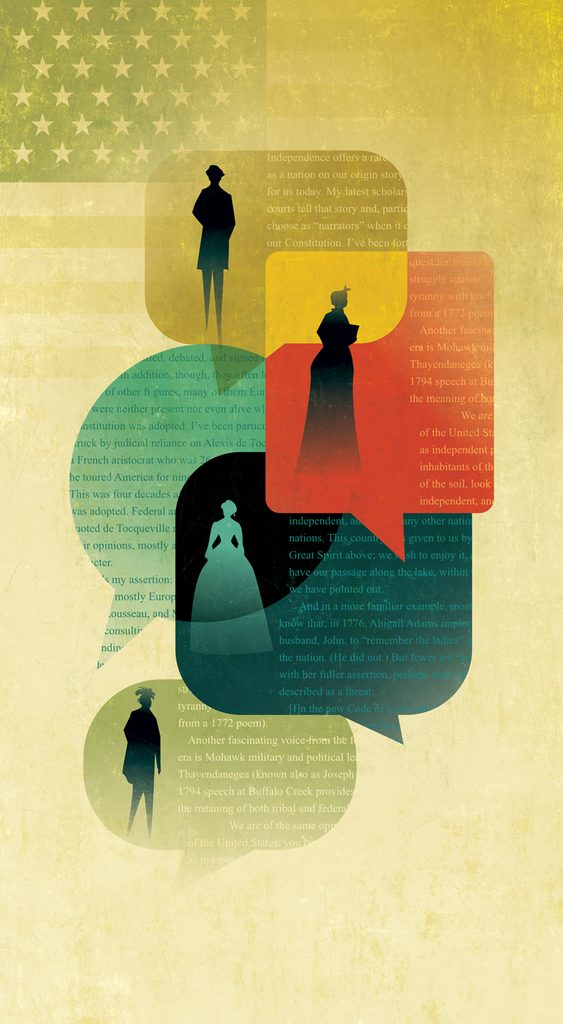
Another fascinating voice from the Founding Era is Mohawk military and political leader Thayendanegea (known also as Joseph Brant). His 1794 speech at Buffalo Creek provides insight into the meaning of both tribal and federal sovereignty:
We are of the same opinion with the people of the United States; you consider yourselves as independent people; we, as the original inhabitants of this country, and sovereigns of the soil, look upon ourselves as equally independent, and free as any other nation or nations. This country was given to us by the Great Spirit above; we wish to enjoy it, and have our passage along the lake, within the line we have pointed out.
And in a more familiar example, most of us know that, in 1776, Abigail Adams implored her husband, John, to “remember the ladies” in framing the nation. (He did not.) But fewer are familiar with her fuller assertion, perhaps more accurately described as a threat:
[I]n the new Code of Laws which I suppose it will be necessary for you to make I desire you would Remember the Ladies, and be more generous and favourable to them than your ancestors. Do not put such unlimited power into the hands of the Husbands. Remember all Men would be tyrants if they could. If p[a]rticular care and attention is not paid to the L[a]dies we are determined to foment a Rebellion, and will not hold ourselves bound by any Laws in which we have no voice, or Representation.
That revolutionary spirit, in my view, speaks volumes about public understanding of democracy and the guarantee of equality at the time of the Founding, as well as its often-unfulfilled promise. More broadly, these are profoundly American stories that should be part of our collective consciousness as well as our state and federal jurisprudence. They expand the we in “We the People” and give us guidance as we face our national future together.
This article was first featured in the Fall 2026 issue of Marquette Lawyer Magazine.