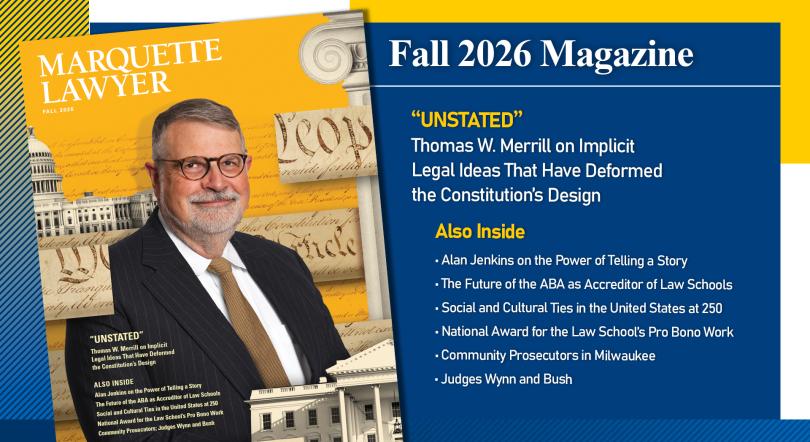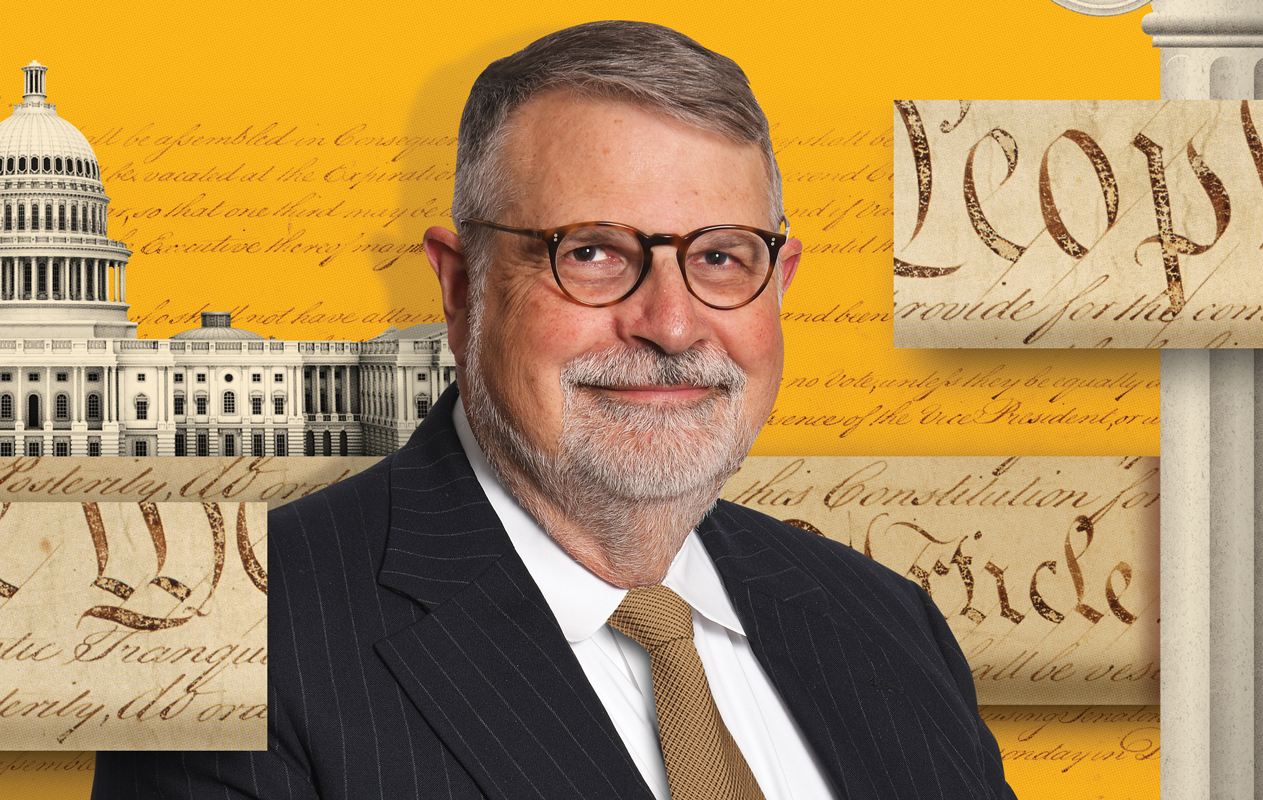
Charles Evans Hughes had a distinguished career of the first order. He was nearly elected president of the United States in 1916. He served before that as a justice of the Supreme Court of the United States and, from 1930 to 1941, as the nation’s Chief Justice. Governor of New York, U.S. secretary of state, and judge of the Permanent Court of International Justice in the Hague—he was each of those, too. He had a three-year stint as a Cornell University law professor and several multiyear periods as a Wall Street lawyer when he was one of the country’s most sought-after advocates.
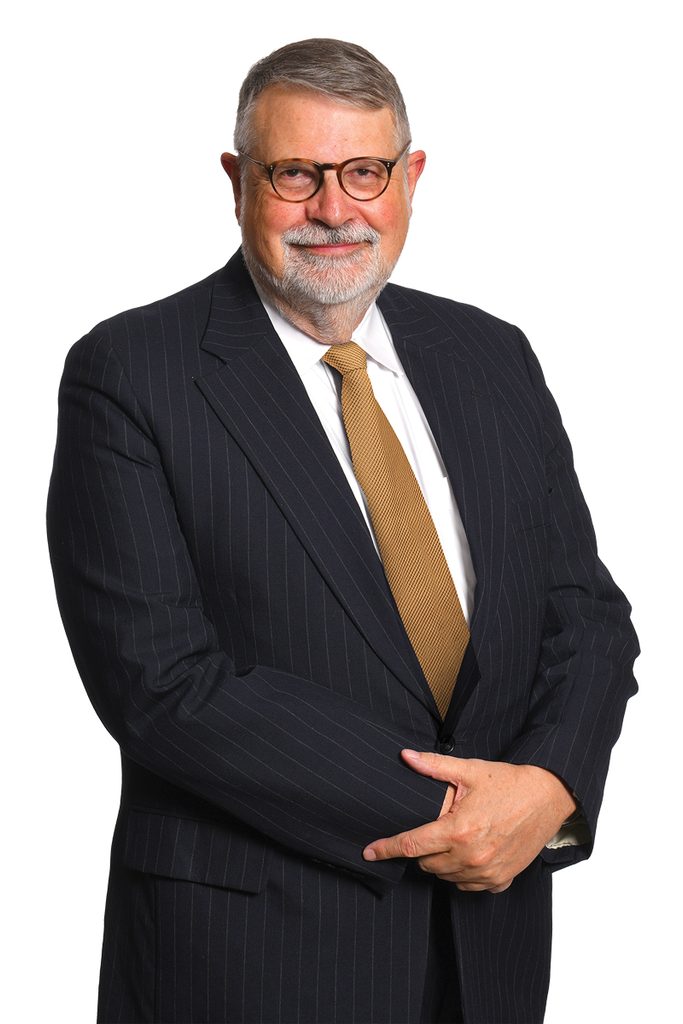
“I’ve always had immense admiration and respect for Charles Evans Hughes,” says Thomas W. Merrill. He described Hughes as a progressive Republican with a wide-ranging and impressive record of public service.
Since 2010, Merrill has been the Charles Evans Hughes Professor at Columbia Law School, Hughes’s alma mater, in New York City. Merrill, too, has had a wide-ranging and impressive career. As a practicing lawyer, as a teacher, and as a legal scholar, he has become one of the most respected figures in American law. He is among the most frequently cited figures in the legal world today.
One major reason for Merrill’s prominence is the breadth of his interests and his expertise in multiple areas of the law. From property law to environmental law to administrative law to public law more generally, his range has been remarkable.
Yale Law Professor Robert C. Ellickson, in an essay on the occasion of Merrill’s winning the Brigham-Kanner Prize for property scholarship in 2013, noted this distinction. First, “[u]nlike many awardees of the Brigham-Kanner prize, Tom also is a master lawyer.” Second, and perhaps as a result, “he possesses exceptional analytic abilities and expository skills. Aware of these comparative advantages, Tom, when turning to a fresh topic of law, typically starts by laying out, with enviable clarity, both the issues and the landscape of the current scholarly debate. These attributes have enabled him to become a central figure in two relatively disparate fields—property law and federal administrative law.”
Merrill described his work in an interview in conjunction with giving the 2026 E. Harold Hallows Lecture at Marquette Law School. The text of the lecture accompanies this article.
Tackling property law issues
Consider one of Merrill’s current roles, as a co-reporter for the American Law Institute’s Restatement (Fourth) of Property, an extensive effort that will impact civil legal practice nationwide. What has Merrill done as part of the project? “I have done a volume for the Restatement on the law of leasing, which is an area in which I’ve written a little bit. I’ve been responsible for a fair number of sections on basic principles, such as what does possession mean, what does abandonment mean, and so forth.”
The work is not yet finished. “My most recent task is to do the last volume we anticipate, which is on public rights. So I spent my summer writing chapters on federal public lands, the public trust doctrine, the implied doctrines of private right of access on public lands, and the public use doctrine in the law of eminent domain.”
And he’s working on a chapter about the law of unclaimed property. “I had never given any thought to unclaimed-property laws,” he says, “and it turns out they’re very interesting and they’re very important. People get all kinds of little claims to money, like traveler’s checks or dividend checks or gift cards or stock shares in dissolved corporations, and they forget about them or never bother to do anything about them. What happens to all these little intangible rights, which accumulate? It turns out eventually they end up in the pockets of state governments, one way or another, and the state governments are very dependent on them.” In Delaware, he noted, unclaimed property is the third-largest source of revenue to the state.
The Restatement work, which will help shape the future of American property law, is just one of the many roles Merrill has played in his career.
The path to the law
Merrill grew up in Des Moines, Iowa, and enrolled at Grinnell College, an hour away. “I wanted to go east for college, and Poweshiek County was as far as my parents would let me go,” he says. After graduating in 1971 with a bachelor’s degree in history, he was awarded a Rhodes Scholarship to study at Oxford University in England, earning a degree in philosophy, politics, and economics. He received his law degree from the University of Chicago Law School in 1977.
He clerked for David L. Bazelon, chief judge of the U.S. Court of Appeals for the D.C. Circuit, and then for Supreme Court Justice Harry A. Blackmun.
He was a full-time lawyer at Sidley & Austin in Chicago from 1979 to 1981, before taking a teaching position at Northwestern University. “I fibbed,” Merrill says. When asked whether environmental law was among his teaching interests, he said “Yes.” For an unusual matter, he remained at the law firm in a part-time of counsel role.
Then came three years as deputy solicitor general of the United States, beginning in 1987. Merrill argued 12 cases before the Supreme Court, winning all but one. And he developed a greater interest in constitutional law, adding to his areas of expertise. “It was a nice learning experience,” as he puts it.
He returned to Northwestern University in Chicago and a part-time role at Sidley & Austin in 1990. At Northwestern, Merrill was named the John Paul Stevens Professor of Law. Stevens, for whom Merrill expresses great respect (and who was on the Court during Merrill’s clerkship and when he argued cases as deputy solicitor general), was also a long-practicing private lawyer as well as public servant before becoming a court of appeals judge and then a justice.
The appeal of teaching law
Merrill found the academic side of the law appealing. “The academic world has enormous advantages,” he says. Alongside teaching opportunities, there is immense opportunity to do research and writing, and Merrill has been prolific on those scores. Ellickson again: “He works ceaselessly and produces more high-quality work in an hour than many of us can produce in three.”
“Most of my writing and research has been generated by teaching,” says Merrill. “In that respect, I think I’m a little bit strange.” Many professors, both in law and other fields, “get their training in Ph.D. and graduate programs, and a lot of their work is generated by controversies in the academy. They look for a special take on a controversy.” Merrill’s orientation is to a wide range of subjects generally based outside the academy.
“I found that teaching is a better stimulus to writing,” he says. “You discover interesting issues that can lead to writing an article or a broader piece of work. You do get a stimulus from the latest decisions that are being rendered or trends that are emerging in the courts or the legislature.”
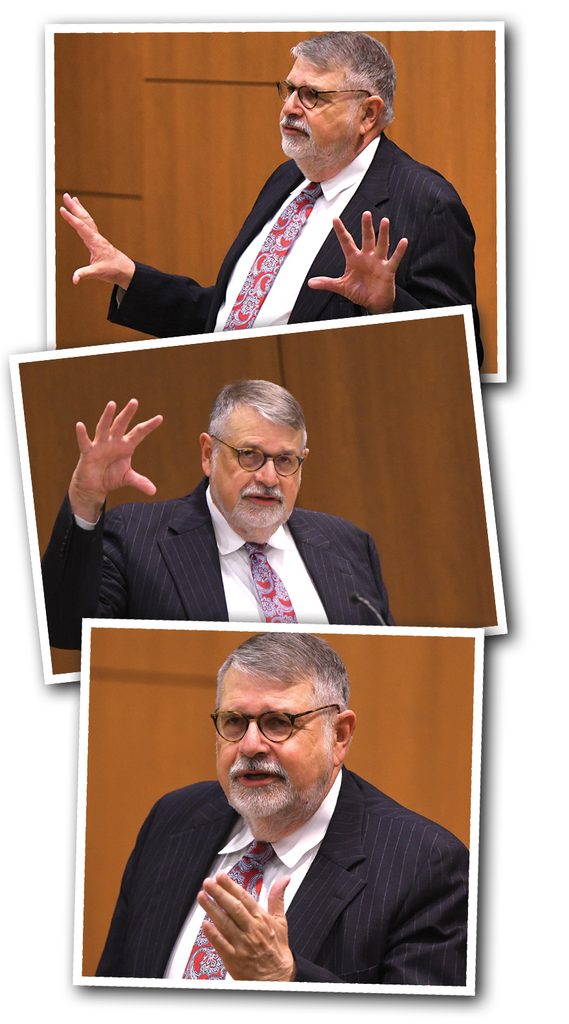
In 2003, he joined the faculty of Columbia Law School. He later taught at Yale Law School from 2008 to 2009, before returning to Columbia in 2010 to take the Charles Evans Hughes chair.
Across his career, Merrill has authored or coauthored four books, including Lakefront: Public Trust and Private Rights in Chicago, coauthored with Marquette Law School Dean Joseph D. Kearney and published in 2021. Kearney met Merrill in 1990, when the former began as an associate at Sidley & Austin and the latter returned to Chicago from his work as deputy solicitor general.
“I knew of Tom from reading that I had done in law school,” said Kearney. “I had an interest in possibly going into teaching someday, so perhaps I would have welcomed a connection in any event. But in fact it was his skills as a lawyer that impelled me to seek him out again and again on projects. To this day, I tell people that if they can get 15 minutes of Tom’s attention on a legal problem, it will likely result in a major advance in their understanding and approach to it.”
Merrill also authored The Chevron Doctrine: Its Rise and Fall, and the Future of the Administrative State, published by Harvard University Press in 2022, and coauthored books on principles and policies related to property and an introduction to American property law. He has also written chapters for more than a dozen books and more than 120 academic articles and similar professional pieces.
Through Kearney, Merrill has developed a longstanding relationship with Marquette Law School. He delivered the Law School’s Robert F. Boden Lecture in 2010, describing how a Wisconsin Supreme Court decision in the late 19th century applying the doctrine of waste to a property on Milwaukee’s south side became a part of legal history. With this year’s Hallows Lecture, Merrill became the only person to give two of the Law School’s spotlighted annual lectures.
“A centrist kind of guy”
Merrill places high value on the principles and structures of the American system of government and of law—and he believes both are in troubled states now. He regards himself as a moderate when it comes to political and legal philosophy, and he has concerns about what is happening on both ends of these spectrums.
“I’m a centrist kind of guy,” he says. “I don’t think I’m a stick-in-the-mud guy, but I’m a centrist.”
In the academic world of law, “it’s gotten a little weird in these later years in the sense that a lot of people who teach in law schools have unorthodox ideas about the law and how the law should interact with the larger society,” he says. Practicing lawyers “tend to be much more grounded—they have clients, they have to win cases before judges, and so forth. So they are constrained to be more pragmatic and to be more realistic about what sort of ideas should be advanced and which ones should not be advanced.”
Merrill adds, “I get a little impatient sometimes with people who advance far-out legal theories and get lots of attention for that in the academy. I’m thinking, for example, about theories that the United States Constitution was adopted in order to preserve slavery and that slavery is the key to understanding all American history or other types of theories that have been propounded in the academy these days.”
He is also critical of some on the conservative side. He recalls that the legendary Justice Antonin Scalia called himself “a faint-hearted originalist.” Merrill says, “There are people on the Supreme Court who are not so faint-hearted, who seem to think originalism is the answer to every constitutional question, and I think that’s far out; I think that’s an unsupportable proposition.”
Merrill says his Hallows Lecture at Marquette was affected by his teaching of administrative law, an area that is in turmoil because the Supreme Court “is remaking administrative law on a fairly regular basis.” When he taught an administrative law course in the fall of 2025, he says, he used a book from 2023 and needed to provide students with 13 supplements reflecting recent decisions. “That’s pretty astonishing,” he says.
“There are far-out people on both sides of the political spectrum,” he says.
Losing the equilibrium underlying the law
And what does that say about the big picture for America today? “I think American society as a whole is in kind of a dysfunctional state. Every society, if it is going to endure and prosper, hopefully has some kind of diversity, which is kind of the yeast that keeps things evolving,” Merrill says.
“But it also needs to have a strong basis of consensus, and I think we’ve kind of lost that recently in the United States, not just in the political sphere, but more broadly, and that is troubling to me.”
As for American law in broad terms, Merrill says, “I am quite troubled by the state of the law. . . . I dearly hope that the equilibrium that has been established over the eons . . . can be restored or perpetuated and the legal profession and the courts can remain on the same page, more or less, and continue to try to adhere to a body of settled principles of the law, particularly in deciding cases between parties that have disputes with each other.”
He adds, “That is still kind of the case with less controversial issues—everyday or mundane issues. But there’s a lot of controversy out there, and when this is true, there is a tendency by lawyers and judges to implement political preferences through the law. That, I think, is a recipe for very bad things if it becomes the general practice.”
Merrill says he is generally alarmed about efforts “to use the law to implement fundamental changes in social practices.” He says, “Historically, legislatures or bargaining or whatever could meld together settlements and practices. Maybe legislatures are overwhelmed, and they can’t do this job anymore, so we’re just going to depend on courts. But you’re asking judges to be legislators. I think that would be tragic if it was extended over a wide range of issues.”
Merrill will retire from teaching in 2027. Beyond that, he expects to continue to write, working on undertakings such as the Restatement of Property. Together with family interests, he also wants to travel and do things he finds intellectually stimulating.
He hopes that some of his work will have lasting value, but he expresses modest expectations. Most legal research, even when it is very good, has impact for a decade or less, he says.
Kearney, a great admirer of Merrill, sees things differently in this instance. “One does not have to have served in all the various roles of Charles Evans Hughes to make a lasting intellectual contribution to the law and even present a model of public service,” says Kearney.
Merrill’s work, informed by practice, teaching, and a broad lens, seems certain to have continuing influence beyond his long career.
This article was first featured in the Fall 2026 issue of Marquette Lawyer Magazine.