
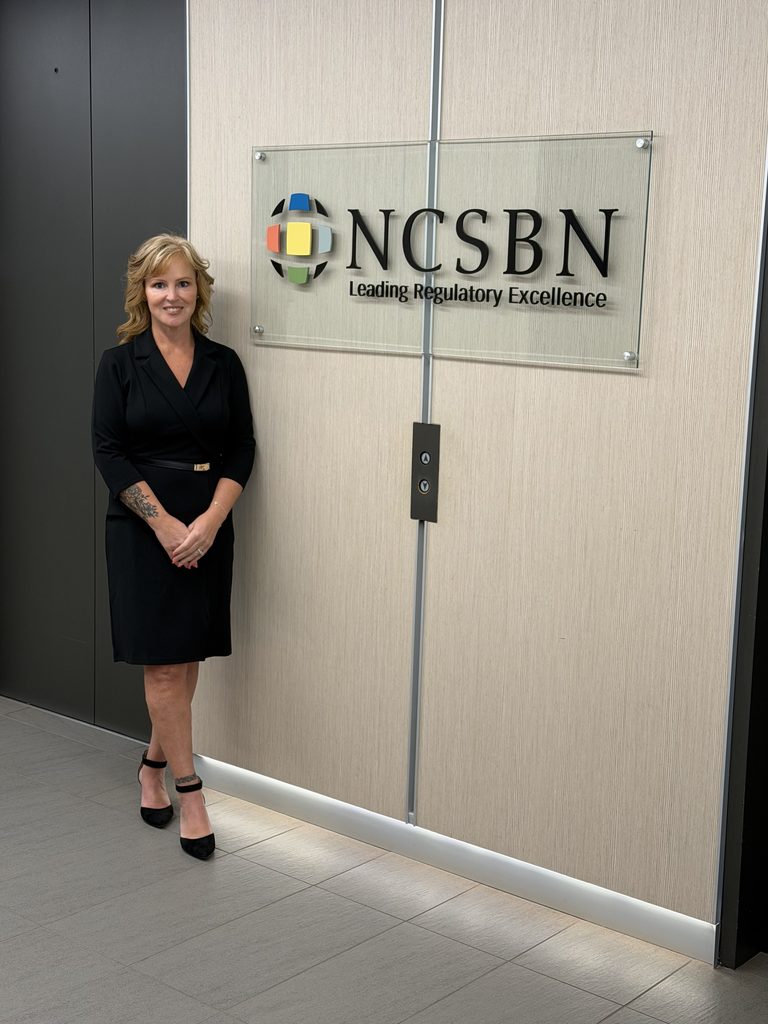
Dr. Aimee Woda, associate professor in the College of Nursing, finished a successful residency with the National Council of State Boards of Nursing. The Scholar in Residence experience is an eight-week, full-time program in which the scholar works closely with NCSBN nursing regulation experts while completing a project related to an area of interest.
During her time with NCSBN, Woda learned about the regulation of nursing education, governance, research, policy and NCLEX development, among many other subjects. She also developed evidence-informed recommendations for support of part-time and adjunct clinical instructors, particularly those who teach prelicensure nursing students in patient care settings.
These recommendations will make it easier for nurses to transition into faculty roles and for institutions to develop meaningful introductory trainings and orientations.
“Ultimately, a strong orientation helps clinical instructors understand that they are not simply supervising students in a clinical setting; they are faculty members with an important role in student learning, evaluation, progression, and patient safety,” Woda says.
The project, titled “Evidence-Informed Recommendations for the Preparation of Traditional Prelicensure Clinical Instructors,” reviewed the available evidence and national guidance to identify what clinical instructors need to be successful in their roles. From that work, Woda developed guidelines for institutions to onboard faculty. These included topics such as student assessment and evaluation, communication and reporting expectations, and ongoing mentorship.
“The biggest thing nursing institutions can do is provide clinical instructors with intentional, structured preparation and ongoing support for the educator role,” Woda says. “Clinical expertise does not automatically translate into knowing how to teach students in the clinical environment. Clinical instructors need preparation not only in the expectations of the institution and nursing program, but also in how to teach, evaluate students, provide meaningful feedback, foster clinical judgment, and respond when students are struggling.”