Making sense of America: Alumnus Astead Herndon’s approach to political journalism
By Jack Goods, Comm ’17, Grad ’26
4 min. read
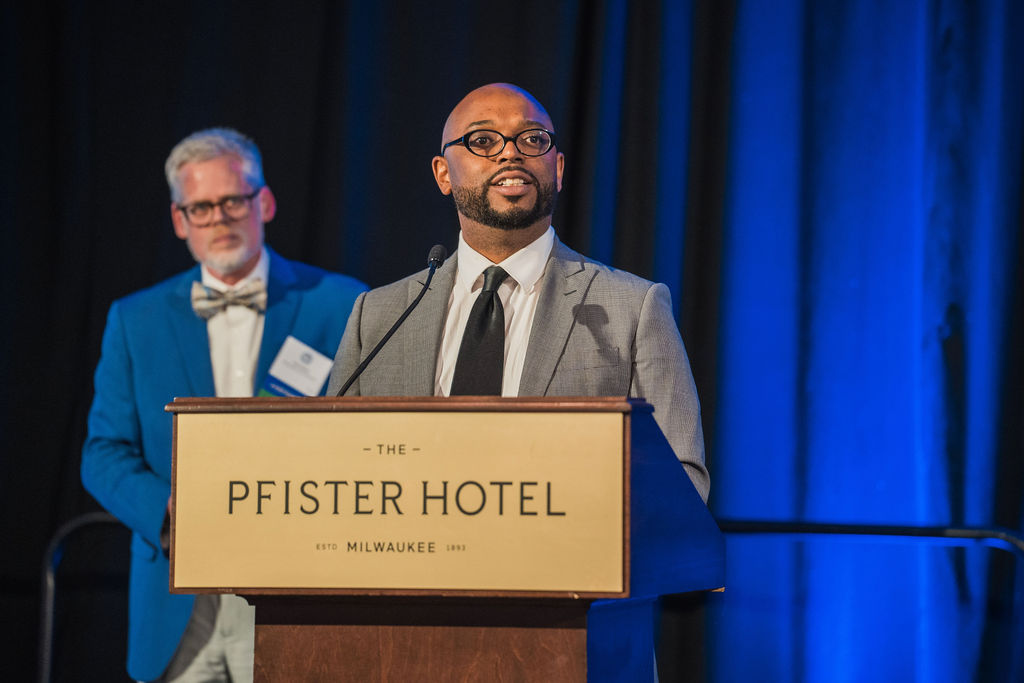
Astead Herndon accepts the Sacred Cat Award at the 2026 Milwaukee Press Club Gridiron Awards Dinner. Photo courtesy of Spottswood Photography.
Astead Herndon, Comm ’15, has built a national reputation for helping audiences make sense of complex political realities — and the Milwaukee journalism community has taken note. The former New York Times political reporter and current host and editorial director at Vox returned to the Cream City in May to receive the Milwaukee Press Club’s Sacred Cat Award, recognizing national excellence in journalism.
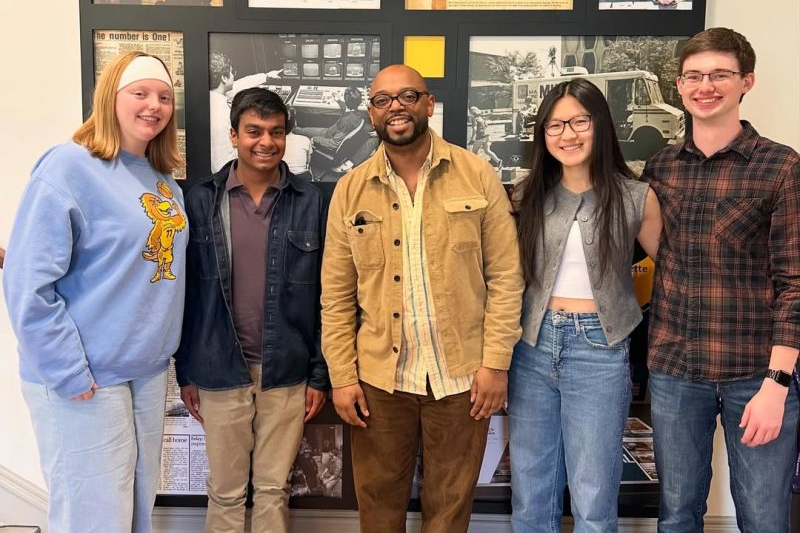
The honor prompted him to reflect on his time at Marquette, where he first wrestled with his values and journalistic voice. “I’m proud that the places that have shaped me, I feel like they see me,” says Herndon, who returned to Johnston Hall while in town to speak with grateful Marquette Wire students. “I’m glad that Milwaukee can look at my journalism and see itself.”
Looking back on a career increasingly defined by his own voice and perspective, Herndon recalls a college student who was still searching for direction and trying to understand what kind of journalist he wanted to become.
“I really was wrestling with, ‘What does impact look like? What kind of journalist can you be?’ Herndon explained. “For me, college is about that type of discovery. There’s one version of collegiate success where you get A’s, know what you want to do and do it after. There’s another version where you find yourself. Marquette helped me find myself.”
There’s one version of collegiate success where you get A’s, know what you want to do and do it after. There’s another version where you find yourself. Marquette helped me find myself.”
Astead Herndon
He credits much of that growth to experiences that pushed him beyond his comfort zone and forced him to grapple with deeper questions about who he was and the impact he hoped to have. “What are my values? What do I care about? How do I want to present myself in this world?” Herndon says.
One particularly formative experience came after his sophomore year, when Herndon joined City Year, a national nonprofit that places teams of full-time AmeriCorps members in public schools to serve as tutors, mentors and role models for students. At the time, he says he was still searching for direction.
“I was kind of lost,” Herndon says. “One of the things that City Year does, you’re in a situation where people have to rely on you every day. Whether you had a bad day or not, those kids don’t care.”
“It made me think about the intersections of a lot of problems instead of one small solution,” he continued. “Sometimes we think about these silver bullets. It made me think about how we should be presenting problems as complex. That really led me to journalism, to think about the nuances of issues, the societal factors that shape an educational experience. Some of that I had to see firsthand.”
Astead Herndon, center, meets with Marquette Wire students during his visit to Milwaukee.
More than a decade later, Herndon sees a direct line between those formative questions and the work he does today. In his role at Vox — a position that allows more of his personality, perspective and curiosity to come through than any previous stop in his career — he continues exploring the complexity and human stories behind America’s political divisions rather than searching for easy answers.
This is perhaps most clear in his work hosting “America, Actually,” a weekly podcast that brings together politicians, journalists and voters to make sense of the road to the next presidential election. Each episode tackles the questions on Americans’ minds, examining the people, ideas and forces shaping the country’s political future.
That focus on understanding how ordinary Americans experience politics has been a defining theme throughout Herndon’s career. As host of The New York Times podcast “The Run-Up,” work that helped earn him the National Association of Black Journalists’ Journalist of the Year honor in 2025, Herndon became known for reporting that centered voters’ beliefs, frustrations and aspirations rather than political insiders alone.
By meeting people where they are and building trust through curiosity and conversation, he has sought to illuminate the forces shaping public opinion and electoral outcomes while making political journalism more accessible to audiences beyond policy experts and political insiders.
“I see my role as multipronged,” Herndon said. “I think there’s a duty to inform. I think there’s a need for accountability. But I also think those things, particularly in political journalism, have usually been filtered through a lens where we’re informing for the wonk, for the expert and we are explaining only for those who read a Politico language of news. What I try to do is make sure ideas are accessible and I don’t take anything for granted. I don’t think just because something is the way it’s always been done, it’s not worth highlighting.”
That approach has increasingly taken Herndon back to Wisconsin as the state has become one of the nation’s most closely watched political battlegrounds. In covering the voters and communities helping to shape national elections, he frequently returns to the place where he first began developing the perspective that would define his career.
“I am proud that we’ve made a career work while not compromising what brought me to that career in the first place,” Herndon said. “When I was in school, there was a lot of fear about journalism’s survival, and there was a kind of sense that you had to do whatever or compromise to keep a job. I’ve really been someone who has been lucky enough to navigate work you care about with work you need to do.”