Future nurses are current lifesavers on campus-based EMS unit
Students on Marquette University EMS — Wisconsin’s only student-run unit — gain vital emergency medicine experience while “showing up for people on one of the hardest days of their lives.”
By Stephen Filmanowicz and Elena Metinidis | Metinidis is a junior in the Diederich College of Communication
5 min. read
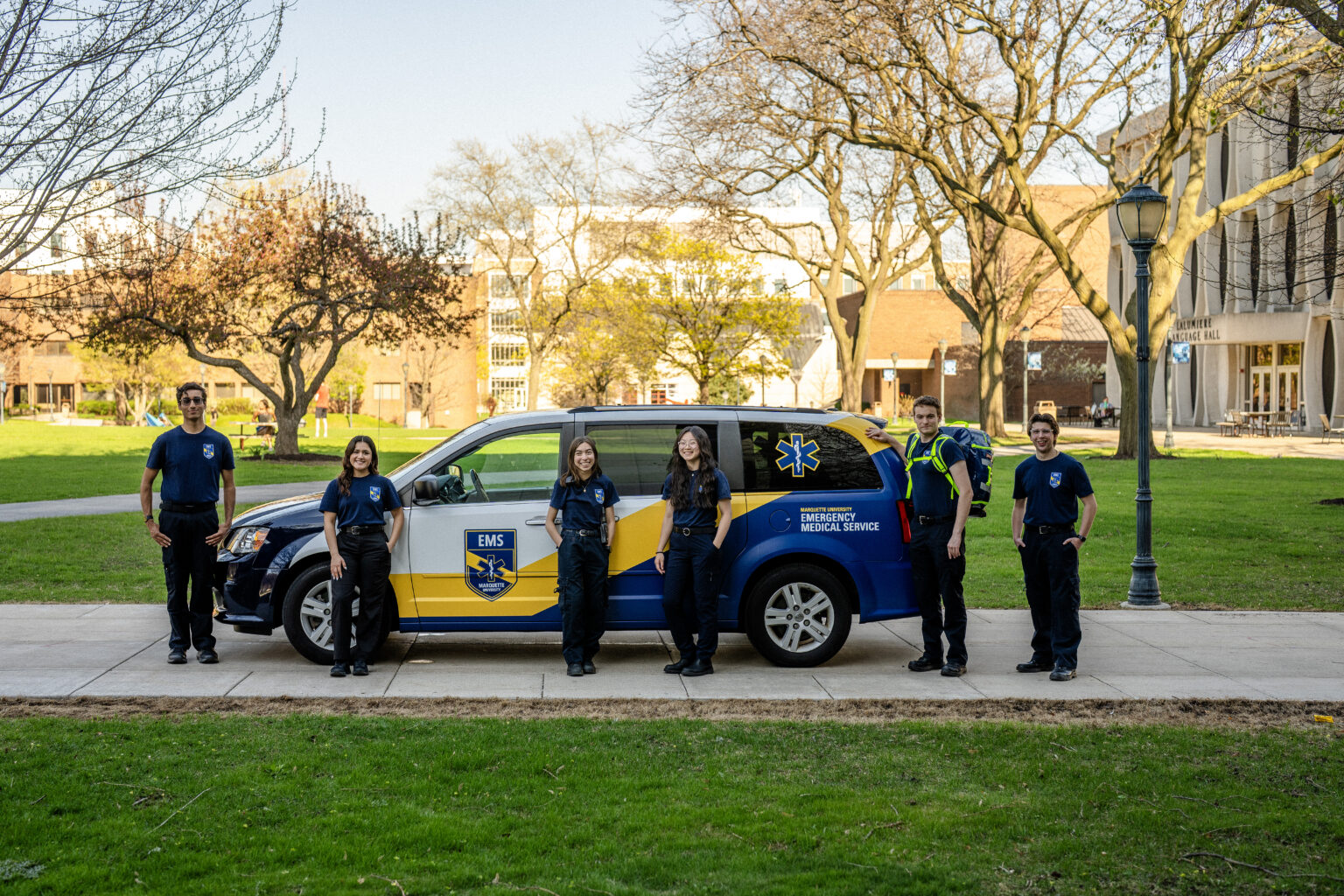
Student EMTS now respond to emergencies on campus and in the surrounding area. Avary Benavides Shefland, Nurs ’26, center, had the idea to establish the unit and traveled to student-led EMS units in Philadelphia and Washington, D.C., to lay the groundwork for Marquette’s unit.
For junior Jessica Wrobel, the call to train as an emergency medical technician came early, before she came to Marquette to study nursing. While working part-time as a server in an Illinois retirement community during her high school years, she saw a resident at one of her tables start choking, requiring a full emergency response.
“That really shifted my perspective,” she says. “It made me realize how important it is to know how to provide emergency care — because you truly never know when someone might need help.”
Her classmate Jackson Fogarty started his journey with emergency medical services during his busy first semester at Marquette, juggling night classes at EMT school with courses on campus, where he’s working toward his goal of becoming a flight nurse. “It was a difficult semester,” he says, “but I am incredibly thankful I did it.”
Both students view EMT service as meaningful, high-impact work that supports community members in crisis while offering young EMTs valuable experiences for future health-related careers. But what neither realized is that they’d get this experience at Marquette as part of a campus-based EMS unit.
That unit launched in March with support from the Marquette University Police Department, making the university the only one in Wisconsin with a student-led EMS program. Wrobel and Fogarty were among the first student EMTs to join the 20-student crew that operates Thursday through Sundays, responding to nearly all immediate medical needs in MUPD’s patrol zone.
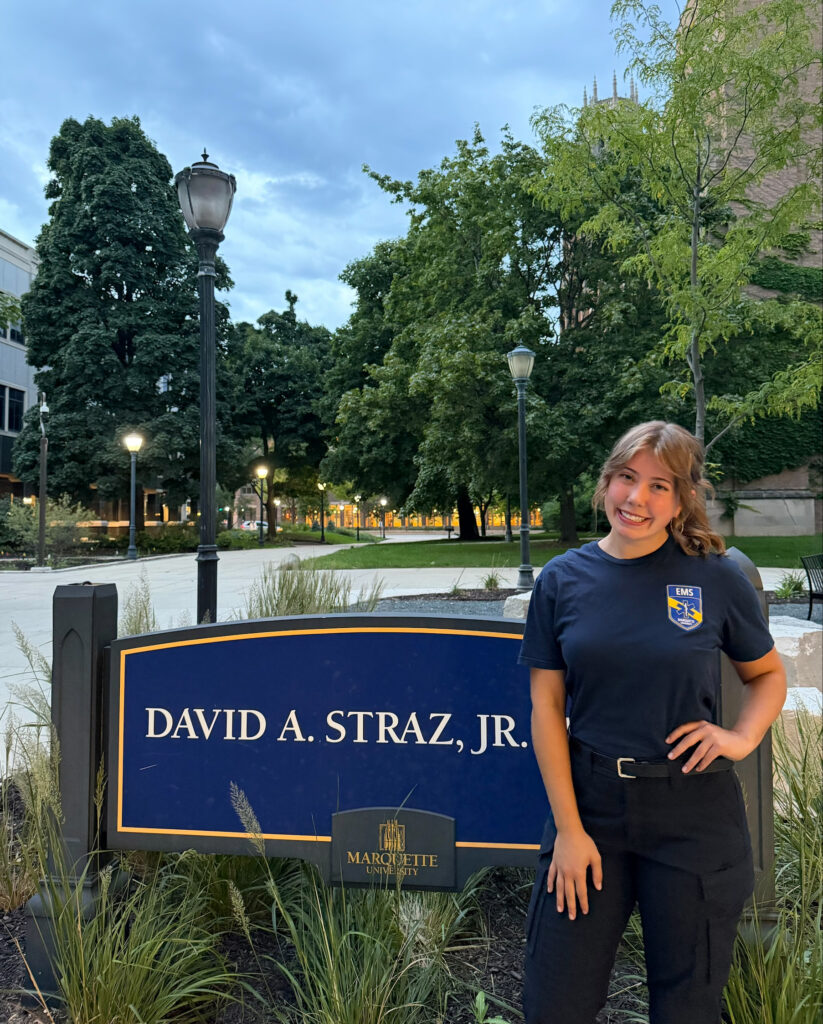
An off-duty Jessica Wrobel outside the College of Nursing, where she’s a junior studying to become an RN.
Whether the calls come from campus or the surrounding residential blocks that are home to students and Milwaukee neighbors, the EMTs have responded to cases such as broken bones from accidental falls, overdoses and urgent medical conditions. “I am impressed with the strength of the team we’ve built,” Fogarty says. “We have a group of highly motivated EMS providers who can provide exceptional prehospital care to the Marquette community — and the Milwaukee community, too.”
While the unit’s ranks are strengthened by EMT-certified students representing a range of majors, from biomedical sciences to psychology and communication, Marquette EMS began as the brainchild of another nursing student.
Avary Benavides Shefland, Nurs ’26, was a junior when she began dreaming of forming a student-run EMS unit. She admits to being caught by surprise by what ensued after she mentioned the idea to a friend — and that friend shared the idea at an open forum hosted by Marquette University Student Government.
Before long, Benavides Shefland was meeting with student government leaders and representatives of Marquette’s Medical Clinic and the MUPD.
With support from these partners, she spent eight months developing the program while keeping up with her studies and working full-time. In the early stages, Benavides Shefland drove across the country to visit EMS units at Villanova and Georgetown universities. She asked questions, shadowed the EMS volunteers on calls and stayed at their houses. “This is what we could be,” she thought at the time. “They’re students, just like us, but they’re running full-blown emergency services.”
Benavides Shefland and partners were proud to see the service launch in March, two months before she graduated. “I can’t even describe the feeling of taking our first run,” says the May graduate, now a nurse at Milwaukee’s Froedtert Hospital. “I cried afterward because it was just that cool.”
University officials give the founders high marks. “It’s a group of students who put forth a grassroots effort … to help the campus and community,” Assistant Police Chief Jeff Kranz says. “When you bring that attitude to the table, you can’t help but succeed.”
The unit provides services — free of charge to students and community members — at the EMS level until paramedics arrive. Those City of Milwaukee crews are authorized to administer medications and transport patients to hospital emergency rooms, if needed.
When he responded to his first emergency call as a Marquette EMT, Fogarty says his heart wasn’t racing; he had already worked several summers at a 911 service in his home community of Door County, Wisconsin. But he and Wrobel appreciate the urgency and the rigor of the work.
“Beyond the honor of helping people in immediate, high‑stakes situations, I genuinely enjoy the challenge and intensity of emergency care,” Wrobel says. “I like working under pressure, staying calm and deescalating stressful moments. Being part of the unit gives you hands‑on experience, sharpens your assessment skills and teaches you how to be effective in fast‑moving situations.”
“After a call, the team always takes time to debrief — talking through what happened, what went well, what we can improve, and how the experience affected us. … Even though you encounter hard moments, having a team that encourages vulnerability and reflection helps you move forward in a healthy way and be ready for whatever comes next.
Jessica Wrobel, student member of Marquette University EMS
Both students also see many synergies between EMS service and nursing study. “Working for a 911 service has made me very comfortable with rapid assessment, decision-making and interventions, and those skills have carried directly into nursing school,” says Fogarty.
Skills such as placing an IV needle in a patient’s arm are now routine for Fogarty “Nursing school taught me the proper technique and the reasoning behind it, while EMS has given me the opportunity to practice that skill repeatedly and build confidence,” he says. And when his Marquette crew responded to a call for a patient experiencing a crisis related to Addison’s disease, a rare condition of the adrenal glands that results in low steroid hormones such as cortisol, the senior’s nursing training made him a better EMT, he says; it helped him understand the underlying physiological process and recognize what the patient was experiencing in a way that wouldn’t have been possible with EMT training alone.
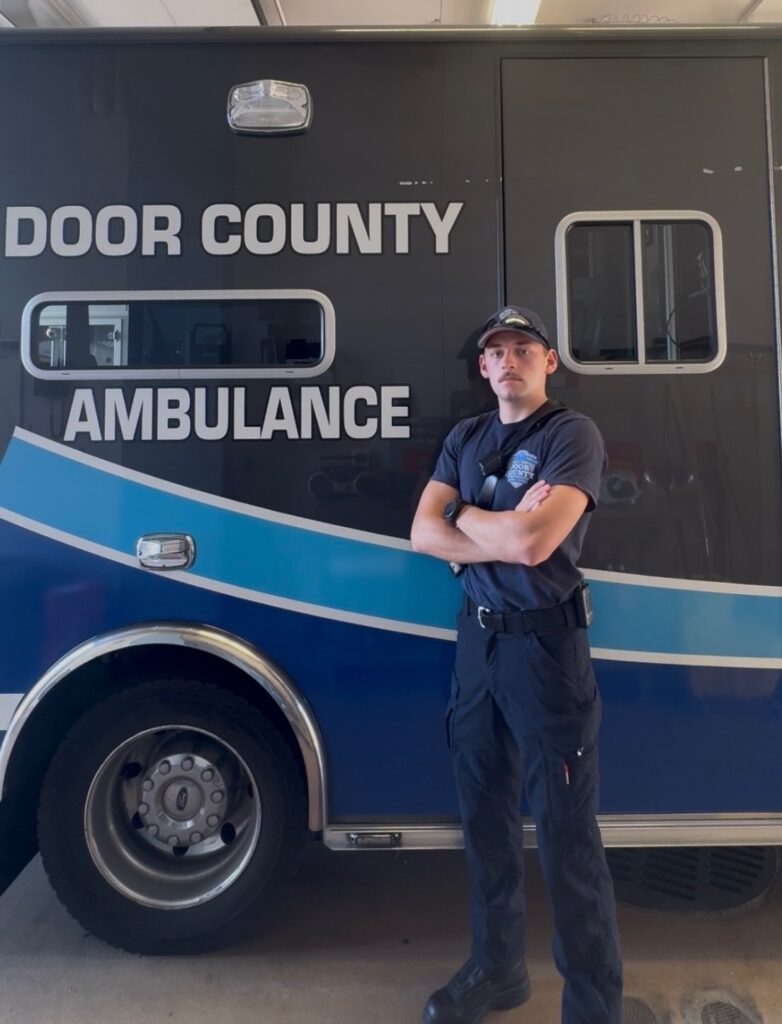
Before joining Marquette’s student-led EMS unit, senior nursing major Jackson Fogarty’s gained experience with Door County Emergency Services in Sturgeon Bay, Wisconsin. He still works there during breaks from school.
Student EMTs say their biggest source of satisfaction comes from serving people in need. “It feels meaningful to be the person who shows up for someone on what might be one of the hardest days of their life,” Wrobel says. “EMS is so much more than providing physical care — it’s talking patients through fear, grounding them and being a steady source of support when everything around them feels overwhelming.”
Adds Fogarty, “We’ve been able to have a real impact on the Marquette community. For me, that’s why I continue to work the late nights and early mornings, sometimes running back-to-back calls on little sleep. When I can come back to the station and think, ‘If I hadn’t been there, that person might not be alive right now,’ it puts everything into perspective. That’s why I know I’ll always work in EMS.”