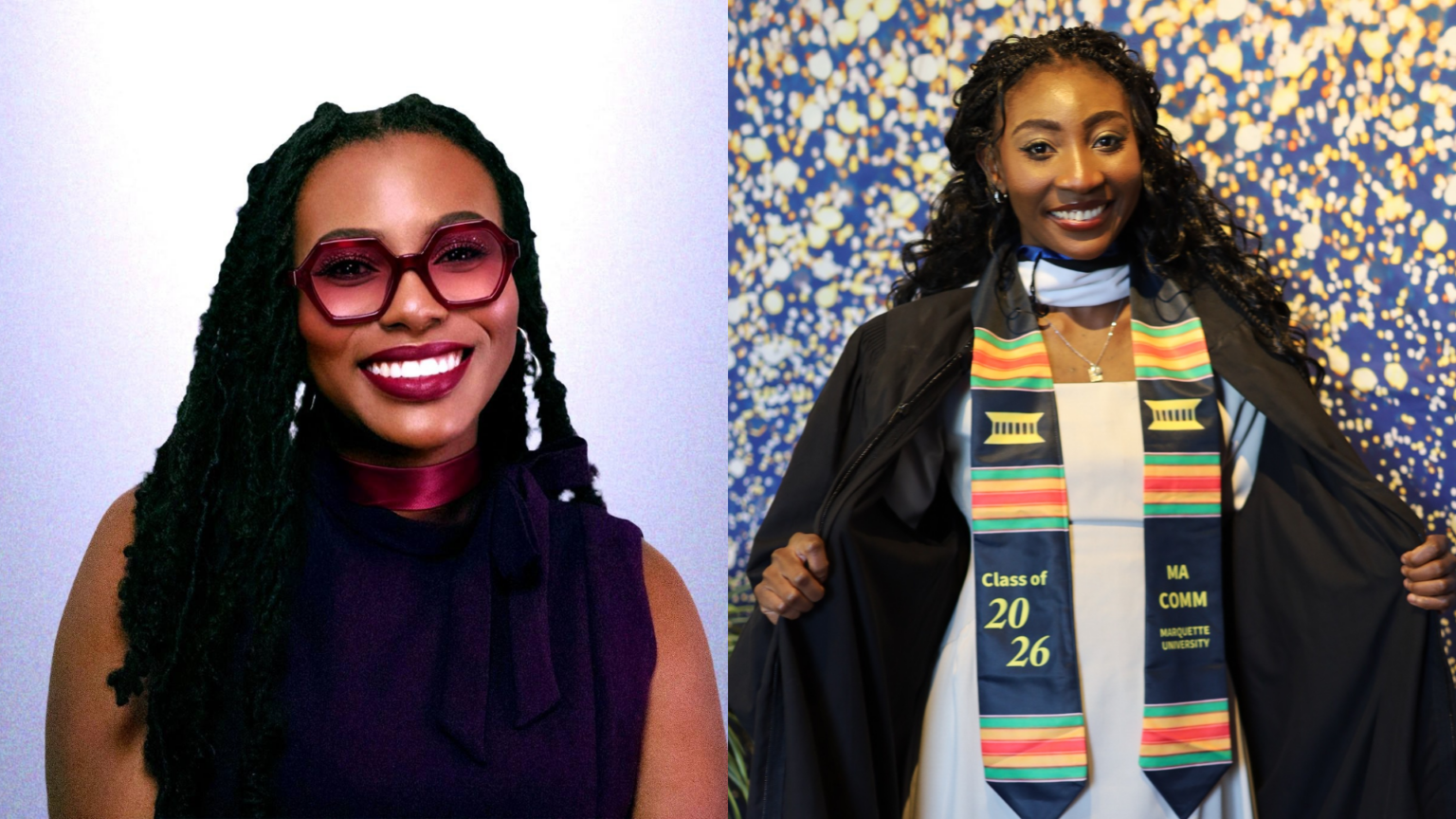
Simply by graduating from Marquette’s master’s program in communication and pursuing a Ph.D., Victoria Adjetey belongs to an exclusive club in her home country of Ghana.
“I grew up in a patriarchal society where women are marginalized,” says Adjetey, who graduated the program in 2026. “I’m proud to say that I am part of the 0.01 percent of women in my community to pursue higher education at the Ph.D. level.”
That ambition was made possible by Adjetey’s decision to pursue a Master of Arts degree from the Diederich College of Communication. Totaling 30 credits, the M.A. in Communication program offers students a research-centric program grounded in personalized engagement with experienced faculty. The program has two optional focus areas: advertising/public relations and media and public engagement.
The program’s mix of experienced, hands-on faculty and rigorous coursework is designed to help students who want to pursue a Ph.D. Adjetey gained deep experience with writing proposals and literature reviews while getting constant feedback from her advisers, Associate Professor Dr. Sudeshna Roy and Associate Dean for Graduate Studies and Research Dr. Sumana Chattopadhyay. All the practice paid off with a 4.0 GPA and a Presidential Fellowship at Temple University, which is reserved for the strongest incoming Ph.D. candidates and comes with four years of full financial backing.
“The professors at Marquette get deep into the details with you; they make sure you know how to cite in APA style, how to structure your work and how to present it. The honest critiques that I got from them have shaped me as a scholar,” Adjetey says.
Phylix Asilevi, who also came from Ghana and obtained her Master of Arts in Communication in 2026, appreciated that the program was flexible on what its students could research. She recalls how Dr. Patrick Johnson, assistant professor of journalism, encouraged her to take a more global view with her journalism ethics research. Asilevi considers Johnson one of her mentors and says his encouragement helped her think more deeply about how her Ghanaian background could inform future scholarship.
“Marquette’s values have shaped so many things about me. I’m proud and grateful to have gone there, and I couldn’t have chosen a better school.”
Victoria Adjetey, Class of 2026 M.A. Graduate from the Diederich College of Communication
“Patrick was very helpful to me in encouraging me to not limit my view to just an American context,” Asilevi says. “Ghanaian journalism ethics is very westernized. It has elements of transparency, objectivity, accuracy — all of those familiar concepts. I’m looking at how we can apply African ethics, such as Ubuntu, a South African philosophy of interconnectedness, to journalism.”
Adjetey also focused on her home country in her research. She is specifically interested in how West African women are represented in digital media and how modern tools might give them more control over their own stories. Her work focuses specifically on survivors of gender-based violence.
Both Adjetey and Asilevi pushed themselves outside the classroom. Adjetey presented her work at the International Association for Media and Communication Research Conference in Singapore and the National Communication Association Conference in Denver, among others. Asilevi presented her research at the National Communication Association Conference and the AEJMC Colloquium.
“Everything that Dr. Roy and Dr. Chattopadhyay told me and exposed me to prepared me for what I’m doing now,” Adjetey says. “I’m repeating some of the things that I learned at Marquette in my courses at the Ph.D. level now, and I can’t thank them enough for nurturing me.”
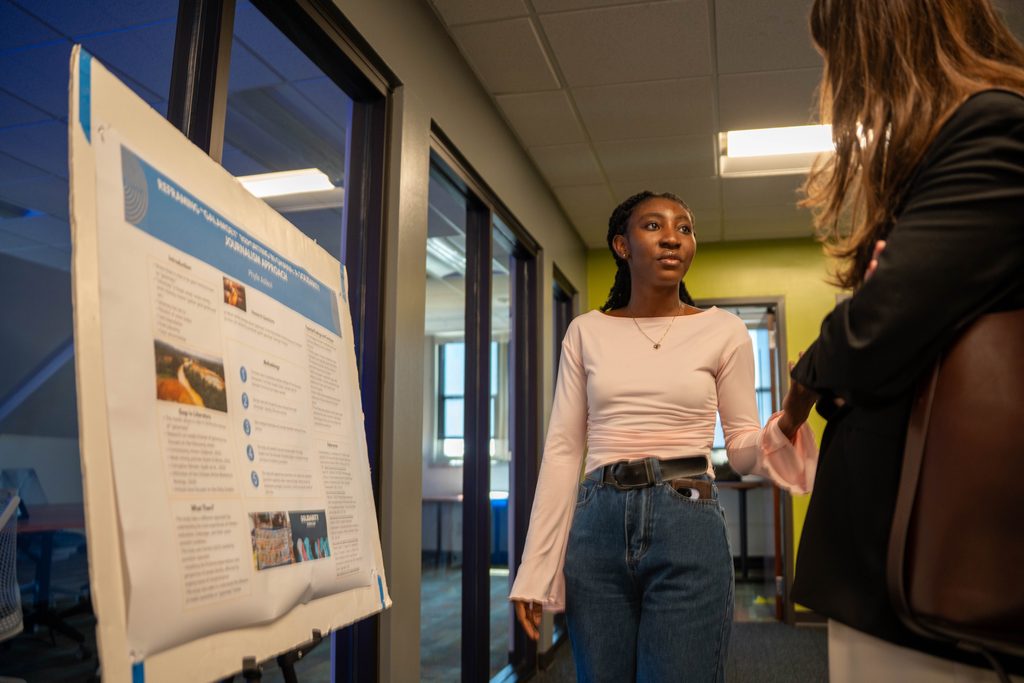
During her time at Marquette, Asilevi also began exploring what a future in academia might look like. In 2025, she applied to five Ph.D. programs and was admitted to three. She ultimately chose the University of Wisconsin–Madison, where she was one of five students admitted to its Journalism and Mass Communication Ph.D. program from more than 100 applicants. Her experience at Marquette, including the research training, mentorship and teaching opportunities she received, helped prepare her for the next stage of her academic journey.
“When I think of how Marquette helped me become the scholar that I am, I think about Dr. Johnson’s research ethics class,” Asilevi says. “It made me think about not just what was in the class, but what was missing from Western ethics, and that informs a lot of my research now.”
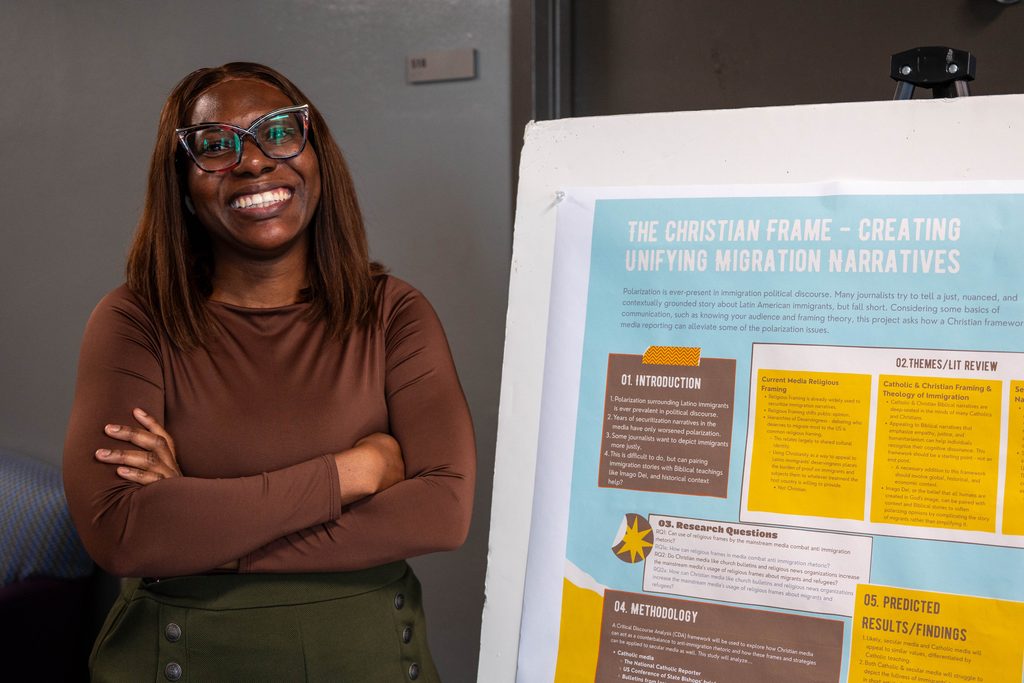
While students in the Master of Arts program spend a lot of time studying in the library, they are also able to enjoy Milwaukee. Adjetey fondly recalls bus trips to Mayfair Mall, relaxing at Bradford Beach and walks through downtown, which is located just off the east side of campus. Sometimes, a trip to the gym or window shopping at T.J. Maxx would provide a much-needed respite from studying.
Despite now living Philadelphia and coming from an ocean away, Adjetey now answers “Milwaukee” when people ask where she is from, mostly because of how foundational Marquette was to her life.
“Marquette’s values have shaped so many things about me. I’m proud and grateful to have gone there, and I couldn’t have chosen a better school,” she says.