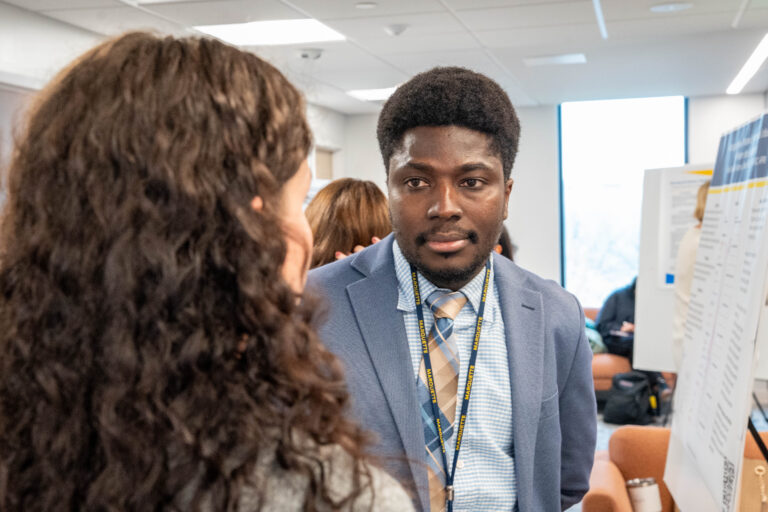
It was not an easy decision for Dr. Henry Duah to come to America from his home country of Ghana.
“I have a brother here in the U.S., but otherwise, all my family is in Ghana,” the assistant professor of nursing says.
Duah has made a sizable impact since first arriving in the U.S. in 2021 to pursue his Ph.D. at the University of Cincinnati. While there, he became interested in studying the prevalence and effects of opioid and substance misuse among pregnant women. That interest has continued during his time at Marquette Nursing, where he is wrapping up his first year as a faculty member.
In this Q&A, Duah talks about his research, what he misses from back home and how nursing education differs in his new home.
How did you decide to make the interaction between opioid abuse and maternal health outcomes your primary research focus?
When I got to Cincinnati, my mentors were already studying opioids. As I got deeper into working with them, I became more passionate about coming up with recommendations to improve maternal health outcomes for people who were struggling with addiction.
What have you been able to find about opioid misuse among pregnant women over the course of your studies?
I used data from the National Survey on Drug Use and Health, which ran from 2015 to 2019. I was looking at predictors of opioid misuse and abuse among pregnant women. What I found was a 5.2% rate of opioid misuse among all pregnant women in the U.S. over the past year, as well as heterogeneity in the impact of race on this trend.
One of the things I’d be interested in finding out more about is whether there is any difference between smaller minority groups. A lot of times, smaller populations are lumped together. We’re not able to understand, say, the rates of opioid abuse among native Hawaiians and Pacific Islander groups because they’re often categorized as “others” in surveys. Subgroups of people may exhibit different tendencies, and it’s important to get a handle on that.
What kind of interaction with the subjects of your study have you had? Have you been able to talk to many of them in person?
I do a lot more data-driven research, so I don’t have a lot of direct interaction with participants. My hope is that I’ll find some community-based resources here in Milwaukee to make some of this more participatory in the future. Joining up with neighborhood groups in the city will be important.
What are some of the biggest differences in nursing education between America and Ghana?
We have a lot of technological integration with our education system in America that we don’t have in Ghana. There have been some initiatives to increase technological integration, but we are still lagging.
The relationship between students and faculty is also very different. Here in the U.S., students can email me freely whenever they have questions about assignments. In Ghana, the faculty-student relationship is generally more formal.
Is there anything besides your family that you miss about Ghana? Was there anything that was hard to adjust to in America?
Ghana is a very social environment where you are friends with everybody. In the U.S., it’s more individualistic whereas in Ghana, it’s a more communal place. I sort of miss the community aspect of life in Ghana. And then, of course, the food is very different; sometimes, I miss that too.
What do you like to do with your free time?
I joined the Ghanaian community here and we have a soccer team. We play at Norris Park right here on campus. I play midfield. We actually played in the intramurals league with students last year; we made it to the quarterfinals before getting eliminated.
Sometimes I go and play table tennis too. I also go to church.