Taking blood tests with your mobile phone? Thanks to Marquette researchers, that future is nearer than you think.
Dr. Sheikh Iqbal Ahamed’s Ubicomp Lab is pioneering a patented system to provide low-cost, needle-free readings of white blood cell levels and other common blood markers.
5 min. read
Dr. Sheikh Iqbal Ahamed and partners have achieved impressive results with a system that uses a smartphone camera equipped with a blue-light filter to read white blood cell levels from the surface of fingertips. A related company collaborating with Marquette on technology transfer has received $250,000 in seed funding and been selected for a Harvard Business School’s founders bootcamp.
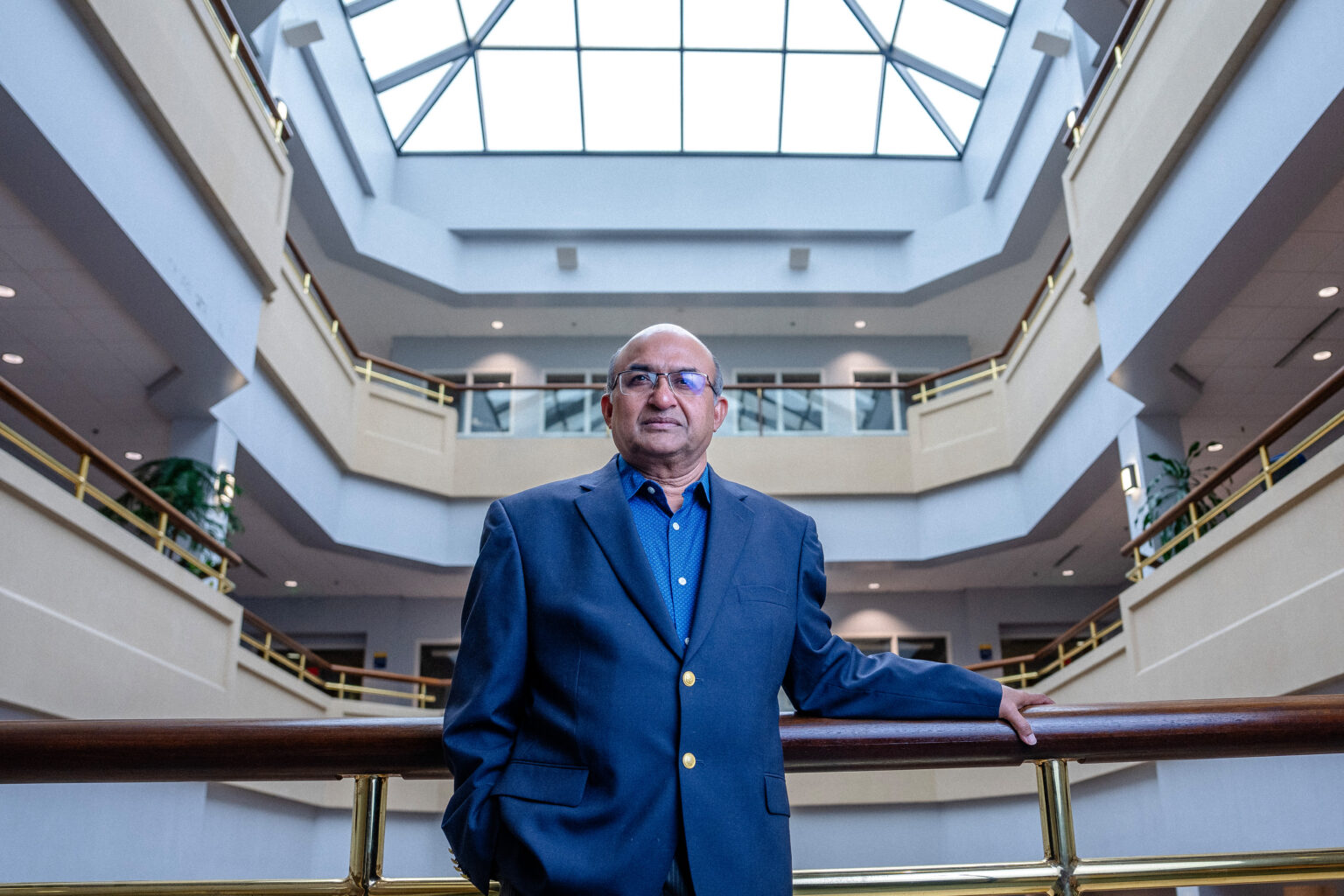
Today, biometric data such as fingerprints and facial scans can unlock our phone screens and open our digital wallets. But someday soon, Dr. Sheikh Iqbal Ahamed, professor of computer science, and partners in his Ubicomp Lab at Marquette expect that similar scans will be used to read your vitals or report blood levels to medical specialists.
“My dream has been to come up with noninvasive solutions,” Ahamed says. “From your face, can I give you some indication that, ‘Oh, your blood sugar level is high?’
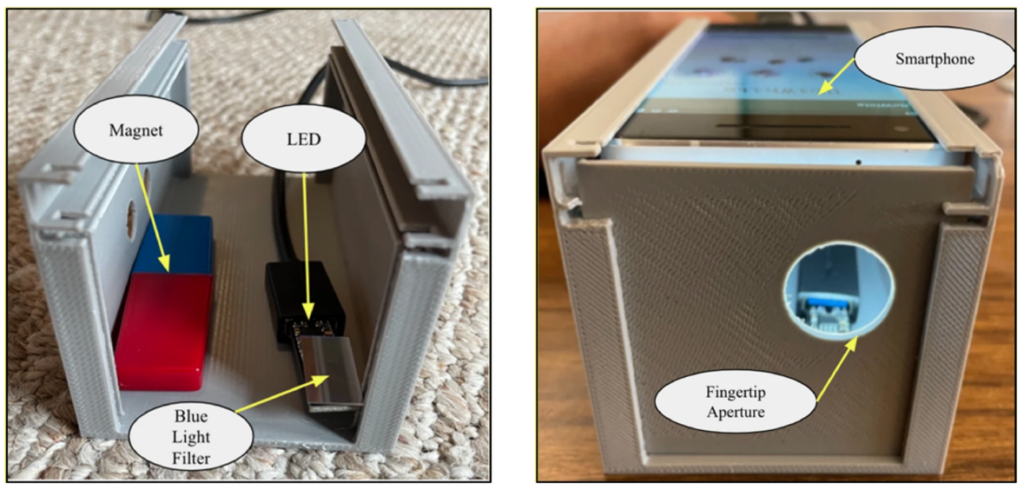
Conducting blood tests with a smartphone, not a syringe, sounds incredibly futuristic, but it’s a vision that Ahamed is working hard to make a reality. In fact, his lab has patented, piloted and begun testing UbiWhite, a system that uses a smartphone camera equipped with a blue-light filter, an LED flashlight, a magnet and the surface of a patient’s fingertip to generate the white blood cell readings that are crucial for diagnosing and treating serious infections, leukemia, lymphoma and other diseases. Research papers on the system have been featured in prominent journals published by Nature and the Institute of Electrical and Electronics Engineers, or IEEE.
As a pioneer in the field of ubiquitous computing who was named among the top 2 percent of world scientists in AI, image processing and software engineering by Stanford University, Ahamed leverages the technology and increasingly the artificial intelligence embedded in everyday objects such as smartphones for a variety of strategic ends. Most recently, his quest has been making healthcare less painful (fewer pinpricks and blood draws) and more accessible through UbiWhite and a broader mobile health platform designed to help patients and their physicians manage common medical conditions.
As doctoral student Masud Rabbani, Grad ’25, puts it, the lab is fast at work turning smartphones into “your own personal diagnosis wellness product.”
Beyond white blood cell count, Ahamed and those in his lab are targeting the capacity to test levels of creatinine, hemoglobin and blood glucose, along with vital signs such as blood pressure and heart rate, using little more than a short video recording.
With continued progress, the team’s mHealth tool and related ubiquitous computing advances could lead to transformative change in our health systems. Ahamed points to the potential for expanded home-based care and overall reduced healthcare costs. Making care available to more people in their homes could also allow more patients to access medical specialists, because they may no longer have to travel long distances to visit them. The system may also lower care burdens in triage centers, with medical teams handling low-level concerns from a computer screen.
“When you go to any doctor’s visit or do any lab test, it’s costly, right? Even with insurance, it’s costly,” says Sakifa Aktar, a doctoral student in the lab. “Our goal is a low-cost, non-invasive, not painful, needleless system” for health monitoring, both at home and in the hospital.
Every year, U.S. doctors and clinics administer more than 1 billion complete blood count tests, at a cost of about $30 each. In addition to drastically reducing those costs, video-based diagnostics could also provide test results more quickly. Such ideas are gaining ground, as researchers at the University of Washington and the Swiss Federal Institute of Technology also experiment with smartphones as diagnostic health tools.
UbiWhite and how it works: Inside a custom compartment, the UbiWhite system incorporates a magnet (which acts on iron in red blood cells), an LED light and a blue-light filter for a smartphone that slides into the top channel. When the front panel is closed and a fingertip inserted, the camera reveals red blood cells, shown as red pixels in each video frame. Frame-by-frame analysis determines white blood cell levels based on disturbance of blood flow.
To count white blood cells, Ahamed’s system, unveiled in a 2025 paper in Nature’s Scientific Reports, uses the filter-equipped smartphone and a magnet to capture short videos of a patient’s fingertip. With a bright light shining on the finger and the filter absorbing blue light, the device illuminates red blood cells — shown as red pixels in each video frame — as they flow through veins, a process helped along by the magnet (hemoglobin found in red blood cells is magnetic). Through frame-by-frame comparisons, the system is able to calculate disruptions in blood flow caused by the presence of white blood cells. Computer algorithms, boosted by machine learning, allow the team to estimate white blood cell count based on the observed blood flow.
Understanding white blood cell counts is important for a number of illnesses, including leukemia, because white blood cells provide immune support and protect the body from infection, unless disease causes them to malfunction and crowd out working cells. The lab tested the solution in a pilot study of 20 patients, where it showed no significant difference between the tool’s algorithmic predictions and actual, measured white blood cell counts. To further validate UbiWhite’s efficacy, the lab is collaborating with the Georgia Cancer Center on data gathering from 200 subjects and with researchers in Ahamed’s home country of Bangladesh.
UbiWhite’s technology has also been licensed to UbiVital, a company Ahamed formed to collaborate with Marquette on commercializing the technology. The company has received $250,000 in seed funding, been selected for Harvard Business School’s Foundry Bootcamp for founders of high-impactventures, and is seeking a corporate licensing partner to develop UbiWhite along one of two tracks. A more accessible route would create a wellness-focused app for people to monitor immunity indicators and seek follow-up care, if indicated. The high-investment route would involve clinical trials, government regulatory clearance and future medical applications such as monitoring patients undergoing chemotherapy.
The tools would not replace current clinical standards, according to Rabbani, who has worked in Ahamed’s lab for five years, but they could increase medical access for people living in rural areas or provide more consistent monitoring, particularly for those who live alone.
Ahamed’s current work on UbiVital and mHealth builds on decades of computer science leadership and more than a decade of work in computer and phone-related health applications. Initially, Ahamed focused on ubiquitous computing applications in smart classrooms and security systems until, eventually, he noticed a gaping hole in wellness analytics. He began working to directly help patients in the late aughts, when he and his colleagues introduced the idea of a “Wellness Monitor” that networked small devices like mobile phones and smartwatches to constantly monitor certain health metrics among cancer patients.
Later, using funding from the National Institutes of Health, Ahamed helped develop another mobile platform where caregivers of children with autism spectrum disorder could document milestones, creating a longitudinal data log that could help inform care over time. And he has recently collaborated with colleagues at Marquette, the Medical College of Wisconsin and the U.S. Department of Veterans Affairs on a widely available app, Battlepeer, that offers peer-to-peer mental health support to veterans via their smartphones.
“The strength of this lab is in the students. They are the ones who make dreams a reality.”
Dr. Sheikh Iqbal Ahamed
While serving in leadership positions in his field — he currently co-chairs IEEE’s COMPSAC conference, which is attended by 400 researchers from 50 countries — Ahamed has also built a legacy at Marquette, including by supporting the creation of the university’s dedicated Computer Science Department. In his decades at Marquette, his group has welcomed dozens of doctoral students, many of them international scholars. Those students fill key roles in the Ubicomp Lab, regularly appearing alongside Ahamed as authors on published papers.
“He takes so much time to guide each student individually,” says doctoral student Paramita Basak Upama.
Dr. Padmapriya Velupillai Meikandan, a postdoc in the lab who works on the mHealth platform along with research on applying blockchain technologies to healthcare services, echoes that sentiment. “He gives researchers the freedom to explore ideas while also providing the right guidance,” she says. “That balance helped me grow both technically and professionally.”
Overall, Ahamed says his goal is to support future researchers, while making healthcare more accessible and inexpensive for the masses. “The strength of this lab is in the students. They are the ones who make dreams a reality,” says Ahamed. “The students bring experience from computer science, data science and electrical engineering — all essential in creating these systems.”
Related Articles
Campus Life, MU+ Milwaukee & Beyond, Stories at MU