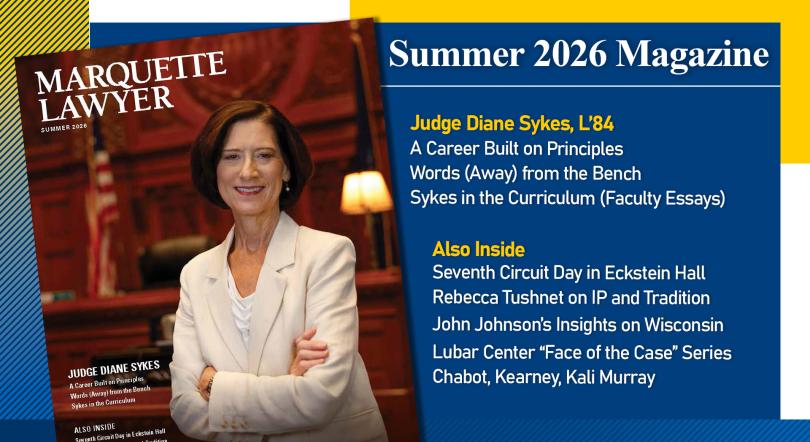


The hundreds of opinions written by the Hon. Diane S. Sykes in her career on the U.S. Court of Appeals for the Seventh Circuit and the Wisconsin Supreme Court make up a wealth of material about the law. In the links below, seven members of the Marquette Law School faculty discuss how various of Sykes’s writings have been a source for study and discussions with their students.
Torts

Professor Alex Lemann
My first-year torts class reaches something of a climax when we read Palsgraf v. Long Island Railroad Co., the landmark 1928 New York Court of Appeals decision. Palsgraf is one of those old chestnuts that are simply irresistible to law professors. It combines engrossing facts, beautiful writing, and philosophical richness. I would probably assign it even if it didn’t have canonical status and thus represent part of the esoteric lingua franca by which first-year law students are inducted into the cult of lawyers. Read more…
Legal Writing

Professor Lisa A. Mazzie
Every fall semester, my first-year class in Legal Analysis, Writing & Research 1 is filled with eager students, excited to learn the law.
Law students and lawyers know that legal writing is a skills class. I don’t teach doctrine for its own sake, as does, say, a torts professor who teaches about negligence, its elements, and its nuances. I work with students as they learn how to work with doctrine, doing so through an issue grounded in any area of law. Read more…
Criminal Law

Professor Chad M. Oldfather
A little more than a decade ago, I switched from teaching Criminal Law with a traditional casebook, featuring opinions from across the United States, to doing so using almost entirely Wisconsin materials. One of the benefits of the change is that it allows students to start to familiarize themselves with the criminal code many of them will spend their lives working with. They begin to learn how to work with the statutes, including how to interpret their occasionally unclear provisions. So the 2004 case of State ex rel. Kalal v. Circuit Court for Dane County—more often referred to simply as Kalal—would have appeared in the materials I prepared no matter what the statute it interpreted Read more…
Contracts

Professor Karen Sandrik
In Contracts, a required first-year course each fall, we use one opinion by Judge Diane Sykes. And this past year, a second of the judge’s opinions shaped my final exam.
The case we study together is Karma International, LLC v. Indianapolis Motor Speedway, LLC, a 2019 Seventh Circuit decision. The opening line draws us in: “The Indianapolis 500 race has been a fixture of American life since 1911, interrupted only by world war.” Read more…
Property

Professor David R. Papke
I switch over late in the semester in first-year Property from traditional common-law doctrine to modern zoning law. The students for the most part welcome the switch, but some find the abundant map amendments, conditional permits, special uses, and assorted variances as problematic additions to existing zoning ordinances. Fortunately for instructor and students alike, Justice Diane Sykes’s thoughtful opinion for the Wisconsin Supreme Court in State ex rel. Ziervogel v. Board of Adjustment (2004) not only sorts out the state standards for variances but also provides a valuable metaphor for understanding how variances might best be conceived. Read more…
Copyrights and Civil Procedure

Professor Bruce Boyden
We have used opinions by Judge Diane Sykes in two of my classes. In both instances, I looked for an opinion that presented a complicated doctrinal issue in clear terms that students could understand and debate.
In Copyrights, for many years, I supplemented the casebook with Kelley v. Chicago Park District, a Seventh Circuit decision from 2011. Kelley deals with a basic yet challenging question: what, exactly, is a copyrightable work? Read more…
Advanced Civil Procedure

Dean Joseph D. Kearney
In Advanced Civil Procedure, an upper-level elective offered each spring, we have occasion to read all or parts of five opinions by the Hon. Diane Sykes. One we consider for its role in establishing the law, whereas the others we take up more for their exemplifying it. The distinction is familiar in the law: Some cases break ground or set precedent, while others are less well-known but useful for their representativeness of a doctrine or concept. Both sorts can be valuable in teaching and learning. Read more…
This article was first featured in the Summer 2026 issue of Marquette Lawyer Magazine.