Spinal cord injuries can be devastating, compromising people’s ability to walk, talk, breathe efficiently and complete daily tasks. Dr. Jordan Williams — assistant professor of biomedical engineering and one of several Marquette faculty members tackling the challenge of restoring lost function — is encouraged that scientists can now stimulate meaningful activity in muscles of individuals with injured spinal cords.
But that’s just a first step. Stimulation alone does not produce the precise coordination of multiple muscle groups that allows someone to pick up a coffee cup or walk to the door. Enabling those movements, Williams says, will require bioengineers to choreograph specific nerves firing in specific sequences for various muscles to contract and relax, each at the right moment.
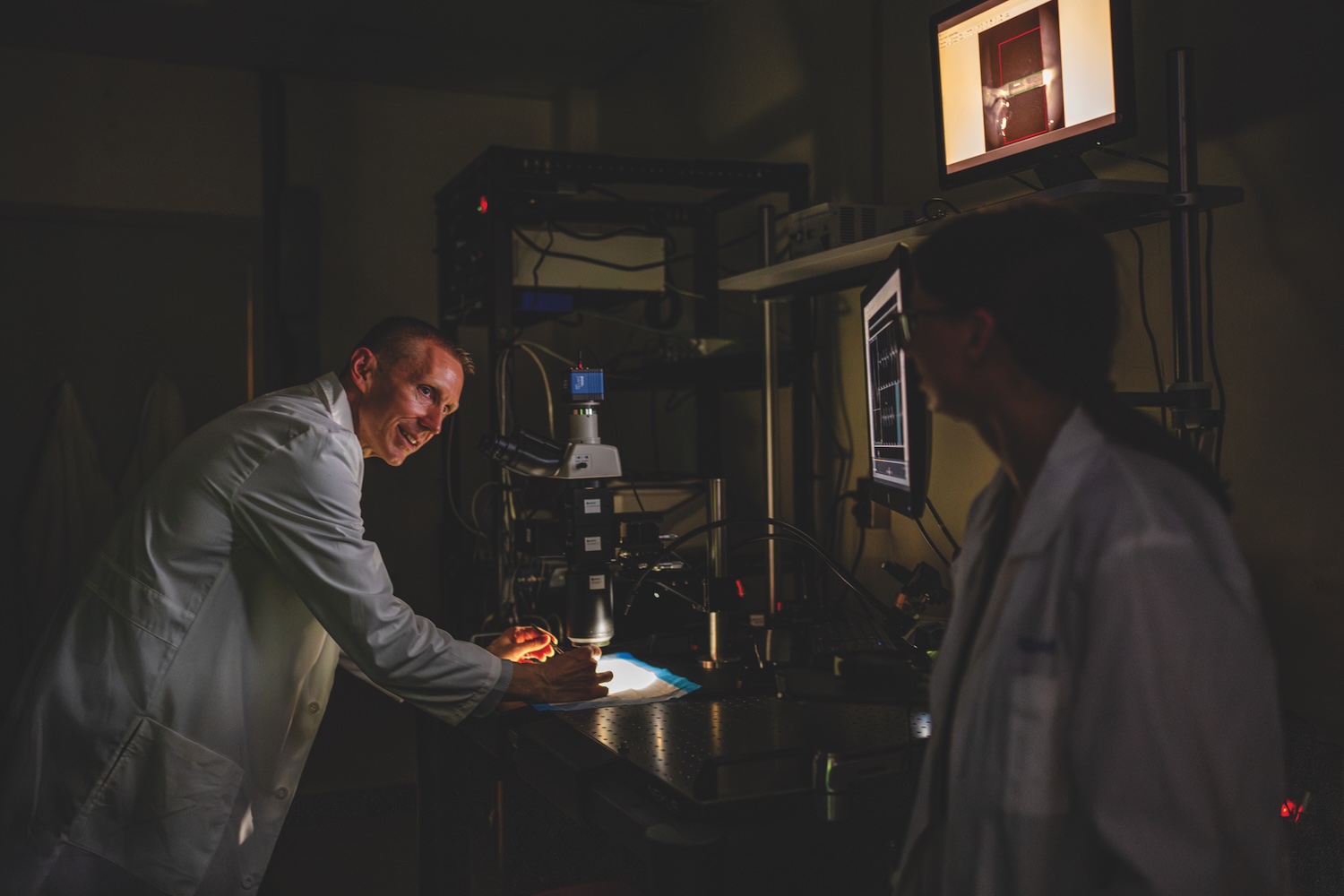
In August 2025, Williams received a $400,000 award from the Craig H. Neilsen Foundation to test the use of an emerging approach, optogenetic nerve stimulation, to facilitate this complicated dance. This method uses virus-delivered gene therapy to modify neurons to respond to pulses of light, rather than electric signals. This therapy allows Williams to target individual neurons or nerve types, offering a layer of specificity that other methods lack. Different viruses coded to different wavelengths of light allow different muscle groups to be stimulated independently of one another. Creating coordinated, complex movements requires this level of specificity and differentiation, Williams says.
“It sounds very sci-fi,” Williams confesses, but his project is an important next step in the quest to help people resume daily tasks after spinal cord injuries. While testing this approach in rodent subjects, Williams is anticipating a future phase incorporating an implanted brain-computer interface to help decode task-related brain signals and translate them into the coordinated light pulses that make those actions happen. The hope is for the system to bypass the injury and allow neurons to talk to muscles as before.
In the College of Health Sciences, Dr. Kristi Streeter, assistant professor of physical therapy, has a $2.7 million R01 award from NIH to target the breathing impairments that are a primary cause of death in those with injured spinal cords. By activating sensory neurons carrying sensory information from the diaphragm, she and her team aim to strengthen feedback loops, using the body’s neuroplasticity to restore respiratory neural function and improve breathing. And her colleague, Dr. Murray Blackmore, professor of biomedical sciences, has had support from multiple NIH R01 grants to investigate stimulating regrowth of damaged spinal cord neurons through viral-delivered gene therapy.

“Marquette is a relatively small research institution, but we’re showing that we can examine these cutting-edge technologies and really bring them to the forefront,” Williams says.

Illustrations by SHOUT