
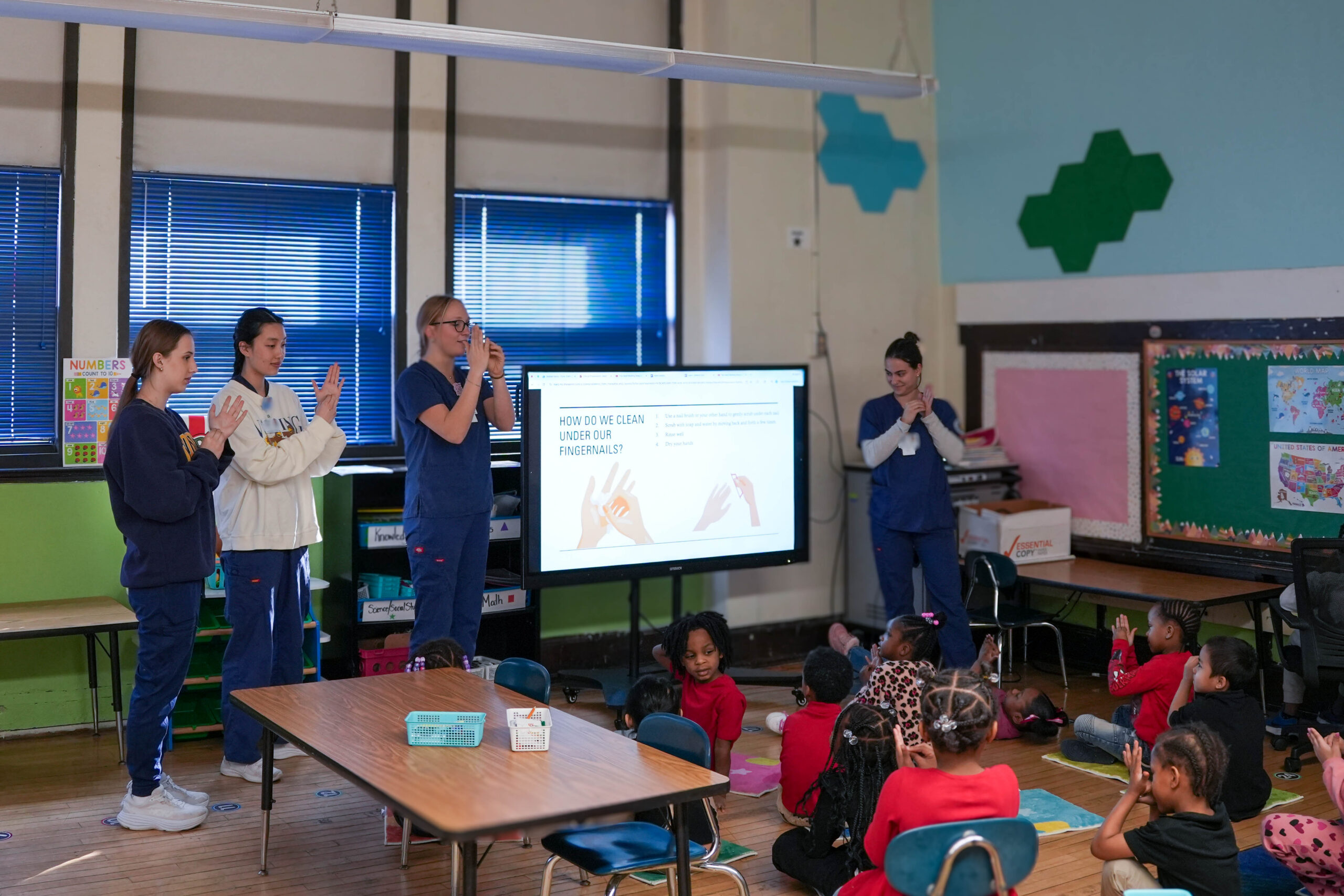
If Dionne Young’s nursing students are making an impact, she hears about it quickly from one of the kids at her Seton Catholic Schools clinical site.
“We’ll have little kids running up to us with their water bottles and saying, ‘Hey, I’m drinking water, just like you told me!’” says Young, a clinical nursing instructor. “When we come into the building, we’ll get hugs from the back, because they know who we are and they know that the nurse is here.”
Marquette Nursing partners with 15 different schools within the Seton Family of Catholic Schools. Each semester, dozens of future nurses spend a semester at one of the schools for their community health clinical rotations. It’s an up-close look at what the life of a school nurse entails.
Most people do not remember school nurses having a presence outside of their dedicated offices, which were to be visited only when feeling sick. That concept of a school nurse has changed drastically. “My students are not waiting for a student to come into their office, they’re going into classrooms proactively,” Young says. Nursing students take on recess duty, perform assessments of community health needs and give weekly presentations on ways for students to live healthier lives.
Junior Izzy Field confronted the challenge headfirst. When Field first walked into her school, she saw students from four to 14 years old all sharing the same space. She also noticed that many students were eating breakfast at school before classes started for the day and intuited that some of them qualified for free or reduced-price meals. That led her to make nutrition a core focus of her time there.
“For the first three weeks of that clinical rotation, we went around to all the classrooms and taught students about what a healthy diet looks like,” Field says.
Students also get to see how their work overlaps with social determinants of health. Some of the Marquette nurses are placed in predominantly Hispanic schools where students have concerns over immigration enforcement. Other students live in neighborhoods where gun violence is prevalent; it is not rare for students to know gun violence victims.
“I love being able to understand where others are coming from and being a support system for them, whether it’s kids or anyone else.”
Izzy Field, Marquette Nursing Junior
To address these kinds of concerns, it’s important to establish trust and meet students where they are.
“We’ve been there long enough that they get to know us, and we get to know them; that makes it really enjoyable,” Field says.
The College of Nursing partners with more than 40 organizations in southeast Wisconsin and Illinois, which provide over 100 clinical sites to future nurses. Marquette’s relationship with Seton Catholic Schools is similar to the one it has with Milwaukee Academy of Science, where the college maintains a nurse-in-residence to train students on the finer points of community health. These rotations occur before students ever step foot in a clinical setting.
“I like that they start us outside the hospital, because it makes you really apply what you’ve been learning in the fundamentals classes,” Field says. “We learn that you need to treat the whole person, not just the illness. That’s the Jesuit way of nursing and you get to apply that here.”
Field has worked in health care settings ever since her first job in a nursing home when she was 14. She sees a throughline between her early professional experiences and this one: help people thrive.
“I love being able to understand where others are coming from and being a support system for them, whether it’s kids or anyone else,” Field says.
“I’m hoping that through this experience, students understand that not every nurse has to wear a stethoscope and not every nurse has to give an injection, but the love, the compassion, the listening and the education you give is all the same,” Young says.
Editor’s note: Marquette President Kimo Ah Yun serves on the Seton Catholic Schools board of directors.