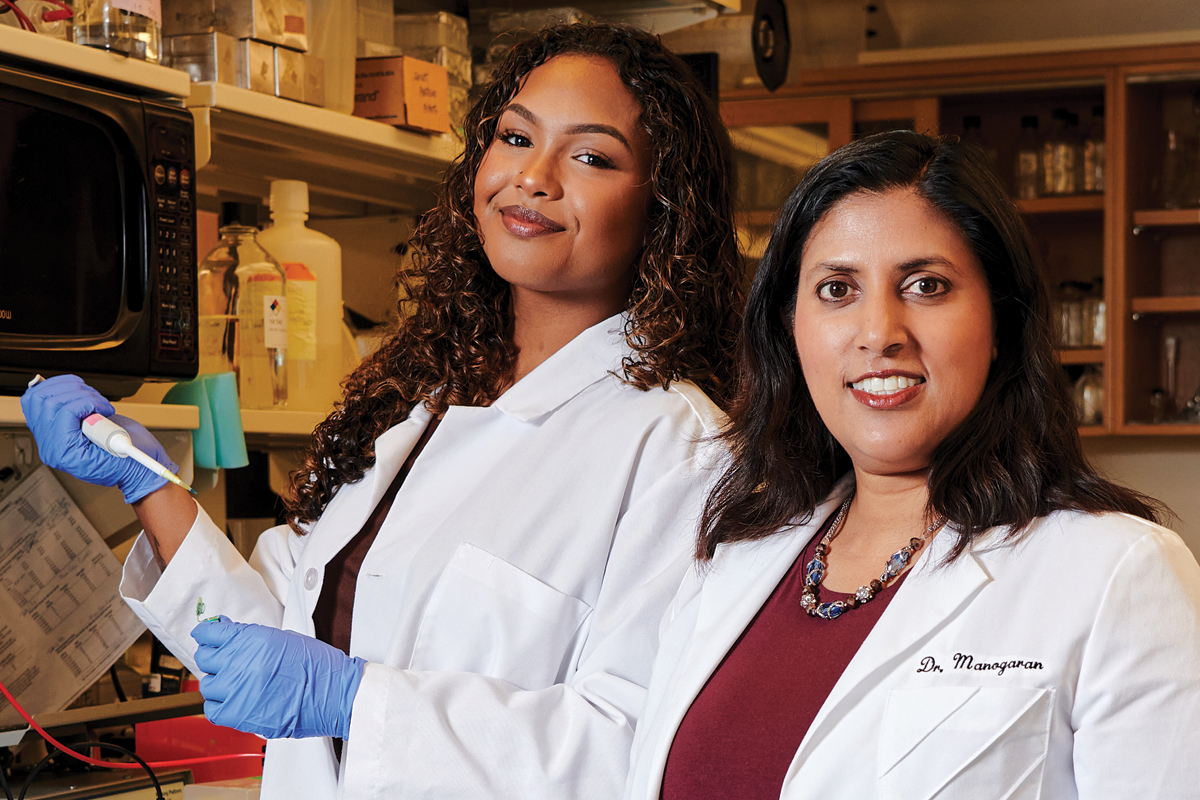
By the time Natalia Beans first arrived on campus, she had survived childhood cancer, earned a full ride as a Marquette Urban Scholar, and was already chasing a dream to give back to the cancer community that shaped her early life. Since then, the now-junior has found a sense of belonging at Marquette, co-authored a research paper and earned a Goldwater Scholarship — a national award recognizing STEM students poised to be the next generation of research leaders. It all started when Dr. Anita Manogaran took a chance on a first-year student.
Always say yes
Beans’ research journey began when her adviser, Dr. Rosemary Stuart, professor of biological sciences, encouraged her to take Foundations in Biological Inquiry, a research course for freshmen. “Research wasn’t really on my radar at that point, but I fell in love with the class,” Beans says. Seeing her enthusiasm, Stuart introduced Beans to Manogaran, Grad ’03, associate professor of biological sciences and director of graduate studies, who soon invited Beans to join her lab for a summer internship.
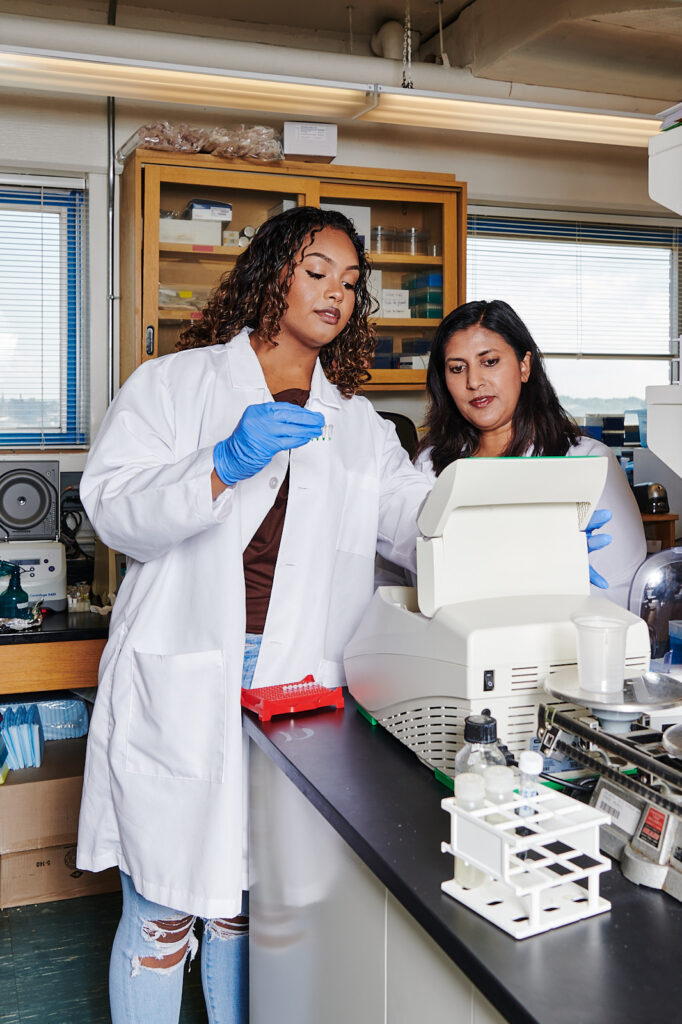
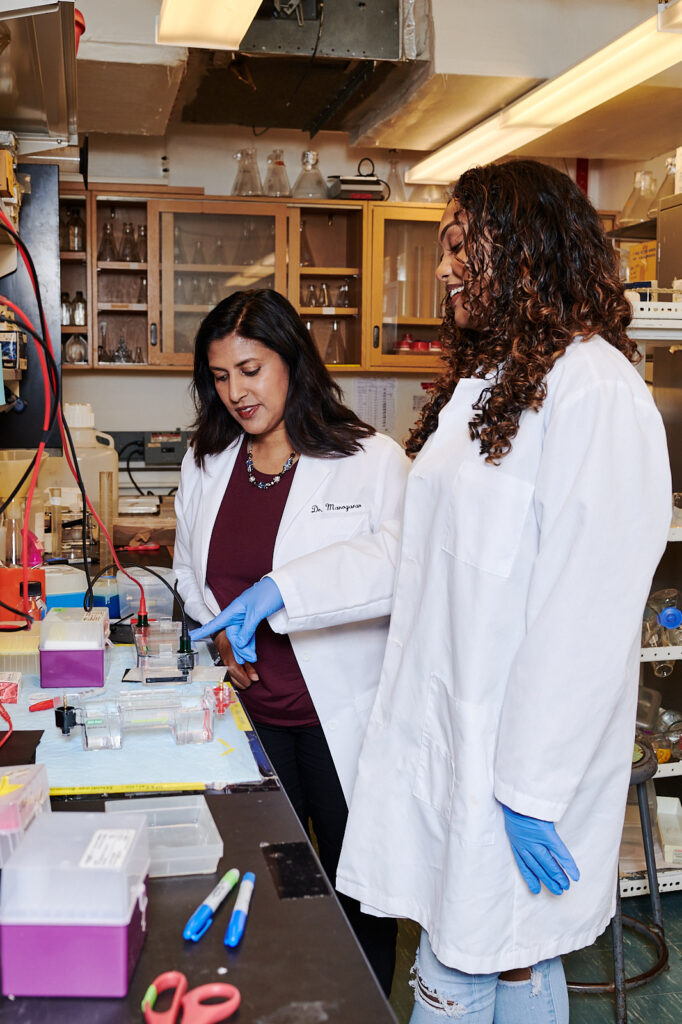
a prestigious Goldwater Scholarship.
“Most students come from high school taught that science is just a list of facts, but it’s not. It’s a search for knowledge and truth,” Manogaran says. “Natalia got that right away — from the get-go, she was asking probing questions you don’t normally get from freshmen.”
Beans hesitated at first — her schedule was packed with travel and competitions as a professional salsa dancer — but she took the chance. “In college, if you always say no, you don’t really get much,” she says. “So, I always say yes.”
Proteins misbehaving
Manogaran is an expert in the study of protein misfolding and aggregation, a biological phenomenon tied to diseases such as Alzheimer’s and Parkinson’s. With a $1 million grant from the National Science Foundation and another grant from the National Institutes of Health fueling her work, she leads a lab focused on how and why cells fail to manage misbehaving proteins as we age.
This biological process has also been associated with cancer risk, so the research resonated with Beans — and that connection only deepened as she found support in Manogaran’s mentorship-driven lab. “I can’t take credit for Natalia’s mentorship by myself,” Manogaran says, noting that Beans worked closely with a senior scientist, two doctoral students and a fellow undergrad. “Our lab is a team that comes together and brings people through so they’re successful.”
“It’s a very uplifting community,” Beans adds. “I’ve really liked working on the bench with people that are passionate and knowledgeable. I learn so much from them.”
Beans started out shadowing scientists in the lab but soon was engineering yeast strains to visualize where a key protein, Pab1, collects in the cell. Her strains were crucial to a study that identified the role of molecular chaperones, called Hsp70, in keeping the proteins from clumping together — preventing an event known as aggregation that can disrupt cellular function. “We couldn’t have answered the question without Natalia’s strains,” Manogaran says.
“It’s a very uplifting community. I’ve really liked working on the bench with people that are passionate and knowledgeable. I learn so much from them.”
Natalia Beans
The discovery brings Manogaran one step closer to her goal of understanding how healthy cells prevent proteins from aggregating, and why aging cells sometimes don’t. Insights like these are critical for unraveling the causes of neurodegenerative diseases associated with these protein aggregates, and could one day inform strategies to prevent or reverse them. It’s a perfect example of Marquette researchers pushing the frontiers of molecular biology while training the next generation of scientists along the way.
Dedicated to giving back
The resulting paper, which Beans co-authored as a sophomore, helped her stand out in her Goldwater application. “They knew that I’m taking this seriously, that it’s a dedication I’m willing to make because I know what it took to get here,” she says. “I’m not taking it for granted.”
Diagnosed with cancer before she was 2, Beans spent much of her early childhood in hospitals. Though she doesn’t remember much of the treatment, she knows the toll it took on her family — and still bears the scars. “My end goal is to help cancer patients and survivors, to give people that beacon of hope,” she says. “Whatever I end up doing with my Ph.D., whether I’m working with people or behind the scenes on preclinical trials, I just want people to know that my work is making a difference — that I’m here, and I’m helping them.”