
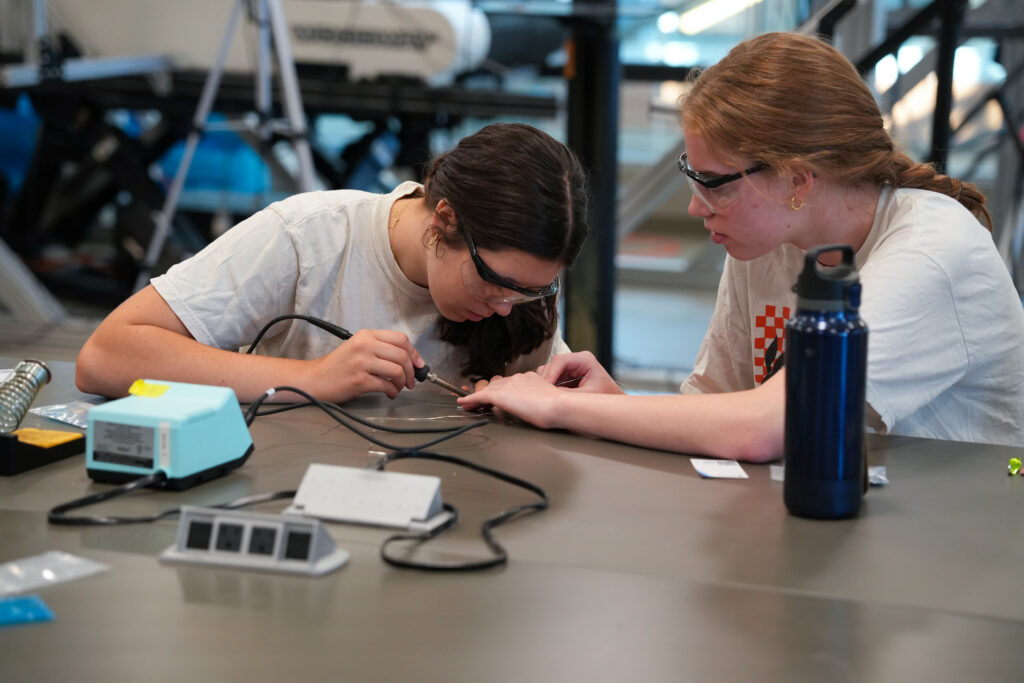
This summer at Marquette, a group of curious high school students gathered for a three-day, hands-on experience in biomedical engineering, exploring how engineers merge biology, mechanics and electronics to improve lives.
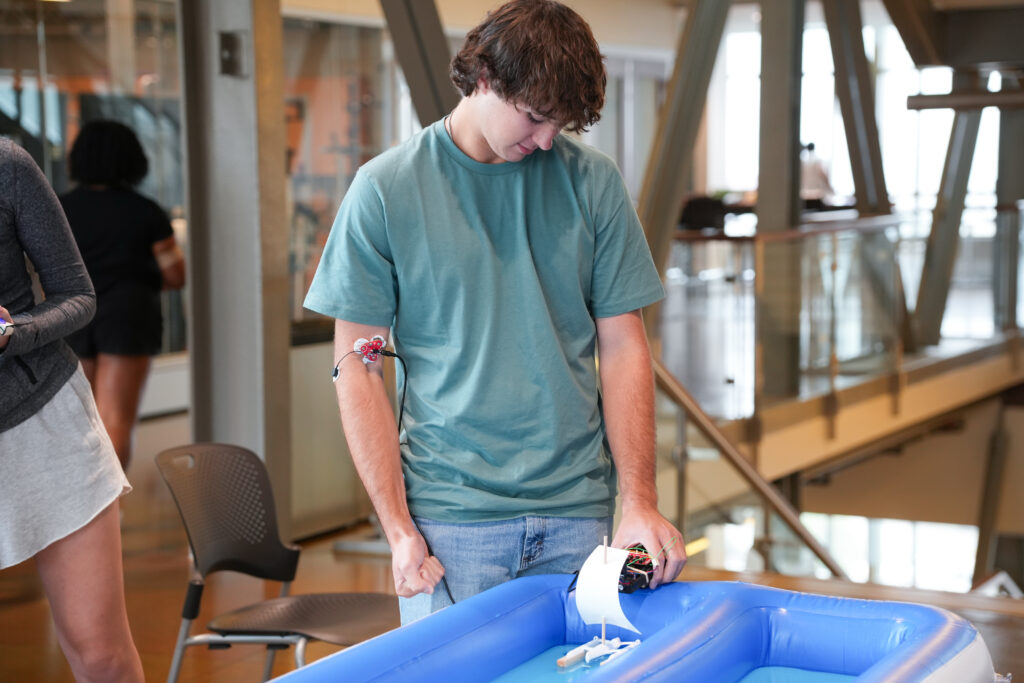
The camp, led by faculty and staff in the Opus College of Engineering, introduced students to the core concepts of biomechanics, bioelectronics and biocomputing. Students experimented by measuring signals from their muscles and writing code to interpret them. The camp culminated with a final project: the students used muscle contractions to control a fan-powered sailboat in a rain gutter regatta.
“That was really cool,” says Ella Walker, a high school student who participated in the camp. “Flexing the muscles and having that go into the computer was very interesting to me. I didn’t know how our muscle function largely affects the data that appears on the laptop.”
For Walker, who is considering a future in engineering, the camp offered not just fun projects, but also an expanded view of what biomedical engineers do. “I didn’t know how big of an influence biomedical engineers have on the entire medical field,” she says. “We were talking about CT scans and MRIs; all those machines are done by biomedical engineers. I thought that was really interesting.”
That kind of clarity is exactly what the camp’s organizers hoped students would take away.
“The main thing we want students to leave with is a sense of curiosity, empowerment and possibility, whether they choose engineering or not,” said Shahd Sawalhi, associate director of enrollment management and outreach for the college. “We want them to take away skills in problem-solving, being curious, figuring things out and hands-on experience.”
The camp is designed for high schoolers interested in STEM, especially those drawn to biomedical, mechanical, computer or electrical engineering. Students work with tools like Arduino microcontrollers, breadboards and sensors that measure muscle signals, all guided by faculty like Dr. Tanya Onushko, an instructor in Marquette’s Biomedical Engineering Department.
“As an engineer, you have to be able to design for issues that might arise for variability in different patients and users alike,” Onushko says. “Being able to play with these tools and devices gives them a little bit of inside knowledge on what they could expect out in their careers.”
The learning process isn’t always smooth, and that’s part of the point. “They’re a little intimidated,” Onushko says. “We try to remind them that they are here to learn. They can get to where they want to be if they just ask questions and be involved. The best way to learn is to fail and try again.”
That lesson resonated with Walker. “One skill that I’ve improved on is patience,” she says, “Not everything’s been perfect; there’s a lot of trial and error. That’s something I definitely need to work on, but I’ve worked on it at this camp.”
Unlike some traditional classrooms, the camp’s structure emphasizes collaboration and creativity. “The projects are cumulative, touching on multiple subjects,” Sawalhi says. “As a college student, you’d dive deeper into the details, but here, students get a general understanding and then apply it to a concept they can see in front of them.”
From simple coding challenges to using real muscle data to drive motion, students were encouraged to explore how various branches of engineering intersect and how engineers can make a difference in people’s lives.
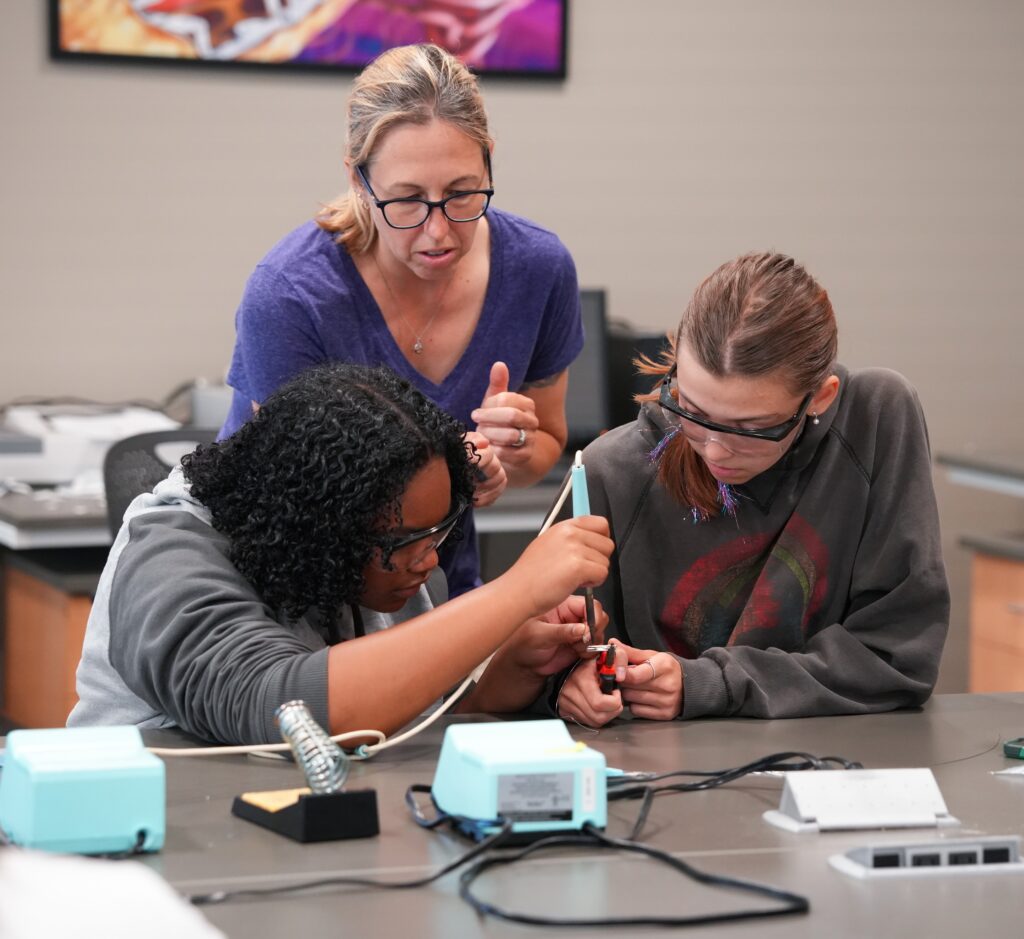
“Sometimes students don’t see that direct connection,” Onushko says. “They may not interact with the end users in their first job. But understanding both the development side and how the technology is applied gives them better insight into the challenges they’ll face as designers.”
The program also aims to welcome students from diverse backgrounds, regardless of experience. “We don’t require prior skills,” Sawalhi says. “Even if a student is eager but doesn’t have the background, we still allow them to join, they just need to be ready to keep up.”
And for students unsure about their future, the camp offers a space to explore possibilities without pressure.
“You don’t need to know you like biomedical engineering to do the camp,” Walker says. “Sometimes it’s great to just go into it and figure out, maybe this isn’t for me. Just be open to it. It’s a good way to figure out what you like to do, and what you don’t.”
For many, it’s also a confidence boost. “It’s made me more confident,” Walker adds. “Seeing all the different things, I’ve been very interested in it. It’s definitely helped me realize this is something I’m passionate about.”