This summer, more than 30 undergraduate engineering students are leading hands-on research projects alongside faculty experts in Marquette’s Opus College of Engineering. These projects offer students the opportunity to practice new technical skills, explore their curiosity and learn from experts in the field.
Fifteen of this year’s undergraduate researchers are supported by the Opus College’s Summer Undergraduate Research Fellows (SURF) program, with additional undergraduate research students being funded by faculty research grants. This summer’s cohort of research students also included a biology major from Wisconsin Lutheran College, who joined Dr. Brooke Mayer’s research efforts for the summer through Mayer’s nationwide leadership of the Science and Technologies for Phosphorus Sustainability (STEPS) Center.
In addition to hands-on laboratory experience, the Opus College’s summer undergraduate research programs offer a professional development seminar series for students to attend throughout the summer, covering topics from artificial intelligence in research to communicating technical work to a wider audience.
The students will reconvene for the Opus College’s Undergraduate Research Day on Friday, Nov. 7. This annual event is an opportunity to showcase recent undergraduate engineering research success and to gather as one Marquette engineering community.
As students prepare to return to their course work in a few weeks, several researchers shared their reflections from a summer focused on curiosity and discovery outside of the classroom.
Monica Dixon
Civil engineering major
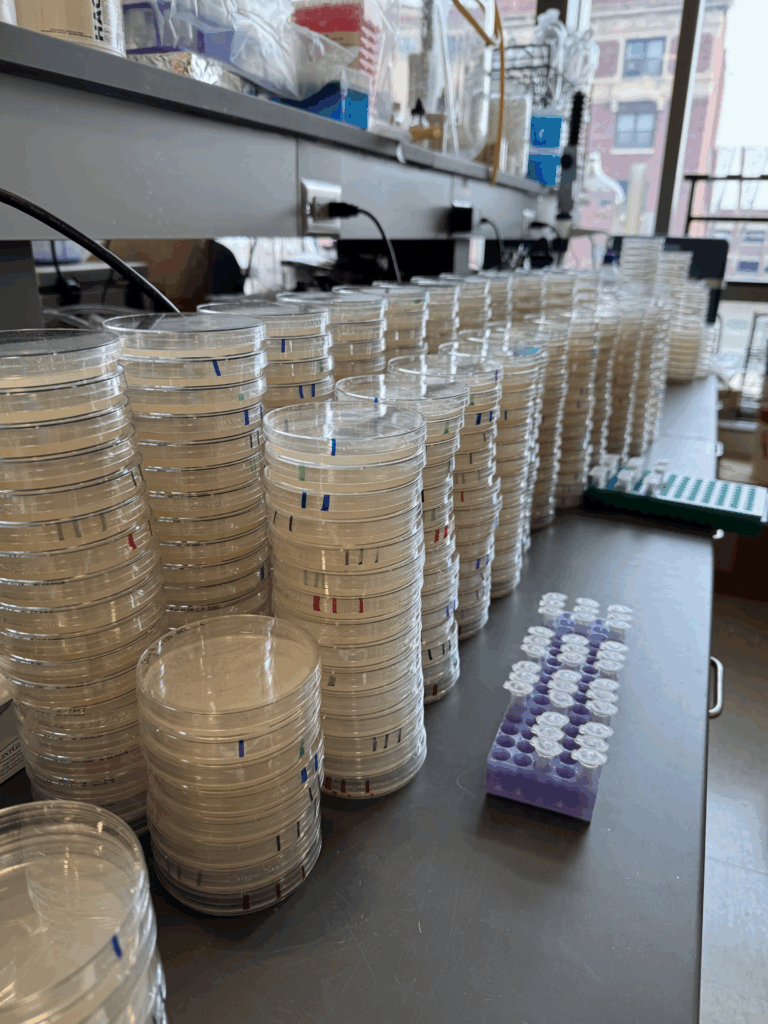
Summer research focus: Disinfectants Modulate Corrosion Product Effects on Antibiotic Resistance
Faculty mentor: Dr. Patrick McNamara and Veronika Folvarska (graduate student)
What new skill(s) are you most excited about from this summer?
Knowing how to use different instruments that are often not taught or limited to higher up classes. Also, being able to do various calculations and seeing how they relate to the experiment at hand.
What has been the biggest surprise during this experience?
How research is conducted. I have very little experience in the lab besides chemistry. Being able to assist a graduate student and having them explain their research allowed me to gain an insight on how things work outside of a classroom. It has helped me in deciding on what field I might potentially pursue.
What has been your biggest challenge during this experience?
The various variables that come into play during an experiment. There are often things such as prepping/disinfecting areas to measuring chemicals that I did not consider when first hearing about what I was going to be doing. Also, how the weather, plate prep, etc. all have to be exact in order for the experiment to go forward with no delay.
Hannah Koskovich
Biology major at Wisconsin Lutheran College*
*Koskovich has joined Marquette’s research programs for the summer through the Science and Technologies for Phosphorus Sustainability (STEPS) Center, a multi-institutional research initiative co-led by Dr. Mayer
Summer research focus: Phosphorus binding proteins to remove phosphorus from water
Faculty mentor: Dr. Brooke Mayer and Alondra Deras (graduate student)
What new skill(s) are you most excited about from this summer?
I have been mastering my fundamental laboratory skills, such as micropipetting and weighing compounds. Through mastering these skills, I have built a strong foundation for future lab work.
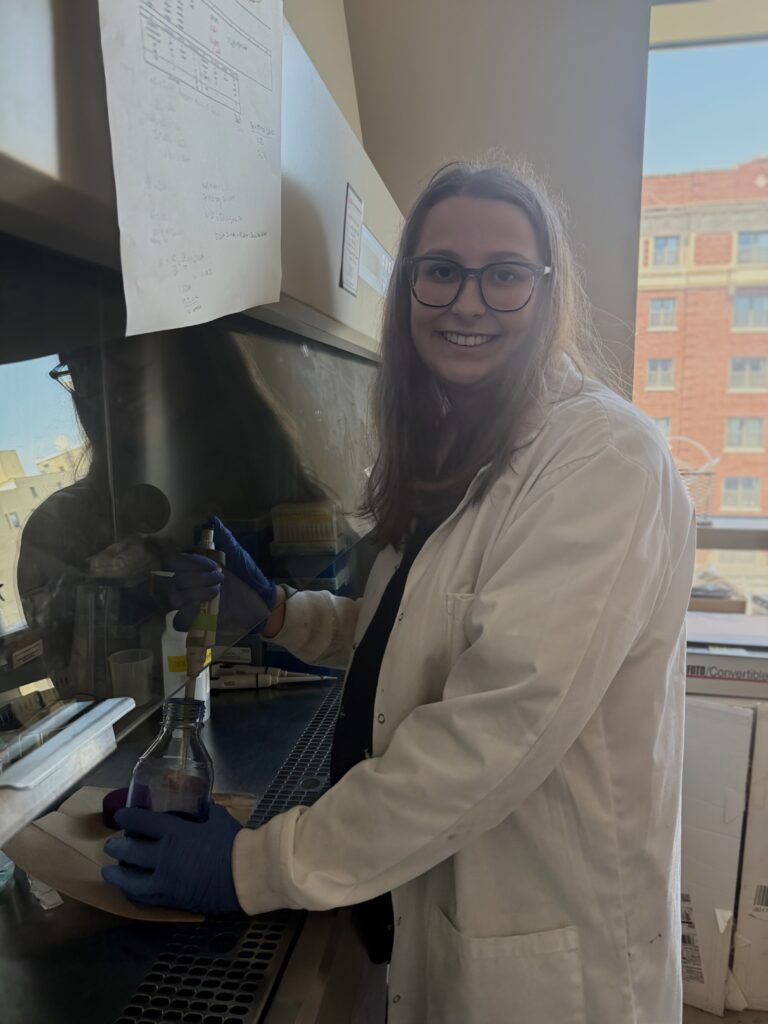
Along with refining these skills, I have become very familiar with protein assays — these methods test the concentration of protein in various ways. Using these methods, we can test the results of many of our experiments.
What has been the biggest surprise during this experience?
A surprise for me this summer was learning how much work goes into getting usable data. Proteins can be a tricky material to work with because they can denature. To prevent this from happening, we flash freeze the protein, store them at negative 80 degrees Celsius, and only thaw them when necessary. Even with these protocols, we still run into problems because proteins are not stable for long when at room temperature.
What has been your biggest challenge during this experience?
My biggest challenge was learning how to troubleshoot an experiment when it does not work. With the help of my mentors, I have learned how to troubleshoot experiments and how to improve further results. We have been trying to immobilize proteins with smaller volumes but have run into issues working with such a low volume. Because of this, we had to troubleshoot many methods to mix them, our best solution being to use a vortex attachment to mix them.
Diana Moses
Biomechanical engineering major
Summer research focus: Reactivating nerves that have been severed in a spinal cord injury using light-sensitive opsins
Faculty mentor: Dr. Jordan Williams
What new skill(s) are you most excited about from this summer?
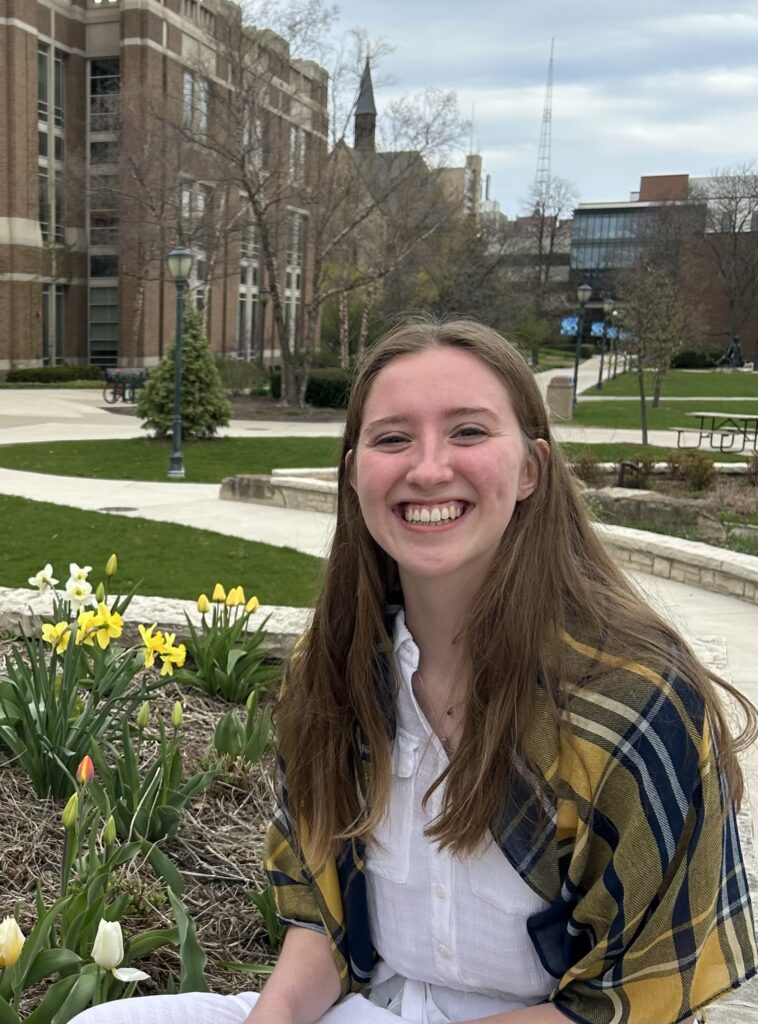
I have been most excited to learn skills in histology, surgery and animal experiments. I have loved studying biomedical engineering. In the first two years here at Marquette, many of my classes have done much to lay the foundations of the engineering process. However, I have really missed being closer to the anatomical side of science. So, as silly as it sounds, I was very excited to work with our rats.
What has been the biggest surprise during this experience?
The biggest surprise to me has been the level of autonomy and responsibility that comes with working in this lab, especially when compared to academics and other jobs I have had, where daily tasks are strictly assigned and monitored. While I spent much of my time early on watching, learning and performing supervised tasks, I have now spent much more time independently driving my own research process. I have made my own decisions about how to achieve an objective, from setting large benchmark goals to troubleshooting daily problems — and there are quite a few daily problems that arise. Some of the work, especially in histology and coding, can be repetitive, but I have found purpose in them, knowing that I chose them as part of a larger strategy. I have found empowerment in owning the research process, not only as a means of advancing my own academic journey, but also in contributing to the advancement of medical science.
What has been your biggest challenge during this experience?
I have faced obstacles in being able to schedule or perform some tasks on my own due to my limited clearance where our lab is located. This has given me more time than I wished in between accomplishing the benchmark goals I have set. However, in this time off experiments, I have been forced to sit with the intricate details of processing data. This time proved to be very fruitful, as it allowed me the time and space to try and fail. Rather than setting up one system and calling it good, I tried many different strategies and learned more from each one. My current code is extremely improved from my first attempt, and I am very excited to see where it goes from here.
Giancarlo Passanante
Computer engineering major
Summer Research Focus: Portable Water Sensor System
Faculty Mentor: Dr. Cris Ababei
What new skill(s) are you most excited about from this summer?
This summer has deepened my understanding of project design and system development. I’ve learned how to take an initial idea and continually iterate — optimizing and innovating within tight design constraints. That design mindset has been one of the most valuable takeaways.
What has been the biggest surprise during this experience?
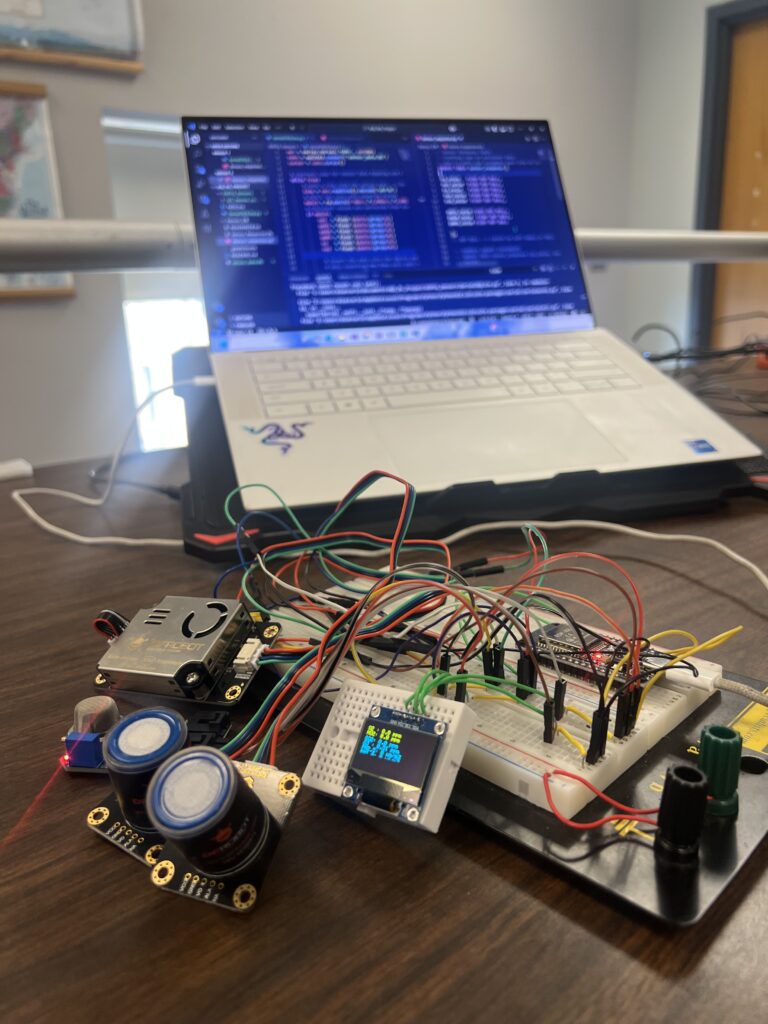
I’m constantly amazed by the complexity of the systems we interact with every day. Our project — designed to detect various chemical pollutants in water — relies on layers of scientific principles that I’m just beginning to appreciate. It’s a reminder of how intricate and fascinating the world of engineering and science truly is.
What has been your biggest challenge during this experience?
One of the biggest challenges has been working alongside brilliant professors and graduate students who have much more experience and technical knowledge. Learning to absorb their insights and translate them into meaningful improvements in my work has been both humbling and incredibly rewarding.