
Landmark legal decisions are often known by one name, that of a leading party. Miranda. Brown. Dobbs. But the people themselves often receive little attention, says Derek Mosley, director of Marquette Law School’s Lubar Center for Public Policy Research and Civic Education. So during the past two years, Mosley has branched out in the Lubar Center’s “Get to Know” series, hosting three “Face of the Case” programs in Eckstein Hall, providing a human aspect of major changes. Here is a brief recap of each program.
Grant House
February 5, 2026

One day in 2020, Grant House was sitting beside a swimming pool with some other athletes on the Arizona State University (ASU) swim teams. House heard another swimmer say into her phone that she knew the perfect person for what the caller was looking for. What was that all about?
The caller was the teammate’s mother, a lawyer with a Seattle firm involved in legal action challenging National Collegiate Athletic Association (NCAA) rules limiting ways college athletes could get paid. She was looking for athletes who might be representative plaintiffs in a class action suit. Grant House—a national-class swimmer and an academic standout at ASU—was the perfect person, as the teammate put it.
House had not been involved in advocacy around the issue but agreed with the cause. Other students, such as musicians, make money doing what they love to do, he said, but athletes were restricted, and only in recent years were they able to receive money even for use of their names, images, and likenesses. House said he had turned down things such as sponsorship opportunities so that he could maintain his college eligibility.
He agreed to join the lawsuit, which became widely known as House v. NCAA. He took part in a daylong deposition at one point, watched a court proceeding in San Francisco, was interviewed by reporters, and fielded some strong (and sometimes negative) reactions to the issue. He had little involvement in the legal proceedings, but with a federal judge’s approval in June 2025 of a $2.6 billion settlement of the class action, Grant House became part of college sports history.
During the 2026 Get to Know (Face of the Case) session at Marquette Law School, House talked about his personal background, his current training with a goal of making the 2028 Olympic team, and some of the stresses of being involved in the case. After the case made news nationwide, he received a large volume of reactions, including some from people who thought he was involved in ruining college sports.
Audience members, many of them students in Marquette Law School’s sports law program, had many questions. An audience member asked about the message of the case. “It’s all about educating and uplifting one another,” House said. So many doors were closed to athletes. He hoped the case would help athletes “to continually uplift one another and build forward.”
Another audience member asked how Marquette can compete in college sports against universities that have more money and “can buy the best athletes.” House responded that some schools with a lot of money are doing poorly now, while some with more modest resources are doing well. Success, he said, doesn’t have to come from money alone, but from the culture, character, or integrity of programs. He said universities are going to need to be innovative and forward-thinking, and the voices of athletes will need to be heard.
He expressed appreciation for the chance to talk about his background and perspective, something he hasn’t done often. His final words during the program: “Go Marquette!”
Mary Beth Tinker
April 24, 2025
In the 1960s, Mary Beth Tinker was a schoolgirl whose family included her five siblings. Her father, who had been a Methodist minister in a small Iowa town, lost his position after he got involved in fighting a ban on Black people’s use of the local swimming pool. The family then moved to Des Moines. The Tinkers became involved in social causes, including a protest following the death of four Black girls in 1963 when Ku Klux Klan members planted dynamite in a church in Birmingham, Alabama. The protest involved wearing black armbands. Mary Beth, then 12, took part.
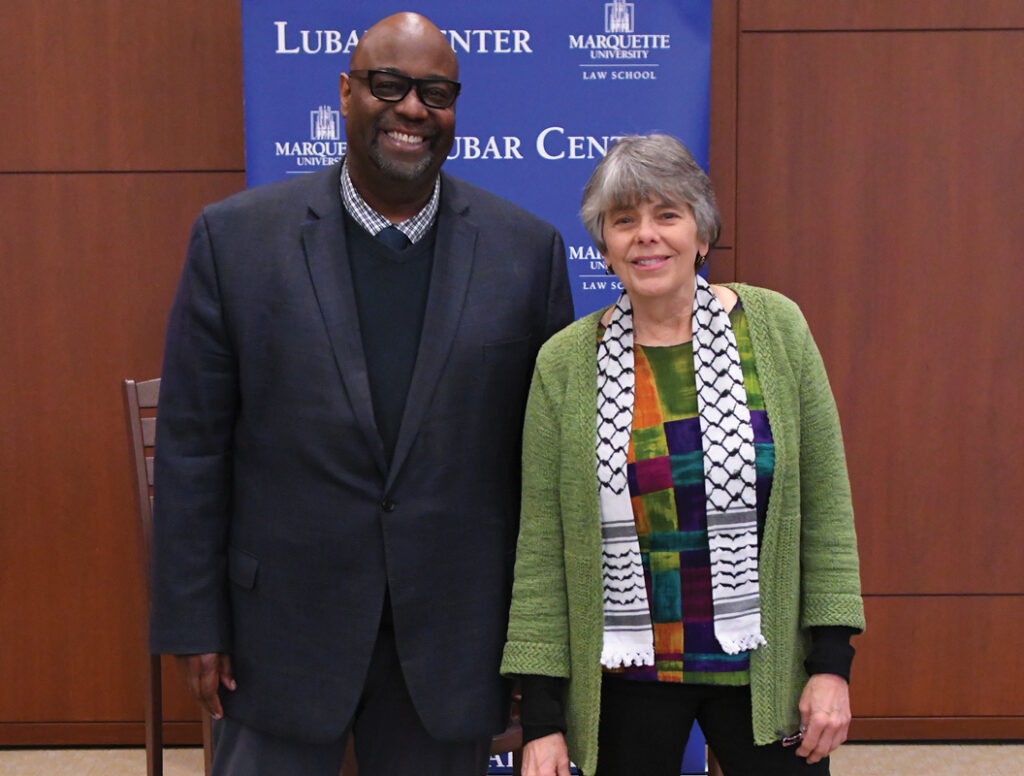
A year later, the United States escalated its military involvement in Vietnam. A group called Iowans for Peace was launched, with members of the Tinker family becoming involved. Participants decided to wear black armbands to mourn people killed in Vietnam.
The plan was to wear the armbands on December 16, 1965. Mary Beth wanted to take part, but the principal of her school banned the armbands. “You could wear a black armband if you were sad about the football games,” Mary Beth said, “but not the war.” She said, “I was the shyest kid you could ever imagine. I was a scared little kid. I was nervous.” She was sent to the principal’s office and told to take off the armband. She did. “I got suspended anyway,” she said. So did four other students.
A challenge to the suspensions made its way to the Supreme Court of the United States, with the Tinker name first on the Court’s opinion. On February 24, 1969, in Tinker v. Des Moines Independent School District, a 7 to 2 decision, the Court upheld the right of the students to wear the armbands. In a phrase that became well-known, the majority held that neither students nor teachers “shed their constitutional rights to freedom of speech or expression at the schoolhouse gate.” That right has limits, particularly related to potential or real disruption. But what became known as the Tinker principle remains relevant to this day.
“I didn’t know how important the case was at all,” Tinker said, until she was in college, studying to be a nurse. Her case—and name—were in one of her textbooks. “It kind of hit me: ‘Well, I guess this is a little more important than I thought.’”
Tinker, who lives in the Washington, D.C., area, went on to a career in nursing, counseling young people, and being involved in social causes. “This Tinker case is about controversy,” she told the Marquette Law School audience. “We have to speak up for our conscience.” There is a risk to speaking up, she said. “But it’s so worth it to live a life speaking up for what you believe in.”
James Obergefell
September 18, 2024
James Obergefell was raised in Sandusky, Ohio, the youngest of six children in a blue-collar family. He became a schoolteacher in Cincinnati. He knew he was gay, but “I was deep in the closet.” In 1992, he went to a bar with a friend, who introduced him to a man there named John Arthur. Later, Obergefell was invited to a New Year’s Eve party at Arthur’s house. “And I never left,” Obergefell said.
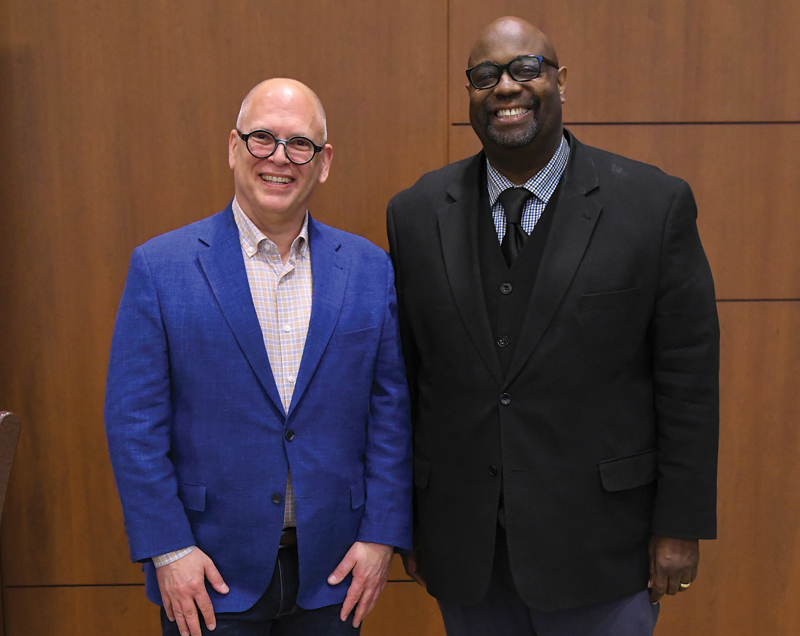
They decided they wanted to get married, Obergefell said. They didn’t want a symbolic wedding—they wanted “marriage and everything that came with it.” At that time, there was nowhere in the United States where gay marriage was legal. But, he said, “Our family and friends considered us married; we considered ourselves married.”
In 2011, after they had been together for 19 years, Arthur was diagnosed with ALS. His physical condition declined quickly. On June 26, 2013, the U.S. Supreme Court struck down the federal Defense of Marriage Act. Obergefell said he and Arthur immediately decided to get married. That wasn’t permitted in Ohio then. A friend suggested they go to Maryland, where it was allowed for one person to appear in applying for a marriage license. Obergefell got the license. Arthur was severely disabled by then, Obergefell said, so, with family and friends picking up the $14,000 cost, they chartered a medical jet, flew to Baltimore, and got married on the ground without ever leaving the plane. Then they flew home.
A Cincinnati reporter wrote about the wedding. That led to Obergefell’s meeting with a lawyer, who brought him an example of a death certificate. “It broke our hearts,” Obergefell said, that he wouldn’t be listed as a spouse when Arthur died. He and Arthur filed a lawsuit arguing that getting married in Maryland meant Ohio had to recognize their marriage.
Arthur died three months after they got married. Both names were on the death certificate, pursuant to a federal court injunction shortly before Arthur’s death, but lawyers for Ohio argued that Obergefell’s name as “surviving spouse” should be taken off. The resulting court case made its way to the Supreme Court, where it was combined with other cases arguing that same-sex marriage should be legal across the country as a constitutional right.
Obergefell was present when Obergefell v. Hodges was announced by Justice Anthony M. Kennedy on June 26, 2015. When it became clear that the plaintiffs had won, “I burst into tears, and I could hear people around that courtroom sobbing,” Obergefell said. “For the first time in my life as an out gay man, I felt like an equal American.”
After the decision, Obergefell said, he became involved in advocacy not only for gay rights, but for rights of others more generally. And for those present at Marquette Law School’s Face of the Case program, Obergefell emphasized his realization that what he learned as a child is true: “A small group of people really can change the world.”
This article was first featured in the Summer 2026 issue of Marquette Lawyer Magazine.