
Professor Kali N. Murray joined the Marquette Law School faculty in 2007. She is codirector of the school’s intellectual property program and has published widely on intellectual property, administrative law, and property. This piece excerpts the introduction and conclusion of her recent essay, Seeing the Dead: Marks, Meaning and the Haunting of American Trademark Law, 103 Tex. L. Rev. 1499 (2025).

The retirement of trademarks such as “Uncle Ben” and “Aunt Jemima” during the fulcrum of the Black Lives Matter movement prompted scholars to reconsider how trademark law protected various marks that perpetuated images built on a terrifying scaffold of racist imagery. In many ways, though, this reckoning stopped without a full accounting of trademark’s fraught relationship with social identities of race and caste in the United States.
Indeed, if we simply sit with the vocabulary of trademarks, we can see the ghosted remnants of trademark law’s relationship with enslavement. We “brand” ourselves as enslaved people were “branded” by an iron. We “pass off” the goods of another as a person could “pass” from one race to another. We “register” a mark today as enslaved people then received a new name and had their new name “registered” on a ship register.
The “haunting” of trademark law, though, does not rise simply from the remnants of an older order glimpsed through this vocabulary. What we understand as trademark law was formed in the fulcrum of what I term the “enslavement economy,” which describes the political, economic, and social order produced by the process of enslavement imposed throughout the Atlantic World. As Professor Roberto Saba notes:
Slave labor was central to the making of the modern world. It gave Europeans the means to occupy and develop the Americas. The trade in slaves helped merchants accumulate capital that was reinvested in agriculture, industry, and infrastructure. Slave plantations produced the sugar, cotton, and coffee that propelled the industrial revolution in the North Atlantic countries.
Trademark law is an ideal place to consider the relationship of intellectual property to the political, social, and economic system of enslavement. Trademarks, which protect the commercial signs associated with the goods and services of its users, seem to be intimately connected to the economic practices of enslavement, either because a slave market would advertise its services in selling enslaved individuals using trade names or because goods like sugar or cotton produced by enslaved persons would be trademarked.
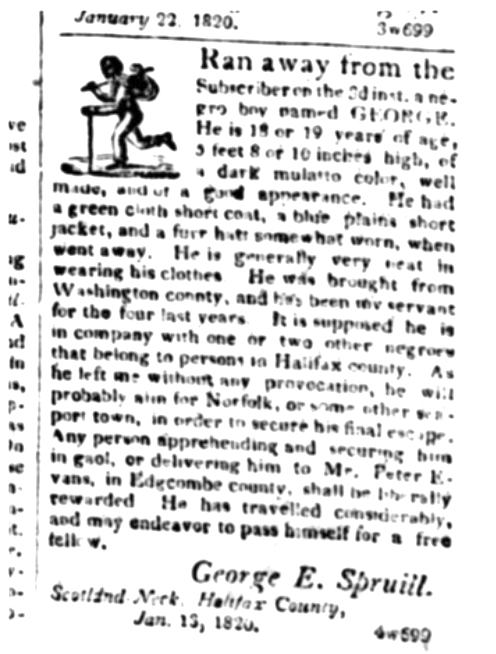
I use fugitive slave advertisements—advertisements placed in colonial and antebellum newspapers that sought the return of an enslaved person to their enslaver—to explore the relationship of trademark law and the construction of race and caste in the United States. Fugitive slave advertisements are understood to be a crucial part of the social, cultural, and economic history of enslavement. Figure 1 depicts an example of a fugitive slave advertisement placed by George Spruill in the Edenton Gazette and the North Carolina General Advertiser, in Halifax, North Carolina, in 1820, seeking the return of George, an 18- or 19-year-old enslaved person.
This advertisement contains hallmarks of the fugitive slave advertisement: a stylized picture of an escaping individual, a description of the individual, and, indeed, a claim that the individual sought to “pass himself for a free fellow.”
This essay adds to a substantial, interdisciplinary literature on fugitive slave advertisements. Uniquely, I read them as though they are a legal source, much like a legal opinion. Jonathan Bush has identified what remains a significant problem in the study of the law of enslavement, that is, its reliance on the public law embodied in criminal law, rather than through private mechanisms, such as tort and contract law. Overlooking these private law mechanisms results in a paucity of legal opinions. This paucity of legal source is intensified because the law of England did not offer sufficient analogues to the experience of Atlantic slavery, thus making it difficult to incorporate into preexisting legal doctrines.
Bush’s critique of “sourcing” the law of enslavement could extend to the specific development of trademark law as well. Indeed, as early as 1925, Frank Schechter identified a key problem in understanding the development of trademark law: that it is difficult “to . . . determine[] the actual point of contact between the fragmentary law of trade-marks as developed in the guilds and the modern common law and equitable doctrines of trade-mark law.” Fugitive slave advertisements are also useful for a practical reason: they are now more accessible given recent efforts to successfully digitize these advertisements. In this essay, I will be relying on two databases, the North Carolina Runaway Slave Notices Project, which has fully digitized images associated with fugitive slave advertisements, and the Freedom on the Move Project, which has crowdsourced information about more than 33,000 fugitive slave advertisements (although its images are not transferable from the website).
Fugitive slave advertisements offer us one way to explore how the legal framework of both enslavement and trademark law was created, in light of the sparseness of “official” texts like legal opinions or statutes during the colonial and antebellum period. In this essay, I use fugitive slave advertisements to examine how “the haunting of trademark law” helps us comprehend two fundamental elements of the legal history of trademark law. In Part I, I explore how trademarks operate as both information forms and information systems in the construction of the social process of market exchange. In Part II, I explore how the informational content of the fugitive slave advertisement helps us to retrieve the “ghost texts” and the “haunted texts” of trademark law. In highlighting the historical methods associated with Atlantic history and diasporic studies, I explore how the fugitive slave advertisements and enslavement economy visualized the status marks that sought to bridge local, regional, and national slave markets in the colonial and antebellum United States.
• • • •
What does the haunting of American trademark law teach us? Initially, the ghost text speaks to what is very often absent in our understanding of the development of trademark law in the United States: its origins in, and relationship to, the system of enslavement that endured in the Atlantic world until Brazil abolished slavery and emancipated enslaved African communities in 1888. I foreground how an enslavement economy built on visualized marks of status sought to bridge local, regional, and national markets of enslavement. It seems to me the ghost text demonstrates how trademark law, given its ongoing relationship with other forms of commercial law, is an ideal place to consider the relationship of intellectual property and the political and economic system of enslavement. Trademarks—which protect the commercial signs associated with the goods and services of its users—are intimately connected to the economic practices of enslavement.
Likewise, the “haunting” of American trademark law by the haunted mark also widens the scope of our understanding of how trademark law developed in the United States by focusing on the ways in which trademark law was embedded in the public regulation of colonial and antebellum markets. For example, Mississippi’s 1822 An Act Concerning Strays and Drovers, Horses, Cattle, and Other Stock, and Directing Stock Brands and Marks to be Recorded not only designated who could engage in the act of branding (“the act of status branding”) but also required “any horse, cattle or other stock” to have a “brand and ear mark different from the brand and ear mark of every other person in the same county,” “required ear mark and brand shall be recorded in the office of the clerk,” and resolved “any dispute shall arise respecting the brand or mark.” Debates over the development of trademark law have typically focused on the private law of trademark by tracing its histories through tort actions between competitors. However, the status brands suggest a public law of trademark, where trademark law functioned as a way to control the social meaning of visualized works. Further work in this area may help us to understand the consolidation of trademark law in the United States in the late 19th century.
To conclude, the ghost text and the haunted text offer us two ways to further understand the law of enslavement in the United States. First, regarding fugitive slave advertisements as legal sources offers us a way to trace the informal and formal mechanisms of a legal system dedicated to enslavement. Fugitive slave advertisements were written by enslavers (with the potential support of newspaper staff), and thus offer a way to map non-elite opinion on the status of enslaved persons within the colonial and antebellum United States. Runaway advertisements described enslaved individuals as property, reflecting common conceptions of legal statute. Indeed, considered study of runaway slave advertisements can be seen as a sustained counternarrative to the types of legal narratives seen in the published opinions of elite judges.
Second, both the ghost mark and haunted mark help us contemplate the relationship of intellectual property to broader values within a democratic society. The ghost text helps us to comprehend how the visual landscapes developed during the colonial and antebellum United States. Professor Rebecca Houze describes the visual landscapes as a way to navigate a “built environment” in which “we encounter many images and objects, which are both strange and familiar. They are part of a shared language, a visual vocabulary of the collective imagination.” Runaway slave advertisements allow us to “reconstruct” the visual landscapes of colonial and antebellum United States, which permits us to trace how modern commercial relations, and its accompanying signs, shaped the markets, farms, waterways, and plantations of the modern United States (and elsewhere). Understanding how the visual landscape of the United States developed, trademark law is situated to answer broader questions of political economy—that place where political and economic structures intertwine to produce social meaning in information. For example, seeing anew the country mark and the ways in which it served as both a mark of origin and a political identity helps us to understand how the modern trademark seeks to police self-identity.
The haunted mark speaks to another dynamic within a political culture: the relationship of law to the political subordination of specific groups within a society. I have argued elsewhere that intellectual property law needs to engage and explore how it enforces social hierarchies of “race” or “gender” by “defining a status, by reinforcing a status, and by drawing boundaries between different statuses.” Katrina H.B. Keefer refers to the branding of an enslaved person as simultaneously an “act of violence” that was also an “act of industry and capitalism” that allowed “slaveholders and slave traders to mark those they believed to be their property; it was a fundamental commodification of the human body.” The enslaved brand was a central act of enslavement; it marked “a transition from human to commodity.” The pervasive marking of the human bodies glimpsed in runaway slave advertisements defined the status of an enslaved person by providing visible indicia of a subordination. The markings reinforced that status through the sheer horror of physically defiling the face or body of that person, ultimately offering a visualized boundary between a person and non-person, a citizen and what Chief Justice Roger Taney referred to (Black Americans) in Dred Scott v. Sandford as mere “ordinary article[s] of merchandise.”
This article was first featured in the Summer 2026 issue of Marquette Lawyer Magazine.