Professor Christine Kexel Chabot joined the Marquette Law School faculty in 2023. This excerpt draws from her essay published last year: Trump v. United States and the Half-Originalist Presidency, 58 Mich. J. L. Reform 653 (2025). In addition to other attention, Professor Chabot’s essay was noted by the New York Times as President Donald Trump’s second term began and challenges to his agenda began to arrive last year to the Supreme Court.
In Trump v. United States (2024), the Supreme Court went to new lengths to guarantee a “vigorous” and “energetic” president. The Supreme Court’s decision afforded presidents broad immunity from criminal prosecutions based on official acts taken while in office. The Court defended its ruling in largely consequentialist terms: it explained that the ruling was designed to avoid the prospect of “an Executive branch that cannibalizes itself, with each successive President free to prosecute . . . predecessors, yet unable to boldly and fearlessly carry out [current] duties for fear that [they] may be next.” At the same time, the Court attempted to ground its ruling in Founding-era understandings of the presidency.
The unfettered removal power recognized by the Court conflicts with not only longstanding precedent but also the Founding generation’s understanding of the presidency.
This essay explains that the Court’s historical assertions rest on half-truths and a distorted view of how the Founding generation conceptualized the presidency. The distortion is most evident in the Court’s determination that Article II grants the president an “unrestricted power of removal” which can never be regulated by Congress or considered as evidence of presidential wrongdoing. The unfettered removal power recognized by the Court conflicts with not only longstanding precedent but also the Founding generation’s understanding of the presidency. This essay offers the first account of the historical mismatch between the Trump Court’s ruling on removal and Founding-era conceptions of the presidency. Much of what the Court decided with respect to immunity is unclear, as its opinion made presumptive immunity for most of the president’s official acts turn on a balancing test. Unlike the bulk of the president’s official acts, the Court excepted removal from balancing and categorized it as a “core” executive power committed to the president’s “conclusive and preclusive” authority. The majority opinion silently departed from contrary precedent on removal. It ignored a balancing test that the Court had earlier applied to removal and treated removal as a power that can never be regulated by Congress or the courts. As a result, the Court suggested not only a sea change in governing law on removal, but it did so without substantial briefing on the historical evidence that would typically inform a judicial decision to set aside longstanding precedent in this area.

The Court’s decision treated removal power the same as the pardon and veto powers without recognizing important differences between them. Removal is an implicit, Article II power, whereas the pardon and veto powers are granted by the express text of the Constitution. The pardon and veto powers allow presidents to check other branches in ways that could be undermined by congressional regulation. Removal of executive officers does not operate as a check on other branches. Although the majority asserted that an implicit Article II removal power should nevertheless enjoy the same core status as at least the pardon power, this approach overlooked the fact that an indefeasible removal power would depend heavily on pragmatic enrichment and the historical record. The problem is that the Trump Court’s assertions of an indefeasible removal power conflict with a substantial body of Founding-era history.
Originalist debates over presidential removal power have typically focused on the unitary executive theory of Article II. Longstanding precedent has allowed statutory removal restrictions so long as they do not interfere with the president’s power to remove “close military or diplomatic advisers” or subordinates who violate the law. Unitary scholars have argued that original understandings of Article II extend the president’s removal power to all subordinate officers and empower the president to remove these officials based on disagreement over lawful policy choices. To justify their position, unitary scholars have focused on the president’s need to control policies within the limits of substantive laws, as well as the way that statutory tenure protections interfere with presidential control of a subset of lawful policy decisions. Unitary arguments have not directly addressed whether the president may also use removal at will to promote private ends in violation of substantive laws. Nor have they addressed the Trump Court’s further idea that courts cannot even consider evidence of improperly motivated removals in order to demonstrate wrongdoing.
The weight of recent scholarship presents a formidable historical challenge to unitary scholars’ claims of an indefeasible presidential removal power. And by pushing removal in this absolute direction, the Trump Court’s decision exacerbates these tensions with the historical record. The decision also runs up against longstanding concerns about the president’s abuse of the removal power.
The Court’s decision in Trump v. United States appears to recognize an unlimited unitary executive theory which places the entirety of the president’s removal power above the law. By suggesting that it has excepted the whole of the president’s removal power from the reach of criminal laws, the Court has raised questions about whether Article II empowers the president to remove officers using unlawful means, such as murder. It also raises questions about whether the president may remove or threaten to remove officers in order to promote unlawful ends, such as punishment for refusing to help the president break the law. While the Court may have had in mind other difficult cases in which removal effectuates aggressive and contested interpretations of the law, its absolute approach also excuses presidents who abuse the removal power in furtherance of clearly unlawful or private ends. Under the Court’s approach, an official exercise of removal power can never violate the law. This approach elevates removal power above other executive powers, such as the protective power. It is unclear why the balancing approach applicable to official acts like the protective power should not also apply to removal.
None of the precedents cited by Chief Justice Roberts in Trump v. United States support a presidential power to remove subordinates in order to promote unlawful ends. The Court’s assumed interest in protecting choices presidents make in the “public interest” does not seem present in removals calculated to bring about unlawful action. While members of the Court have sometimes suggested that overruling Humphrey’s Executor v. United States (1935) is a foregone conclusion and will not lead to great change, these arguments fail to account for important aspects of decisional independence in certain agencies or the consequences of extending unitary executive theory to the type of criminal wrongdoing alleged in Trump v. United States. In the discussion below, this essay will show that the Trump Court’s approach conflicts with Founding-era understandings reflected in the Constitution’s text, framing history, and early historical practice. The Court’s approach suggests an erosion of significant limitations that were central to the Founding generation’s understanding of the presidency.
• • • •
A presidential removal power appears nowhere in the express language of the Constitution. While many have argued that this power is nevertheless implied by Article II’s Vesting Clause, the historical record weighs strongly against arguments that Congress cannot regulate the president’s removal power. Exercises of the presidential removal power to promote unlawful, private ends are especially difficult to square with Article II’s language vesting “the executive power in a President of the United States.” As Professor Julian Davis Mortenson’s historical research has made clear, the “signal characteristic of executive power . . . was that it was substantively an empty vessel. The only thing [the Vesting Clause] authorized the President to do was to carry out legal instructions created pursuant to some other authority.” From a Founding-era perspective, as Mortenson has explained, power to “execute” the law was merely the “power to execute plans, instructions, and above all else the laws.” The power to execute was not understood to include the ability to suspend or violate the law. Removing an officer who refuses to help the president violate the law would therefore seem to fall outside the scope of law execution. Unlawful action is ultra vires and outside the scope of the public law execution power conferred by the Vesting Clause.
The Take Care Clause, in Article II, section 3, further requires the president to “take care that the Laws be faithfully executed.” Professors Andrew Kent, Ethan Leib, and Jed Shugerman have marshaled considerable preratification evidence of the duties imposed by Article II’s Take Care Clause and requirement that the President take an oath to “faithfully execute the Office of President.” According to their research, this constitutional language shows “how important it was to constitutional designers that the President stay within his authorizations and not act ultra vires.” They also note that these requirements “may . . . restrict the President’s power to dismiss officials for primarily self-protective purposes against the public interest.”
• • • •
Trump v. United States is the latest in a series of Roberts Court decisions that have forgotten much of our nation’s history on executive removal power. The Court has forgotten what happened at the Founding. It has forgotten that the express language of Article II never included a presidential removal power, and it has forgotten that the First Congress debated the very existence of an Article II presidential removal power for months before adopting ambiguous laws that at best declined to regulate the president’s removal power in three instances. It has forgotten that other Founding-era laws incorporated a panoply of legal restrictions on the power to remove officers charged with executing the law. It has forgotten that the constitutional balance struck by the political branches on removal was never checked by the Supreme Court until Chief Justice Taft’s 1926 decision in Myers v. United States. It has forgotten that an earlier Court approved for-cause removal restrictions in Humphrey’s Executor, and it has forgotten that only one justice dissented from the balancing test that the Court applied to for-cause removal restrictions in Morrison v. Olson (1988).
Recent scholarship has reminded us of a different past: a history that contradicts originalist arguments for an indefeasible presidential removal power. The Court seems bent on avoiding, rather than confronting, this inconvenient historical evidence. Despite lengthy amici briefs on originalist arguments for and against an indefeasible presidential removal power in SEC v. Jarkesy (2024), the Court eschewed the benefits of this additional historical briefing and declined to decide the removal issue in that case. The Court instead injected the removal issue into Trump v. United States, a case in which the parties and amici never presented substantial historical briefing on removal. The removal power recognized by the Trump Court seems to exceed the president’s fundamental power to execute the law as well as the president’s fundamental duty of faithful execution. The Court’s decision demonstrated no awareness of one of the Founding generation’s most important lessons: that the president was never meant to be a king. For the first time ever, the Court has opened the door to a presidential removal power that knows no legal boundaries. It has placed the president above the law.
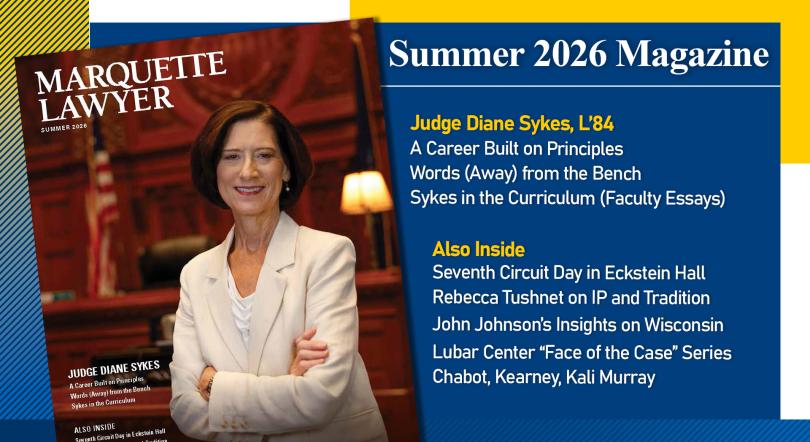
This article was first featured in the Summer 2026 issue of Marquette Lawyer Magazine.