As Mariana Calvo Argus, a second-year law student, put it, “It felt like this event.” Argus was describing “Seventh Circuit Day,” as it came to be known—a daylong set of events on September 25, 2025, at Marquette Law School’s Eckstein Hall, when judges of the U.S. Court of Appeals for the Seventh Circuit held oral arguments and took part in several programs for students and the public.
A key goal of the day was to give law students opportunities to observe the appellate court in action and to hear from the judges. The engagement of the Marquette Law School community was extensive. In particular, the six cases argued before three judges in the Law School’s Lubar Center were divided into three hourlong sessions, of two arguments each, such that about 300 students were able to attend and observe one of the sessions.
“Behind the Scenes” of Organizing
a Visit by an Appellate Court
By Anna Fodor
Assistant Dean of Students,
Marquette Law School
In the estimation of many students and faculty members, the day was both educational and motivating. Afterward, Kaya Dreger, a first-year student, said that the court’s visit furthered her interest in career paths involving advocacy in court. Observing arguments before three federal judges underscored for Dreger how cases involve “real, tangible people” and how provisions of the U.S. Constitution come alive in real cases.
The cases that were heard
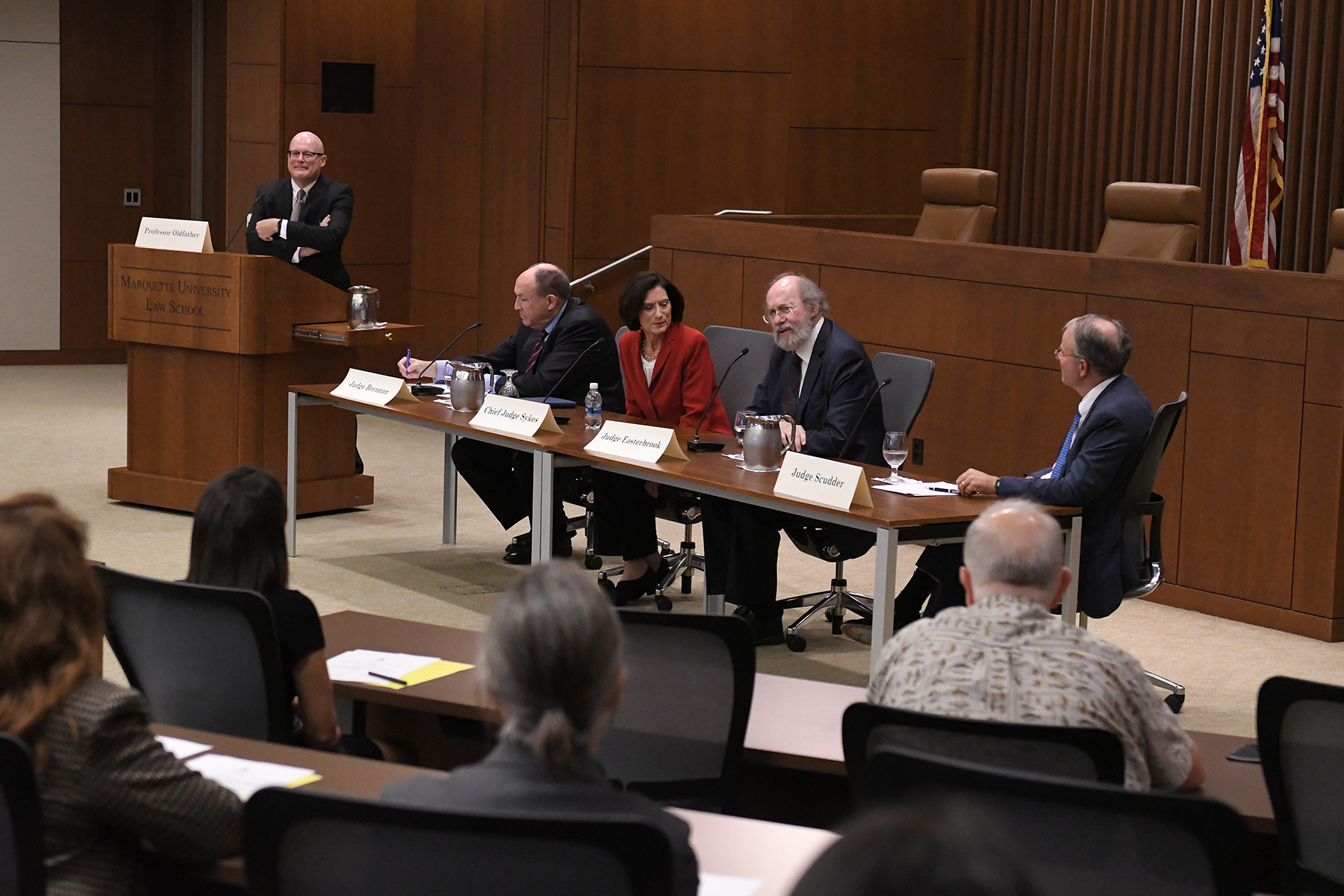
The Seventh Circuit panel hearing arguments consisted of Chief Judge Diane S. Sykes, Judge Frank H. Easterbrook, and Judge Michael B. Brennan. Judge Michael Y. Scudder joined the panel for the afternoon programs.
The six cases argued to the court touched on substantial issues. Some examples: In Public Interest Legal Foundation, Inc. v. Wolfe, No. 24-3258, the central issue—whether the district court was correct in refusing to compel the State of Wisconsin to provide voter lists to an interested nonprofit entity—presented both statutory and constitutional questions under federal law. Ruderman v. Kenosha County, No. 24-2939, concerned whether the federal Trafficking Victims Protection Act applied to civilly detained immigrants, awaiting removal (deportation) or a removal hearing, who were required to perform cleaning duties at the detention facility. And in United States v. Watson, No. 24-2432, appellant’s arguments included that the government’s collection of the defendant’s DNA violated the Fourth Amendment and that a federal criminal statute violated his Second Amendment rights.
Calvo Argus, the second-year student, said, “Just getting to see it live” was valuable. She described it as “a unique experience—and a very beneficial one.” Dreger, the first-year student, said that some of her classmates were taken aback by how assertive some of the judges were in questioning lawyers during the oral arguments. Frequently, the judges interjected into the lawyers’ arguments with questions or criticisms, as is common in appellate courts. But Dreger thought this added to the sense of importance of the proceedings, as well as her feeling of being motivated by the experience.
Chad Oldfather, professor of law, said, “My impression was that the students found it to be a valuable experience, and it was certainly one that they were discussing well after the arguments were over. And the lessons they learned that morning, as well as ones they’ve learned in the months and years leading up to it, were reinforced by the judges’ afternoon Q&A session with the students. There’s always value in having judges underscore the lessons that we try to impart in the classroom.”
Advice on effective appellate advocacy
The afternoon Q&A session was a panel discussion, moderated by Professor Anne Berleman Kearney and attended primarily by upper-level law students taking Appellate Writing and Advocacy. Judge Sykes started the discussion by emphasizing the centrality of briefs in the appellate process;
she characterized the written word as forming 95 percent of persuasive advocacy on appeal. Oral argument then amplifies, tests, and probes the strengths and weaknesses of the parties’ arguments. Her advice included: Tell the facts in story form. Make the factual narrative efficient, readable, and quickly understandable—like a good magazine article. Keep in mind that judges are generalists who need to ramp up quickly on the facts and procedural history.
Judge Easterbrook said that in organizing a brief, lawyers should think about the best set of arguments supporting why a client should win on appeal. That might be different from the arguments in the trial court. Explain why a client has a good legal theory. The judges generally agreed that many briefs are too wordy and too lengthy. Make your point directly, Easterbrook said, and don’t fall into acting on how easy writing on computers makes it to add more words. As for oral argument, he emphasized how much an advocate can learn by listening to the questions the judges ask and then engaging with the judges’ evident interests.
The judges emphasized to the law students the value of limiting the number of issues presented on appeal, in order to be able to develop the arguments adequately and to concentrate the court’s attention. The “fifth issue” has pretty well never won an appeal, Judge Brennan observed. He also advised lawyers to prepare for oral arguments through a moot court process. It will force a lawyer to focus on challenging questions in advance of possibly hearing them in open court.
Dialogue in an appellate courtroom and beyond
Following the Q&A session with students and turning to practicing lawyers, Professor Oldfather moderated a program in the Law School’s Lubar Center for some 200 practicing lawyers. It was an opportunity for relatively informal dialogue with the appellate judges—and dialogue was a central term that the judges used in describing their work. Judge Brennan said that dialogue describes not only the oral argument process but the duties of the judges more broadly. The judges are involved in dialogue with other judges, dialogue with courts across the country and at different levels of the judicial system, dialogue with legislative branches and other parts of the government, dialogue with the legal academy, and dialogue with thought leaders outside the court system. In considering a specific case, appellate judges are aware of the ways others are listening to and communicating with them and vice versa.
Judge Easterbrook, with extensive experience as a law professor, said a lot of people think that what judges do is similar to the work of legal scholars. “That’s not what judges do,” he said. “Judges solve a party’s problem. They don’t provide abstract principles and discussion.” He said, “Legal issues grow out of the real world, not from legal debates.” And when as a judge you have a problem in front of you, he said, “you bring your own jurisprudence to it,” but you don’t just decide what seems right.
Judge Scudder, whose visit to the Law School earlier in the year to deliver the Hallows Lecture had helped inspire Professor Oldfather’s approach to the session, said he wants to know the background and context of a case that is before him. That sometimes includes looking into the legislative history of a statute (“it’s not a sin” to do that, he said) and reading news coverage from the time a law was passed to try to gain more understanding of what legislators were thinking.
Judge Brennan said that a phrase that judges should keep in mind is “self-abnegation”—setting aside personal interests and beliefs. Judges should stick to their judicial role, he said, and when they go beyond it, “that’s where problems occur.” He said that, in considering cases, judges should ask if this is something they should be deciding or need to decide.
Seeing the law in action
Looking back on the day, Professor Rebecca Blemberg said, “Students very much appreciated the opportunity to witness oral argument before the Seventh Circuit judges. They were both impressed by the level of preparation put in by the judges and lawyers and heartened that the arguments unfolded more as conversations than canned remarks or sound bites.” She added, “The students had the sense that they witnessed professionals making real efforts to understand positions and reasoning, a type of ‘argument’ often lacking in public and political discourse.”
For Joe Yamat, a second-year law student, both the formal session of the court and the informal occasions to talk with some of the judges were valuable. He noted that it was particularly relevant to his Appellate Writing and Advocacy course that semester. He was impressed to see the quality of the work of the attorneys who presented oral arguments to the court and to realize how much the judges were concerned about the long-term impact of their work.
And he said he was impressed that leaders of the appeals court and the Law School agreed to bring the court to Eckstein Hall and by how well the events of the day were carried out.
Marquette Law School faculty and staff reflected on Seventh Circuit Day
for the Marquette University Law School Faculty Blog.
This article was first featured in the Summer 2026 issue of Marquette Lawyer Magazine.