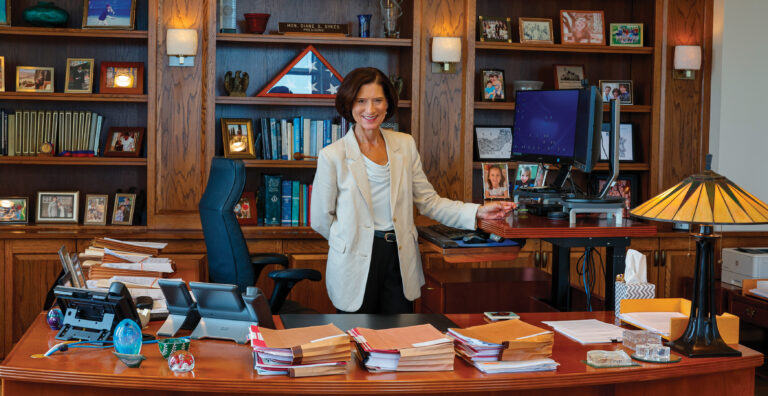
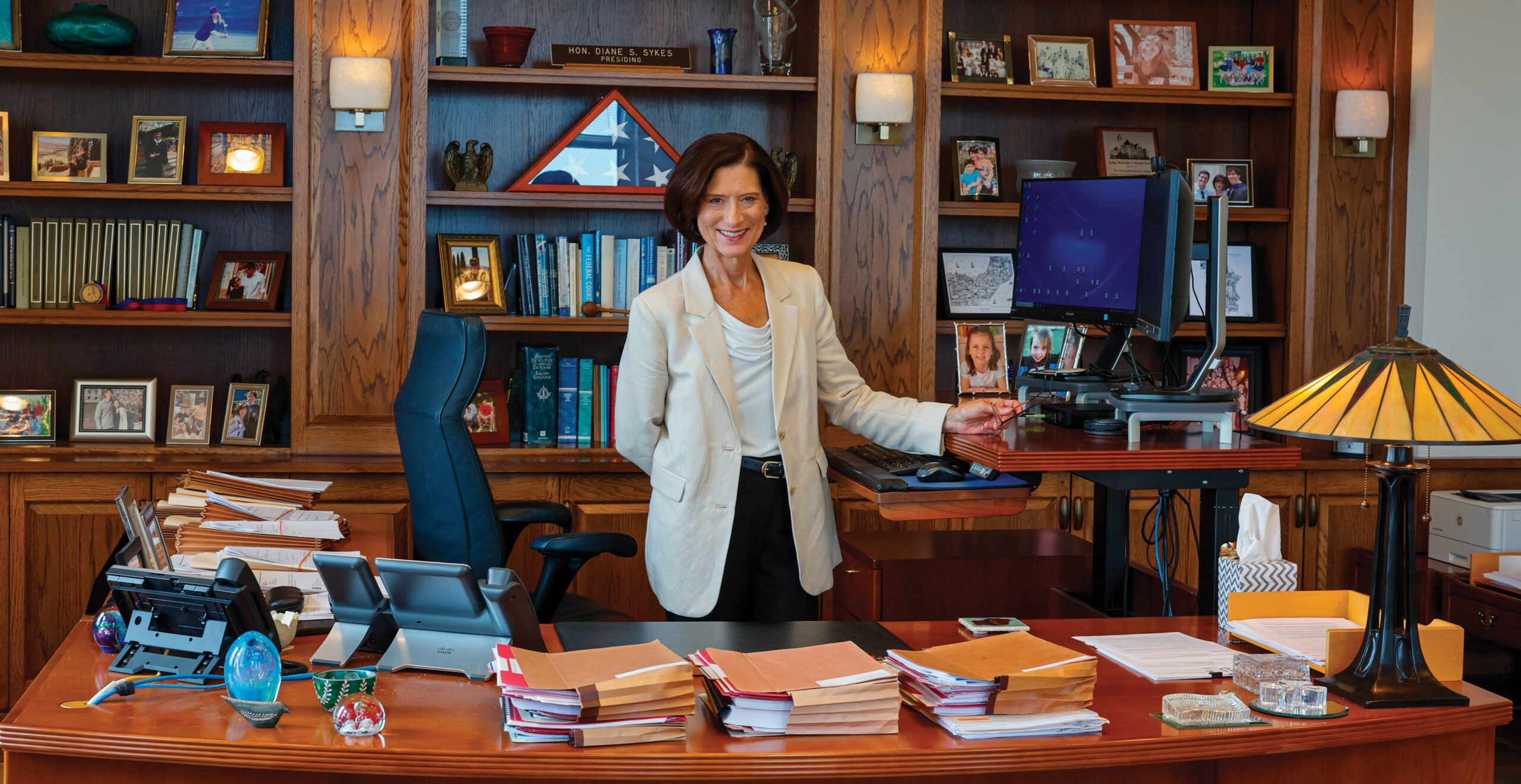
Diane Sykes says she owes everything she has accomplished to her parents.
Her father, Gerald Schwerm, was a civil engineer with a master’s degree in public administration. He was named village manager of the Milwaukee suburb of Brown Deer in 1966 and played a central role in developing the village. He later became transportation and public works director of Milwaukee County, where he was instrumental in the development of Mitchell International Airport, among other projects. Sykes says her father grew up in Whitefish Bay, just outside Milwaukee, in a family of German-Polish ancestry, and after earning his engineering degree at Marquette University in 1955, became a highly capable public administrator and community builder, with a quiet but effective approach to leadership. “When he spoke, you knew it was important.” Sykes says she learned from her father the value of public service. “He made an impression on me about government service and how to do it well.”
Her mother, Joyce Hanrahan Schwerm, was “a people person” with “an Irish personality,” Sykes says. She became a school guidance counselor after the youngest of her five children was in school. She was a behind-the-scenes advisor to her husband. Sykes says her mother was the one who would say things such as, “Jerry, this [Brown Deer] won’t be a real community until you build a library.” Or “until it has recreation spots like a public pond.”
The two of them were models of family connectedness and stability and positive values.
Pick out aspects of the foregoing if you want insight into Diane Sykes. When she speaks, you know it’s important. She has been committed to public service her entire career. Her personality has some elements of reserve, but she has had warm and positive relationships with a wide range of colleagues for many years, including people with decidedly different political and legal philosophies from her own. And she values stability and connectedness.
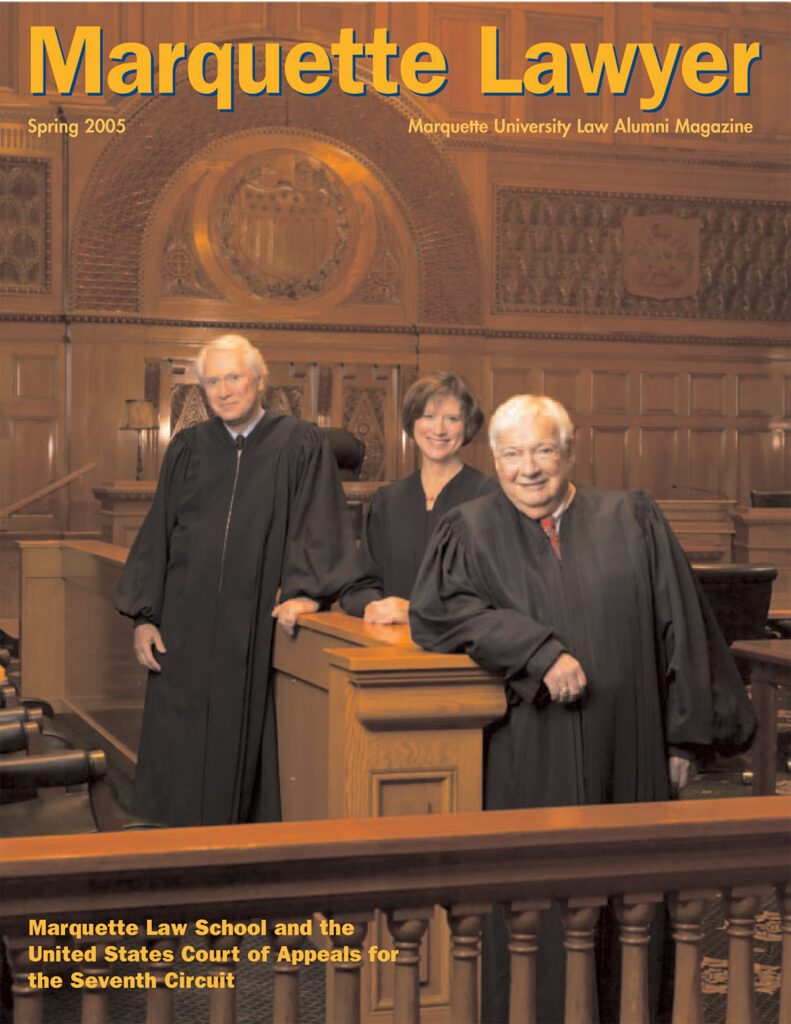
Those qualities led Sykes, who graduated from Marquette Law School in 1984, to a judicial career of upward steps—becoming a Milwaukee County circuit judge at a relatively early age, then five years as a justice of the Wisconsin Supreme Court, followed by the past 21-plus years as a judge on the United States Court of Appeals for the Seventh Circuit. The path almost included nomination to the U.S. Supreme Court.
Now 68, Sykes is lightening her load. In fall 2025, she completed her tenure as chief judge of the Seventh Circuit and moved to senior status on the court, with plans for continuing yet with a reduced caseload. For the first time in her life (except for college), Sykes has moved away from the Milwaukee area. She is living near Washington, D.C.—and, more to the point, near her two sons and their families. She is spending a lot more time with her grandchildren. She says she is “recalibrating my life around my kids and my grandkids.” But, in addition to her partial workload on the Seventh Circuit, she is considering other possibilities, such as teaching. “We’ll see,” she says. “We’ll see.”
From the newsroom to the law school
Her career, Sykes says, “has been a great series of opportunities and people taking chances on me.” Not surprisingly, it’s also involved times when Sykes helped those opportunities arise.
Consider her brief career in journalism. After graduating from Brown Deer High School, she enrolled at Northwestern University’s Medill School of Journalism. One day during her junior year, she presented herself at the front counter of the Milwaukee Journal newsroom. She said she wanted to apply for a summer internship as a reporter and was hoping she could job-shadow a reporter for a day. An assistant metropolitan editor arranged for her to spend time with the newspaper’s young city hall reporter at that time, Charlie Sykes.
Two results:
She ended up working for a year as a reporter at the paper after graduating from Northwestern. She did well and could have had a good career at the Journal. (Author’s note: I know—I was another one of the assistant metropolitan editors at the time and worked with her.)
And she married Charlie Sykes. They had two children and divorced in 1999. He had a career as a longtime prominent conservative radio talk show host in Milwaukee and, in more recent years, a national television political commentator and podcaster.
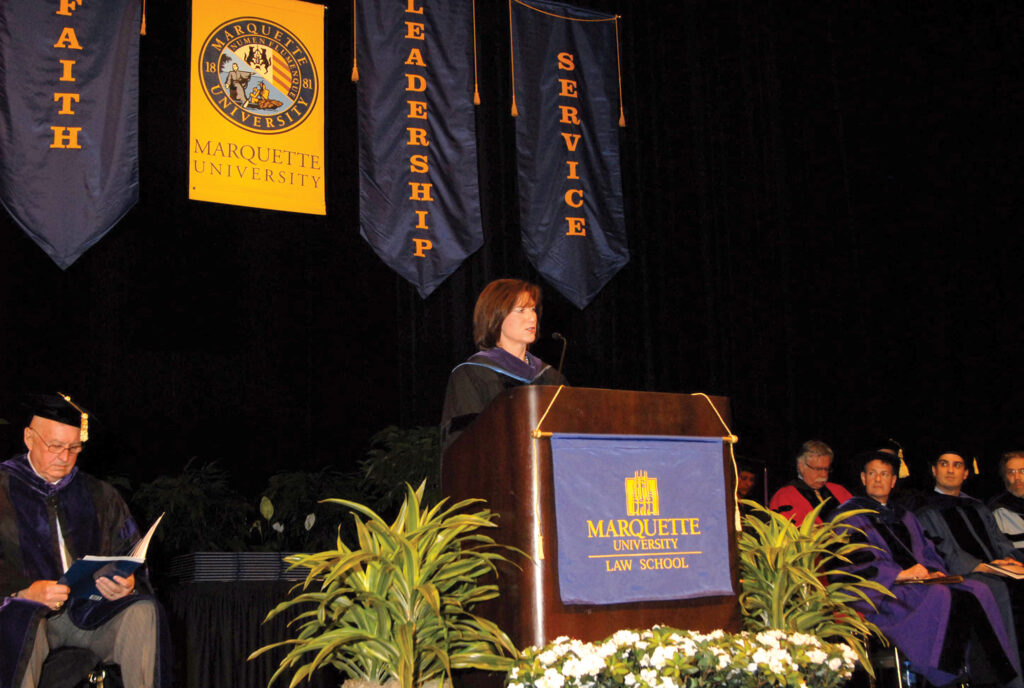
There were no lawyers in Diane Sykes’s family background, but she had seen the law at work in her father’s jobs and was interested in pursuing her interest in public service by becoming a lawyer. She left the newspaper and enrolled at Marquette Law School.
“It was a great fit for me,” she says. She had a general picture of what it was like to be a lawyer, particularly in court settings. But law school taught her “the rules” of the work. The Marquette approach was “very doctrinal,” with “a strong public service ethos,” both aspects that she appreciated.
She recalls particularly the torts class she took from one of the legendary professors at the Law School, James D. Ghiardi, L’42. “That was a formative experience because he was incredibly demanding and really taught us to read cases and distill what they said,” she says. “It was rigorous, demanding, somewhat intimidating, but it also instilled in all of us the absolute imperative of being prepared.”
She also cites other then-professors, Christine Wiseman, L’73, and Carolyn Edwards, as great teachers and role models. Sykes says both were trailblazers for women who wanted legal careers. “They were influential for me in terms of showing what was possible for women.”
Sykes thought she might become a prosecutor or seek a job in government. While she was a law student, she worked at the Milwaukee firm of Friebert & Finerty, which had extensive involvement with government and in court on behalf of businesses and individuals. That gave her “a real education in litigation,” she says. “It was a really fun place to work.”
Looking for a summer internship, Sykes contacted her fourth-grade teacher. Why? Because she knew the teacher’s husband was a lawyer at the law firm now known as Von Briesen & Roper, which she knew did a lot of work involving government units and school systems. She spent a successful summer with the firm.
Upon graduating in 1984, she was offered a clerkship for Terence Evans, L’67, who was then a federal district judge in Milwaukee. Evans became a mentor with a large influence on Sykes. For one thing, he was known for his constructive ways of dealing with people during court proceedings. For another, he wrote clear judicial opinions that made complex matters understandable, even to non-lawyers. Sykes has worked to emulate that.
After a year clerking for Evans, she joined the Milwaukee firm of Whyte & Hirschboeck (now part of Husch Blackwell), where she worked for seven years. But she had an ambition to become a judge—and she credits Evans with encouraging her in pursuing that goal.
A “beyond unusual” campaign for judge
In 1992, at a time when crack cocaine was a big factor in fueling a national increase in crime, three new courts were created for Milwaukee County. Sykes decided to run for one of the seats. She was young compared to most candidates for judge and had two young sons. She also had a legal background only in civil matters and had not worked in the district attorney’s office, which was a frequent precursor to winning a judicial election. “My candidacy was beyond unusual,” she says. But she gained support. “Campaigns then and now are all about crime,” she says, and she ran on law-and-order themes. She won.
Being a Milwaukee County Circuit Court judge was “a rewarding experience for me,” Sykes says. Dockets were exploding, both because of the crack epidemic and for reasons involving civil litigation, Sykes says. “I had to learn on the job very quickly.” But there were excellent judges who helped her. She points to Janine Geske, L’75, and Michael
P. Sullivan as important influences. Geske went on to serve on the Wisconsin Supreme Court and as distinguished professor of law at Marquette University, while Sullivan served later as the Milwaukee County Circuit Court’s chief judge.
In 1999, Justice Donald Steinmetz announced he was retiring from the Wisconsin Supreme Court, creating a vacancy that would be filled through an appointment by then-Governor Tommy G. Thompson. Sykes says some people regarded the seat unofficially as “the Marquette Milwaukee seat” on the court. Sykes was one of several people considered for the appointment and the only one with Marquette and Milwaukee credentials. The opening occurred around the time she and Charlie Sykes were going through a divorce, but he was an influential voice in conservative circles, and he used his voice to support her. “It was not an ideal time” for Diane Sykes personally, but she says, “This was my opportunity.” She got the nod from Thompson.
The appointment meant she had to run in the statewide election in 2000. In that race, she got 65 percent of the vote while Louis Butler, then a Milwaukee municipal court judge, got 34 percent.
Seeing increased reasons not to elect judges
The 1992 race for Milwaukee County circuit judge and the 2000 Wisconsin Supreme Court election were the only times Sykes ran for office in a contested race, and she won both.
In 2000, Sykes wrote an article for the magazine of the Wisconsin Policy Research Institute in which she cautioned that judicial election campaigning was moving in troubling directions.
“I used to be able to defend judicial elections,” Sykes says now. That was when you could focus on broad judicial philosophy…
In her view, things have gotten much worse since then. She thinks the acrimonious and clearly partisan state Supreme Court race between then-Justice Butler (he was appointed to the Wisconsin Supreme Court by Gov. James Doyle as Sykes’s successor in 2004) and Judge Michael Gableman in 2008 hit new lows for appropriate judicial campaigning. (Gableman won.) And things have gone downhill since then.
“I used to be able to defend judicial elections,” Sykes says now. That was when you could focus on broad judicial philosophy and have “highly generalized discussions” on topics such as law and order and the role of courts. Campaigns were reasonably inexpensive, and candidates refrained from saying how they would vote on specific issues that were likely to come before them.
“Those kinds of campaigns have long since become impossible,” she says. Two recent races for seats on the Wisconsin Supreme Court, in 2023 and 2025, were the most expensive judicial races in American history, with extensive direct involvement from both the Democratic and Republican parties. The liberal candidates who won each of those races were clear on their positions on issues such as abortion.
“I cannot continue to defend judicial elections as they currently are run,” Sykes says. That goes for the expense of races, the special-interest money involved, and the campaign rhetoric, which she labels extremely political and non-judicial “in a way that I find to be corrosive.” She says the results are undermining “the proper ethos of judging,” including neutrality, impartiality, due process, and fairness.
Among the regrettable byproducts of the intense partisanship surrounding our judicial campaigns, as Sykes sees it, is a kind of “whiplash” in which important recent decisions are reversed by changed court majorities. It is all “extremely disheartening,” she says, and judges and justices are increasingly being viewed as politicians in robes.
What does the phrase “politicians in robes” conjure up to Sykes? It’s used to criticize judges whose decisions you don’t like, she says. “A politician in a robe is the opposite of what the judiciary should be because it connotes someone who makes decisions not based on the law but on policy preferences or the politics of the moment, and those are improper considerations.” She regrets that “the current environment for judicial elections does not support the advancement of candidates who are committed to setting those [political] interests aside.”
Recent polling by the Marquette Law School Poll has shown that large majorities of voters in Wisconsin are in favor of Supreme Court candidates giving their positions on issues likely to come before them if they win. Sykes acknowledged this and called it a result of the increased polarization and partisan intensity of national politics.
Is there hope for things to get better? “I doubt it,” she says. “It’s very hard to reform judicial elections in any kind of systemic or institutional way because of the primacy of First Amendment interests.” Electing judges carries with it First Amendment values, she says. “Election speech—including election funding, which is a form of promoting and facilitating election speech—is at the core of the First Amendment, as it should be,” she says. The choice to elect judges subordinates judicial independence and prioritizes ballot-box political accountability.
From the state Supreme Court to the federal appellate bench
Sykes says she loved her time on the Wisconsin Supreme Court: “We were doing good work together.”
She had liked being a circuit court judge, even with a heavy workload, limited resources, and the need to make a lot of decisions quickly. Trial judges have a lot of discretion in how to handle some aspects of their cases, and Sykes says she learned from people who managed courts well.
But she took to being in an appellate court setting. The work is different from the work of the trial court and requires different skills. The Wisconsin Supreme Court can pick the cases it takes up, each one carries important weight, and the work calls for “clarification, elaboration, or development” of state law in ways that have broad and lasting impact, she says.
Even though Sykes had a conservative judicial philosophy, Senators Kohl and Feingold said they would go along with the nomination, a result partly of the good relationships Sykes had with judicial colleagues and others. “I was considered noncontroversial,” Sykes says.
Her time on the state high court was relatively brief. In 2003, Judge John L. Coffey, L’48, a former Milwaukee County judge who had served on the U.S. Court of Appeals for the Seventh Circuit since 1982, announced he was going to move to senior status. That opened a seat on the court, which by custom would go to someone from Wisconsin. President George W. Bush, who would make the nomination, was a Republican, and Wisconsin’s two senators, Herb Kohl and Russ Feingold, were Democrats. A bipartisan panel screened candidates for the appellate seat and recommended Sykes and three other individuals. Bush chose Sykes. Even though Sykes had a conservative judicial philosophy, Senators Kohl and Feingold said they would go along with the nomination, a result partly of the good relationships Sykes had with judicial colleagues and others. “I was considered noncontroversial,” Sykes says.
The nomination was approved on a 70 to 27 vote by the U.S. Senate. Sykes was sworn in on July 4, 2004, in the chambers of her mentor, Terence Evans, who himself had moved up from the federal district court to the Seventh Circuit in 1995. Sykes says it was “a tremendous joy and privilege” to join Evans on the Seventh Circuit 20 years after clerking for him when she was fresh out of law school.
Building a national reputation in conservative legal circles
Sykes always has been on the conservative side of the jurisprudential spectrum, from before she ran for circuit judge in 1992 on law-and-order themes. And, she says, her time on the Wisconsin Supreme Court and the period when she moved to the Seventh Circuit coincided with the era in which conservative legal thinking was “coming into its own.” Sykes says conservative judges were no longer just “the loyal opposition,” as they had been during the tenures of Chief Justices Earl Warren and Warren Burger. “Originalism” and “textualism” had gained momentum, especially after John Roberts became chief justice in 2005. The views of Justice Antonin Scalia were increasingly influential, captured in part by a phrase he popularized: the rule of law as a law of rules. Justice Scalia promoted textualism in statutory interpretation and originalism in constitutional interpretation, and both approaches have taken hold.
Sykes, too, adheres to these interpretive principles. She gives “an unequivocal yes” when asked if she is a textualist, and she generally would agree she is an originalist. She says textualism is now the dominant means of interpreting statutes, focusing on the language of statutory law and how it was understood when it was adopted. She emphasizes that textualism does not ignore context, nor is it rigidly legalistic.
She views originalism as “a starting point” in constitutional interpretation, but it is not the entire process. “We are adjudicators, and we have to adjudicate real cases.” Like textualism in statutory interpretation, constitutional originalism focuses on the original public meaning of the Constitution. As Sykes sees it, originalism will not answer all constitutional questions. “There was so much less law” in the Founding era, and most constitutional provisions are phrased in highly general language that does not yield clear answers in actual cases. “We do, in the end, have to decide our cases,” she says, and appellate judges need to clarify the law for lower courts, the bar, and the public. Originalism is the anchor in constitutional adjudication, she notes, but precedent and implementing doctrine also have roles to play.
Thriving as a “collegial” Seventh Circuit judge
Sykes has thrived as a Seventh Circuit judge. While a state Supreme Court focuses almost only on important, consequential cases with contestable and novel legal questions, a federal appellate court hears quite a few cases that are more routine, including a lot of pro se cases. But there are also weighty and complex cases that carry a wide and lasting impact.
As Sykes stands one day last fall in the courtroom of the Seventh Circuit’s headquarters, a midcentury skyscraper in the heart of Chicago’s loop, she looks up at the painted portraits hanging on three of the walls, each one of a current or recent member of the court. She points to each of them, speaking warmly about what kind of people they were and their impact as judges—and on her. Her colleagues are no less admiring of Sykes.
At a reception honoring Sykes in Marquette Law School’s Eckstein Hall on September 25, 2025, Judge Frank H. Easterbrook—the longest-serving member of the Seventh Circuit (he was appointed in 1985)—praised Sykes. The work of appellate judges is collegial, and Sykes has all the qualities that a good collegial leader needs, Easterbrook said. She listens, she can be persuaded, and she can disagree without being disagreeable. And U.S. Supreme Court justices have found her work praiseworthy, he said. As chief judge, Sykes had oversight over all the federal courts in the Seventh Circuit, including district courts in Wisconsin, Illinois, and Indiana. That includes more than 100 judicial officers in the Seventh Circuit and more than 1,000 employees. He said the Seventh Circuit was working well, and that was an accomplishment for Sykes.
“The public has paid exactly the right amount of attention to her service: None,” Easterbrook said. But in the judicial system, people know how well she did the job. He also allowed, “She’s a textualist, which makes her my kind of judge.”
Being considered for the Supreme Court of the United States
In 2016, following the death of Justice Scalia, partisan gridlock in the U.S. Senate prevented action on President Barack Obama’s nomination of Judge Merrick Garland to the Supreme Court. Donald Trump, then a candidate for president, took the unusual step of announcing names of people he would consider for the Court if he won the election. Sykes’s name was on the list.
When Trump was elected, that prospect became real for her. An elaborate process unfolded in which Sykes was interviewed by advisors to the transition team, including Vice President-Elect Mike Pence; Don McGahn, Trump’s incoming White House counsel; and Leonard Leo, a leader of the Federalist Society who was influential in screening candidates for justice. It was a rapid and intensive vetting of her judicial career, including a close review of almost everything she had written as a judge, going back to her days on the Wisconsin Supreme Court and the Milwaukee County Circuit Court.
Sykes was the only woman among a small set of finalists, and she was the oldest of the finalists, having just turned 59. Age has been increasingly an important factor for presidents in federal judicial nominations in recent decades.
In the end, Trump nominated Neil Gorsuch, who continues to serve on the Court.
Sykes has no regrets. “I was extremely gratified to be included in that very elite group,” she says.
The qualities of a good judge
What are the qualities of a good judge? “All of the foundational attributes are well known, well established, and often repeated,” Sykes says. And she subscribes firmly to them, even as she sees partisanship and polarization creating forces working against the classic definition.
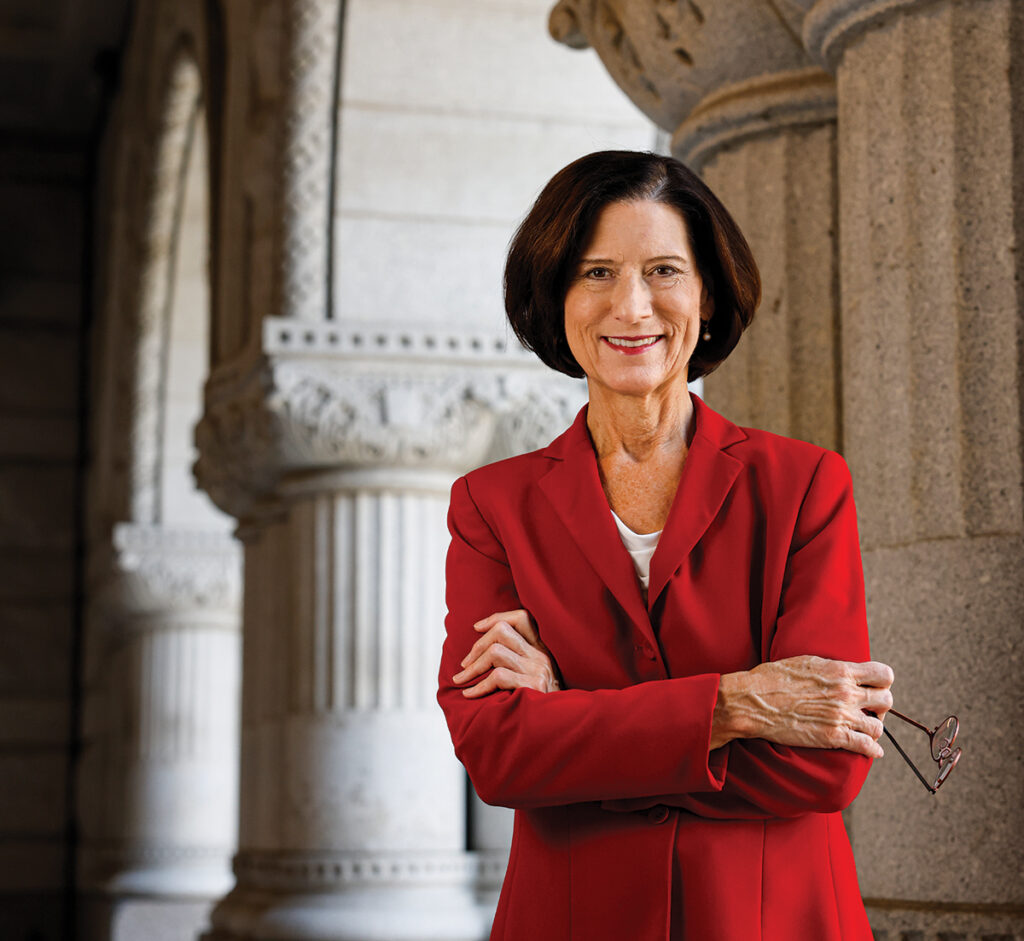
She lists attributes that she has aimed for: Impartiality. Careful attention to the need for every litigant to have his day in court. Listening with an open mind to both sides of a case and giving fair consideration to both sides. She mentions a famous quote from Socrates: Judges should hear courteously, answer wisely, consider soberly, and decide impartially.
She cites an additional maxim: Judges need to be able to put their passions aside in reaching their judgments. “That entails a certain humility and the ability to recognize the significance of the decisions we make—and what we don’t know. It involves the cast of mind and temperament to put the time into learning what we don’t know—about the facts and the law—before making a decision.” She says good judges need “a solid foundation of knowledge of legal history, and history in general, as well as knowledge of the human condition and the path of the law over time and how the rule of law is best preserved.”
Appellate judging also requires a sense of perspective about where the law has come from and where it is now. It’s important to know “not just the rules, but the reasons for the rules and the history behind their development,” Sykes says. And appellate judges in particular need strong communication skills, including the ability to explain the law and to persuade others in writing, on the bench, and around the conference table where judges determine the outcome of a case.
It is inevitable, both as a general matter and especially in this period in American life, that Diane Sykes’s work on the bench would be praised by some and criticized by others. But 42 years after she graduated from Marquette Law School, she has earned high grades for adhering to the “public service ethos” she learned at home and as a student and for dealing with people in a wide range of situations in principled and even gracious ways.
“I have tried to maintain the longstanding norms of judging,” Sykes says.