
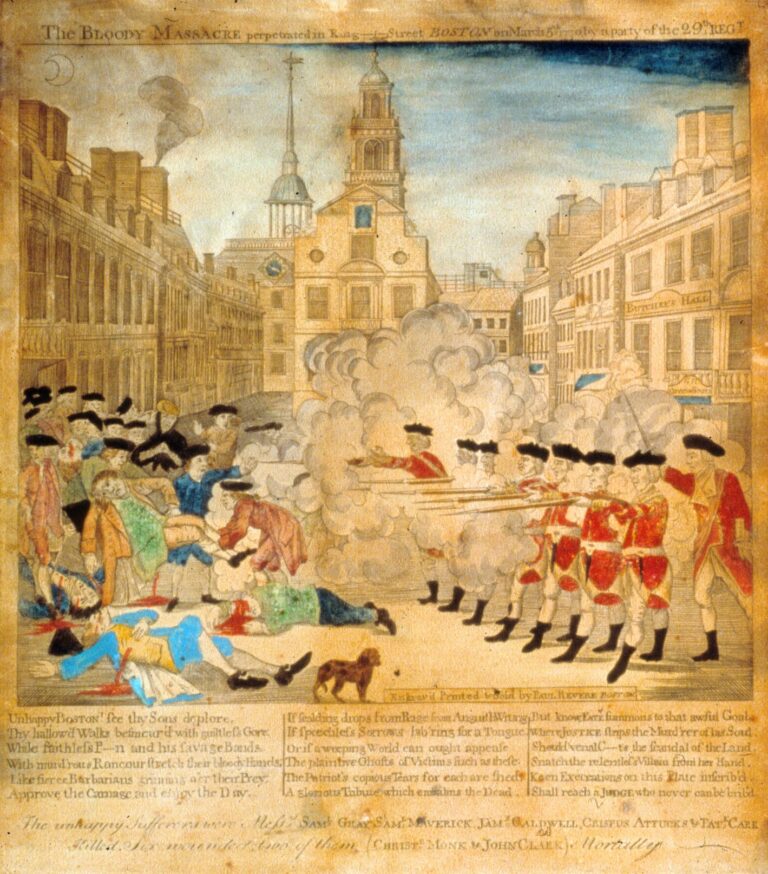
Above, the print The Bloody Massacre (1770) by Paul Revere (American, 1735–1818). Currently part of the exhibition Defying Empire at the Haggerty Museum of Art and on loan from the Chipstone Foundation, the work is an engraving with hand coloring, 1969.7. All photographs by Gavin Ashworth.
As a conventionally trained early American historian, Dr. J. Patrick Mullins pores over the writings of Jefferson, Paine, Hamilton, Franklin and other prominent politicians and thinkers of the period. But watching students stand rapt before artifacts on field trips to museums and historical sites convinced the associate professor of history that studying the things ordinary people treasured could also enrich our understanding of the past.
In a new exhibition he curated at the Haggerty Museum of Art in collaboration with Milwaukee’s Chipstone Foundation, Mullins presents a variety of 18th and early-19th century objects adorned with political slogans and imagery — including popular prints, printed teapots and hand-painted pottery — to show how invested everyday men and women were in the fight to break from England or, vice versa, to keep the empire intact.
Marquette’s director of public history, Mullins hopes viewers come away with a richer picture of how people flashed these pieces to show their allegiances — and how even the most ardent Patriots drew on “a very British tradition of popular protests” stretching back to the Middle Ages. It’s visual history, he adds, that also provides good training for decoding the symbolism and slant of today’s political discourse.
Prints and the revolution
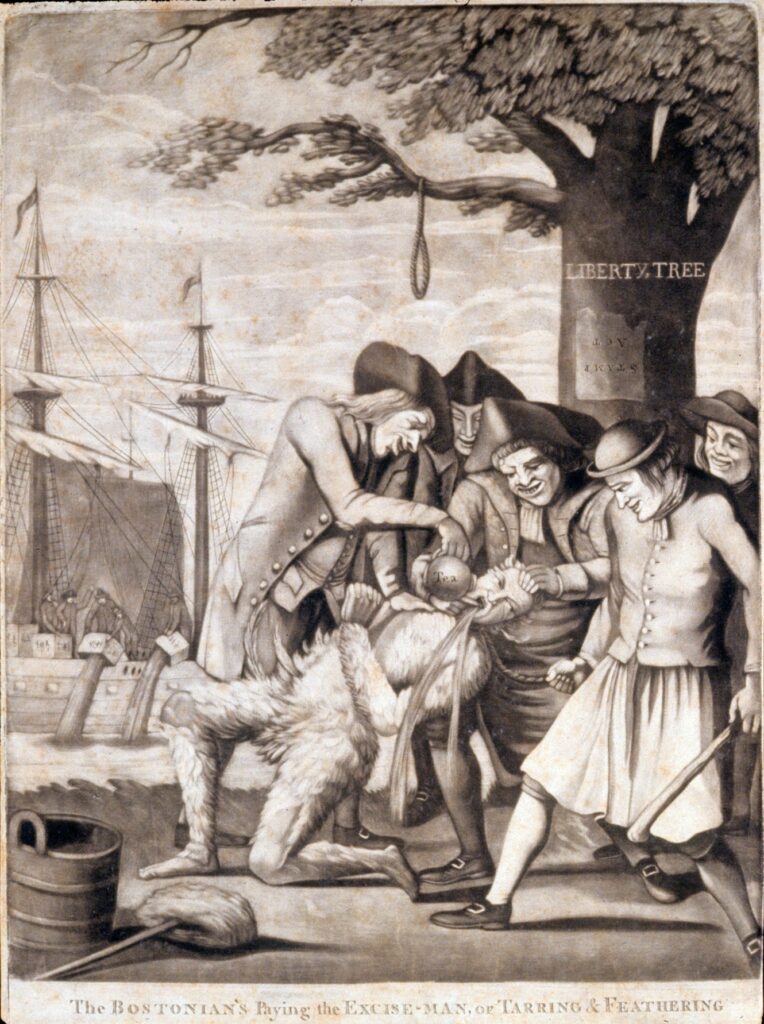
Even a glance at the prints above — on loan from Chipstone and originally hung in taverns to signal Patriot or Loyalist sympathies, Mullins suspects — can knock you back with the violence of our nation’s founding days. At the top is The Bloody Massacre, a hand-painted engraving showing British soldiers firing into a crowd of unarmed Bostonians.
Produced by Paul Revere three weeks after the March 1770 event, it memorializes the killing of five civilians, including Crispus Attucks, a dockworker of African and Native American descent, often considered the first person killed in the American Revolution. Above, The Bostonians Paying the Excise-Man or Tarring and Feathering, printed in London in 1774 and likely engraved by British satirist Philip Dawe, depicts a ghoulish pack of Colonials. They are pouring tea down the throat of John Malcolm, an American-born tax collector loyal to the Crown who had already been tarred and feathered in another New England town because “he was that hated,” Mullins says.
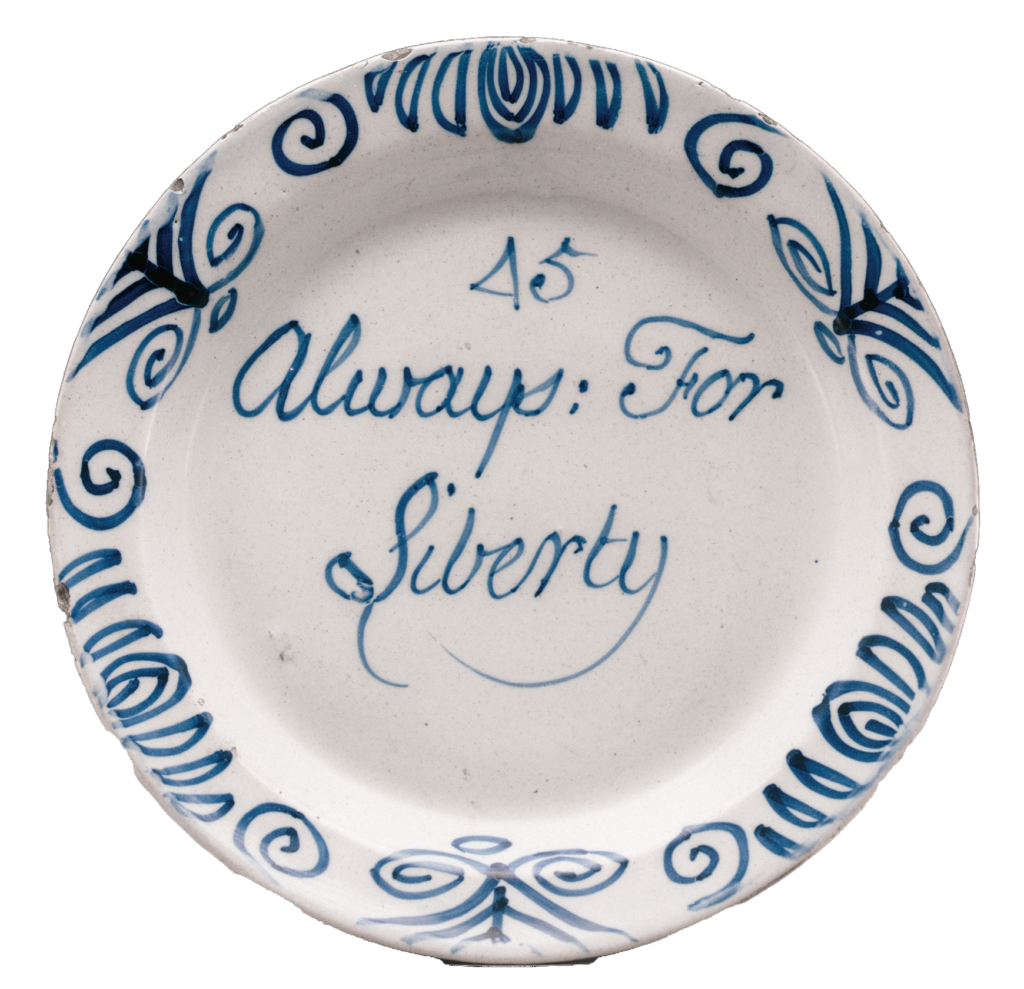
Plate, ca. 1765, Delftware, 1964.41
Persuasive pottery
Women, so often left out of historical accounts and barred from spaces where men convened, telegraphed their opinions through their household pieces. The Delftware plate (c. 1765) above, with peg marks on its backside suggesting it served as wall art, and the porcelain punchbowl below (c. 1770) would have told house guests that their hostess admired puckish John Wilkes, a British parliamentarian and journalist boldly critical of government corruption.
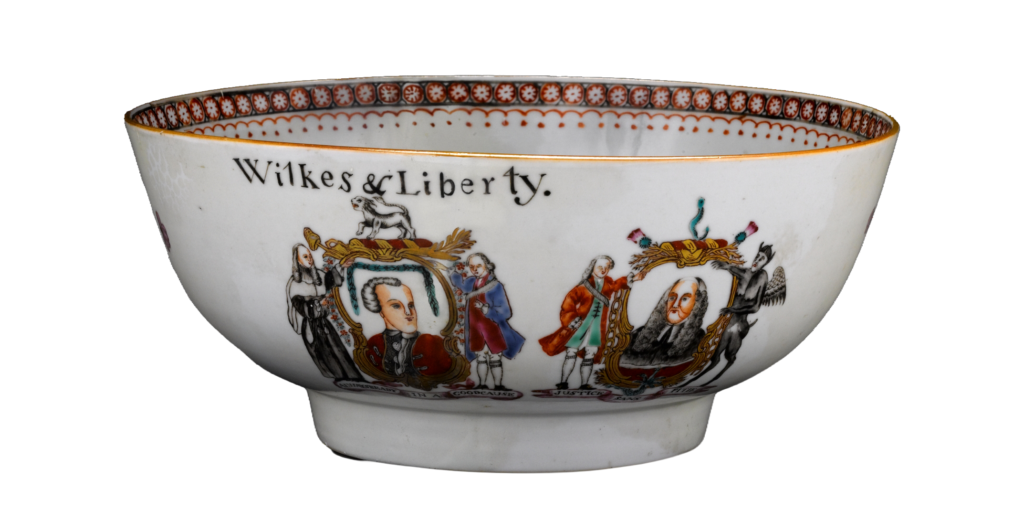
Punch bowl, ca. 1770, porcelain, 1956.8.
Wilkes furthered his renown on both sides of the Atlantic with issue 45 of his pamphlet, The North Briton, featuring a scathing article accusing King George III of oppressive policies. Among both British radicals and American Patriots, “Wilkes & Liberty No. 45” (and its variants) went viral, “like a celebrity meme,” Mullins says, becoming “a communal way for non-literate people to express views on politics and society” because everyone knew the code.
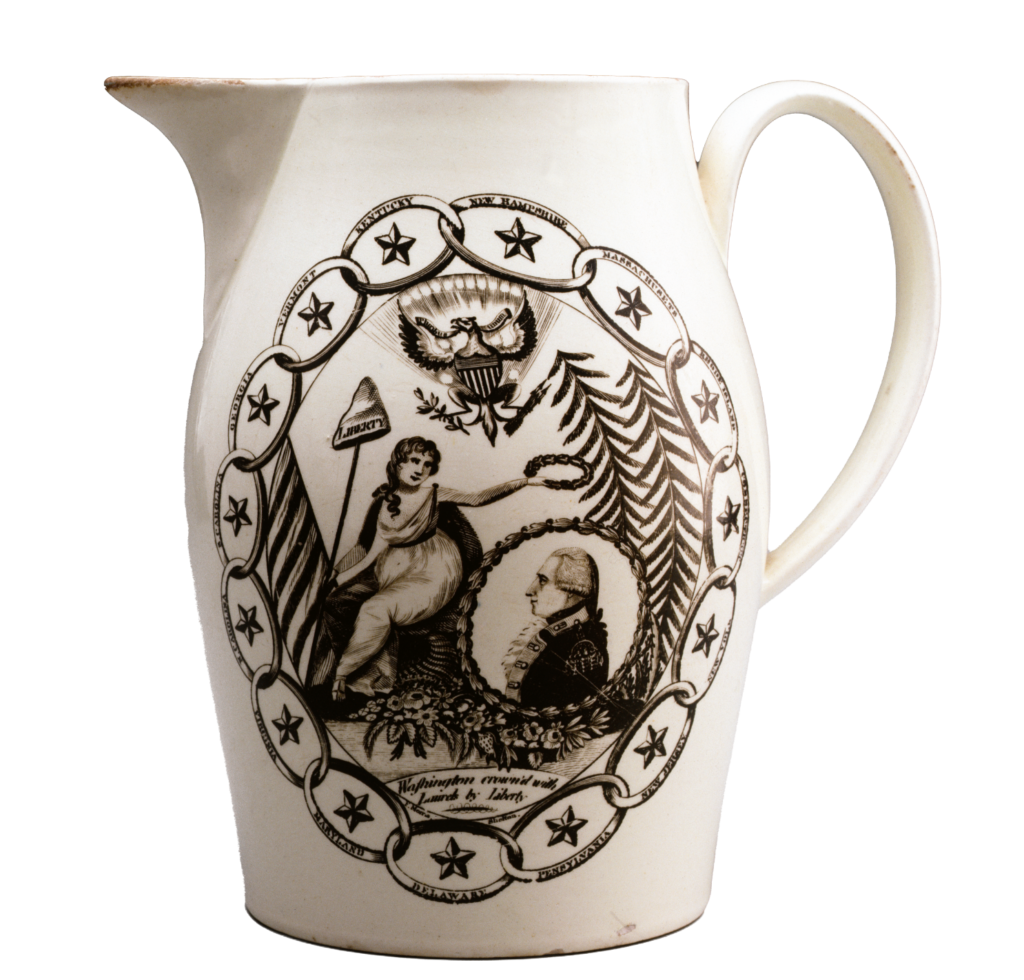
Jug, 1803-1805, creamware with transfer printing and painted decoration
And with its inscription, “Washington crown’d with/Laurels by Liberty,” the creamware jug above, produced in Staffordshire, England, around 1805, gives “insight into the political beliefs, motivations and actions” of its owner. She was likely a middle-class American woman, Mullins says, who ordered her pitcher to serve her friends water — and demonstrate her ardent approval of the first president.

From the spring 2026 issue of Marquette Magazine. Read more web stories from the magazine or see the entire print issue in a PDF viewer.