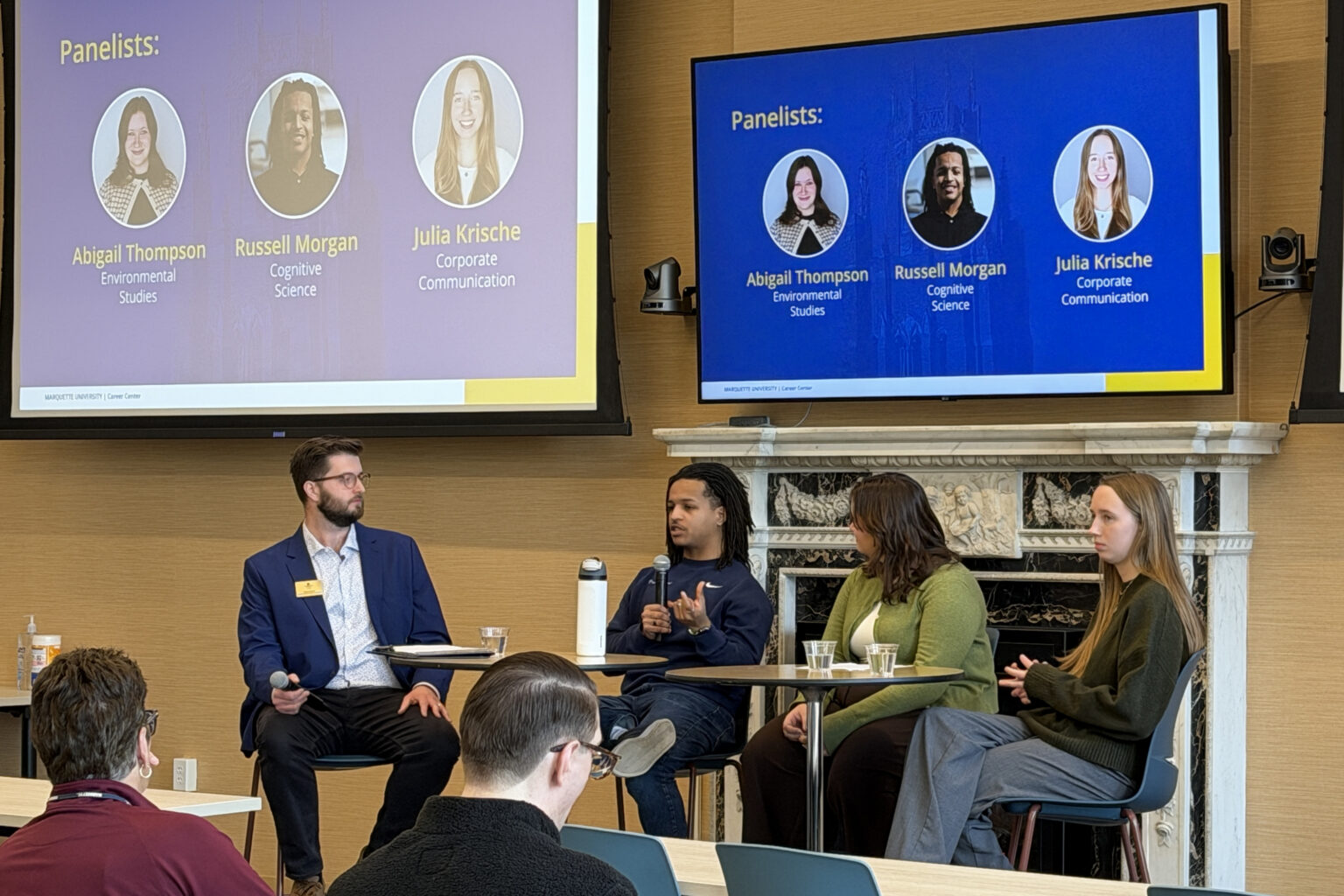
The Marquette University Career Center brought together faculty, staff and employer partners at a “Student Perspectives on AI” event, hosted in the Lemonis Center for Student Success with support from the Northwestern Mutual Data Science Institute.
Attendees heard from a panel of Marquette students about their AI use in previous internship experiences and the classroom, as well as their overall opinions and ideas about AI use. Marquette seniors Russell Morgan, Abigail Thompson and Julia Krische shared diverse perspectives, rooted in their various academic disciplines. Following the panel, the Career Center led a facilitated conversation about AI practices related to post-graduate employment.
Much of the conversation involved the importance of transferrable skills like communication and critical thinking. The student panelists discussed how such skills are essential to preserve nuanced relational and institutional context within communication, avoid creating distance between humans, and ensure that humans are still making the decisions. All three student panelists expressed confidence in their future job security, believing that the skills they are developing and their understanding of AI will help them adapt rather than be displaced by it.
There also emerged a desire for clarity around AI in the workplace and the classroom, both in terms of setting expectations for appropriate AI use and increasing transparency about how employers are using AI in the recruitment process.
The panelists expressed that among students, the outlook on AI varies widely. Some students are enthusiastic about using AI and eager to build skills, while others are more hesitant and have concerns about ethical and practical implications of AI. Attendees were called to understand this array of perspectives and be responsive to it. How can professionals address concerns by adjusting how we talk about AI and/or how we use it? How can professionals foster enthusiasm with intentionality so that students build the right skills and ask the right questions?
Students are engaging deeply and profoundly with questions of AI ethics and where to set personal and professional boundaries. They’re talking with peers, devouring the news, taking in social media content and hearing from forward-thinking faculty members — and they are eager for more faculty, staff and employers to be part of that conversation.