You’ve been doing great work. Now do more.
That’s the happy if challenging state of Marquette Law School’s Office of Public Service, the result of two developments this past June.
First, the Ray & Kay Eckstein Charitable Trust made a $3 million gift to Marquette University to create an endowment to support the Law School’s Office of Public Service (OPS) and the Marquette Volunteer Legal Clinics (MVLCs), which are a core part of the work of OPS. The gift further includes a challenge to Marquette to raise $2 million by the end of June 2027. If the challenge is met, the Eckstein Trust itself will donate an additional $2 million, bringing the total endowment to $7 million.

Second, the American Bar Association (ABA) announced that Marquette Law School is receiving the organization’s 2026 Pro Bono Publico Award in recognition of the MVLCs and the Law School’s commitment to serving low-income and disadvantaged people. This is only the fourth time that the award program, which began in 1984, has recognized the work of a law school.
In its citation for the national award, the ABA said, “The Marquette Volunteer Legal Clinics . . . have developed into a lifeline for unrepresented litigants facing civil legal challenges. From modest beginnings in 2002, handling just 106 client visits, the MVLCs have grown exponentially, recording 6,160 visits in 2025 alone. . . . [P]ro bono programs like the MVLCs both serve as a legal aid ecosystem and engage with legal aid providers, helping ensure that individuals seeking assistance do not fall through the cracks.”
Building on the Eckstein legacy
The Eckstein gift has particular resonance for the Law School. The law school building is named, of course, in honor of the late Ray and Kay Eckstein, who in 2007 made the lead gift of $51 million to support the project. Dean Joseph D. Kearney praised the legacy of the Ecksteins and the way their family is continuing to support Marquette.
“Throughout my relationship with Ray and Kay, they wanted one thing from us at Marquette,” Kearney said. “They wanted excellence. We met that challenge in the concept, design, and construction of Eckstein Hall, which since its opening in 2010 has been acclaimed across the country.”
Kearney expects the new gift from the Ray & Kay Eckstein Charitable Trust to support continued and increased excellence in the Law School’s pro bono program. “It is all about advancing the Marquette University mission,” Kearney said. “The Law School’s work of educating legal professionals who rely on their knowledge, skills, and values to serve people in need is an important example of developing ‘men and women for others,’ in the longstanding Jesuit phrase.”
The growth of pro bono services
A Law Lifeline
That’s what the American Bar Association called Marquette Law School: “a lifeline for unrepresented litigants facing civil legal challenges.” The national organization praised the Marquette Volunteer Legal Clinics (MVLCs) in presenting the Law School with the ABA Pro Bono Publico Award in 2026.
It is only the fourth time in more than 40 years that the ABA has recognized a law school with the award. In its citation, the ABA said that “pro bono programs like the MVLCs both serve as a legal aid ecosystem and engage with legal aid providers, helping ensure that individuals seeking assistance do not fall through the cracks.” Read more about the success and growth of the Law School’s Office of Public Service on page 4.
More than 70 percent of Marquette Law School students take part in pro bono work each year. They help make a reality of the Marquette University mission.
The Law School created the Office of Public Service 20 years ago, partly to help secure a legacy of Howard B. Eisenberg, the Law School’s late dean, who himself had modeled public service and pro bono work before his death in 2002. Yet Kearney, his friend and successor as dean, who led the creation of OPS in consultation with the faculty, nonetheless regards the key development as not having been an administrative initiative from the dean’s office during either Eisenberg’s or his own tenure.
Rather, it was a group of women graduates and students, such as Julie Darnieder, L’78, Tanner Kilander, L’02, and Bridget Kenney McAndrew, L’02, “who imagined and launched” the first Marquette Volunteer Legal Clinic in 2002, Kearney said. “Howard’s and my principal contribution to the MVLCs has been to help channel and support the work of extraordinary lawyers and students.”
In the almost 25 years since the first clinic opened, pro bono and public service work has become a hallmark of the Law School’s identity and the experience of students. More than 70 percent of Marquette law students take part in pro bono work each year, and half of them graduate wearing an honor cord that reflects their having performed 50 or more hours of pro bono legal work.
Along with the students, some 250 lawyers volunteer every year, many but not all Marquette graduates. The leadership of alumni has continued to be essential, as in the 2013 proposal by an alumni couple, Frank Daily, L’68, and Julie Ebert, L’81, to fund the creation of the Mobile Legal Clinic in honor of their law partner, Michael Gonring, L’82. The Posner Foundation, remembering Gene Posner, L’36, and his wife, Ruth, and led by their grandson, Josh Gimbel, a Milwaukee lawyer, has provided substantial operational support for the Office of Public Service for more than a decade and a half.
Generally, the volunteer legal clinics offer brief legal advice sessions to a wide range of low-income individuals and those with special needs. About 40 percent of the people present family and safety issues, a quarter have housing needs, and one in five have debt or other money problems.
Angela Schultz, assistant dean for public service, said estate planning may strike some as not a widespread need among low-income people. In fact, helping people secure titles to their homes, often a family’s sole asset, and address other estate-related questions often proves to be valuable. “It can begin to preserve a form of generational wealth among community members previously without access to such planning,” Schultz said.
Over the years, from the one original 2002 location, the MVLCs have expanded. They now include the Mobile Legal Clinic and a location in the Milwaukee County Courthouse’s Milwaukee Justice Center, which is a partnership among the Milwaukee County Clerk of Courts, the Milwaukee Bar Association, and Marquette Law School. Other locations are the House of Peace on Milwaukee’s north side; the United Community Center, serving especially the Hispanic community on Milwaukee’s south side; and the Milwaukee County Veterans’ Service Office, just to the city’s west. And, for a “silver lining” legacy of the pandemic era, the MVLCs offer Zoom clinics reaching across the State of Wisconsin.
Schultz, grateful for the ABA award, is especially excited about the gift from the Eckstein Trust, assuring that the Law School’s Office of Public Service will stay strong and can even expand its efforts.
Katie Mertz, L’11, director of pro bono and public service, who has worked with Schultz in OPS for more than a decade, said that a guardianship clinic will be offered during the 2026–2027 school year and efforts will increase to build partnerships with the legal community and the business community.
Schultz said that while the Office of Public Service oversees help for thousands of people each year and while its reach has begun to extend to almost all of Wisconsin (68 out of 72 counties in recent years), there is a great need to do more. “We are so far from meeting the need,” she said.
From student to colleague
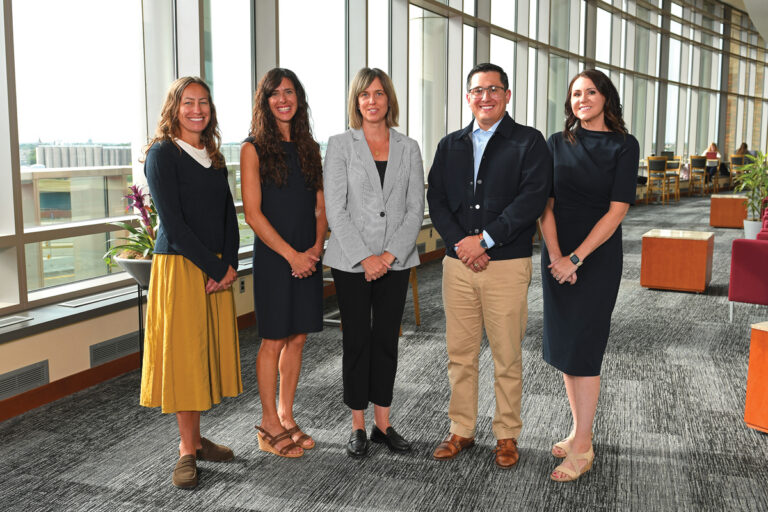
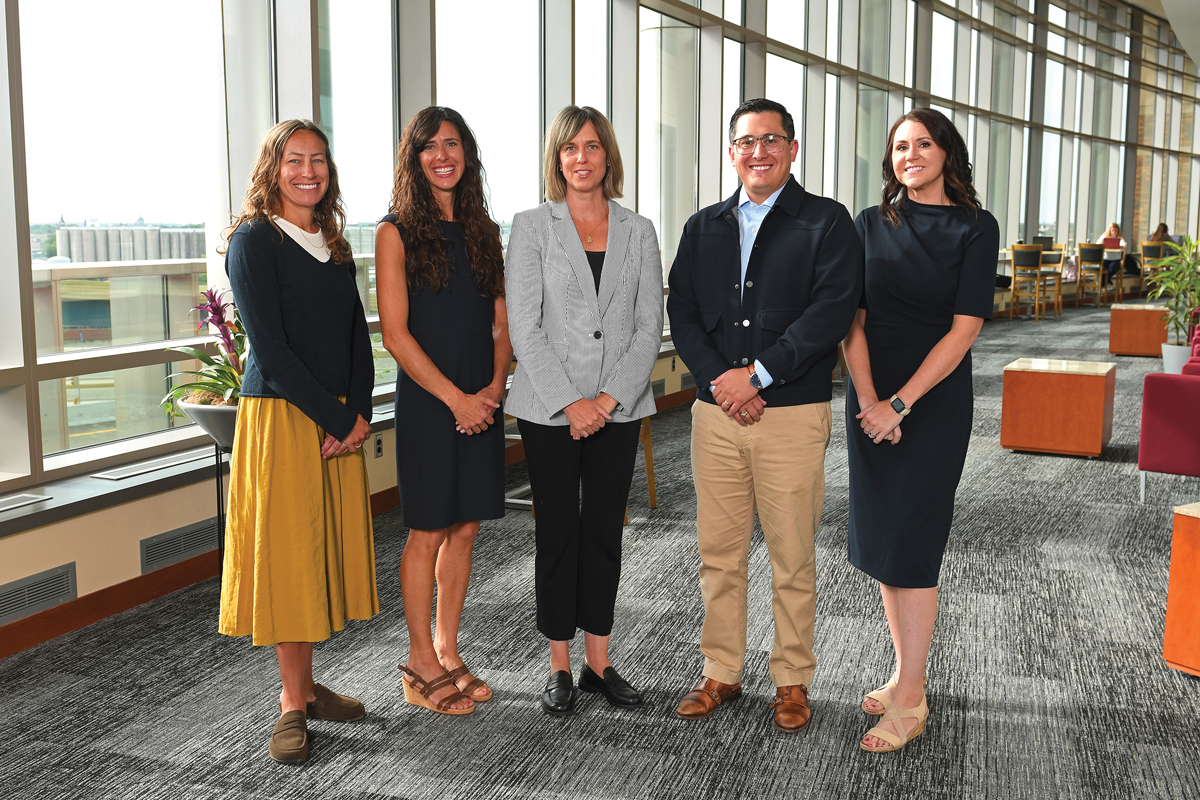
Joshua Hernandez, L’22, wants to help advance the Law School’s efforts. In July, he joined Schultz and Mertz, becoming the third lawyer in the Office of Public Service. Working alongside them are program assistants Maggie Klatt and Mindy Schroeder. Hernandez is assistant director of the Marquette Volunteer Legal Clinics. His hiring was made possible by Daily and Ebert’s longtime support for OPS and the new gift from the Eckstein Trust.
Hernandez’s personal story reflects a good deal about the Marquette Law School of the past several decades. A native of Texas, he had a big interest in sports and worked in the athletics department at The University of Texas at Austin for three years after graduating from the university. That sports affinity drew him to Wisconsin—to enroll at Marquette Law School, with its nationally prominent sports law program, in 2019.
But he also had a strong interest in helping people through the public service program. “I jumped in as soon as possible,” said Hernandez, who joined fellow students and volunteer lawyers in the family forms clinic at the Milwaukee Justice Center in the Milwaukee County Courthouse. He did 300 hours of pro bono work as a law student and won the Milwaukee Bar Association’s pro bono publico student award in 2021.
After graduating from the Law School in 2022, he joined the Reinhart Boerner Van Deuren law firm in Milwaukee, working in employee benefits and institutional investment services. But he continued to be active in volunteer legal work.
As soon as he saw the posting for the new position in the Law School’s public service office, Hernandez responded. “I was looking for the next step in my development,” he said. And he already knew the office has “an amazing staff that is doing amazing things.”
Now he is part of growing the reach and strength of the pro bono efforts. His duties will include helping lead the work of the Mobile Legal Clinic, a van-based program that travels to underserved areas in Milwaukee. He is also aiming to increase community engagement with the services the office offers.
A national award, a new endowment, and an expanded office—quite the set of developments as OPS celebrates its 20th anniversary and the MVLCs approach their 25th. Yet the focus is on the journey ahead.
This article was first featured in the Fall 2026 issue of Marquette Lawyer Magazine.