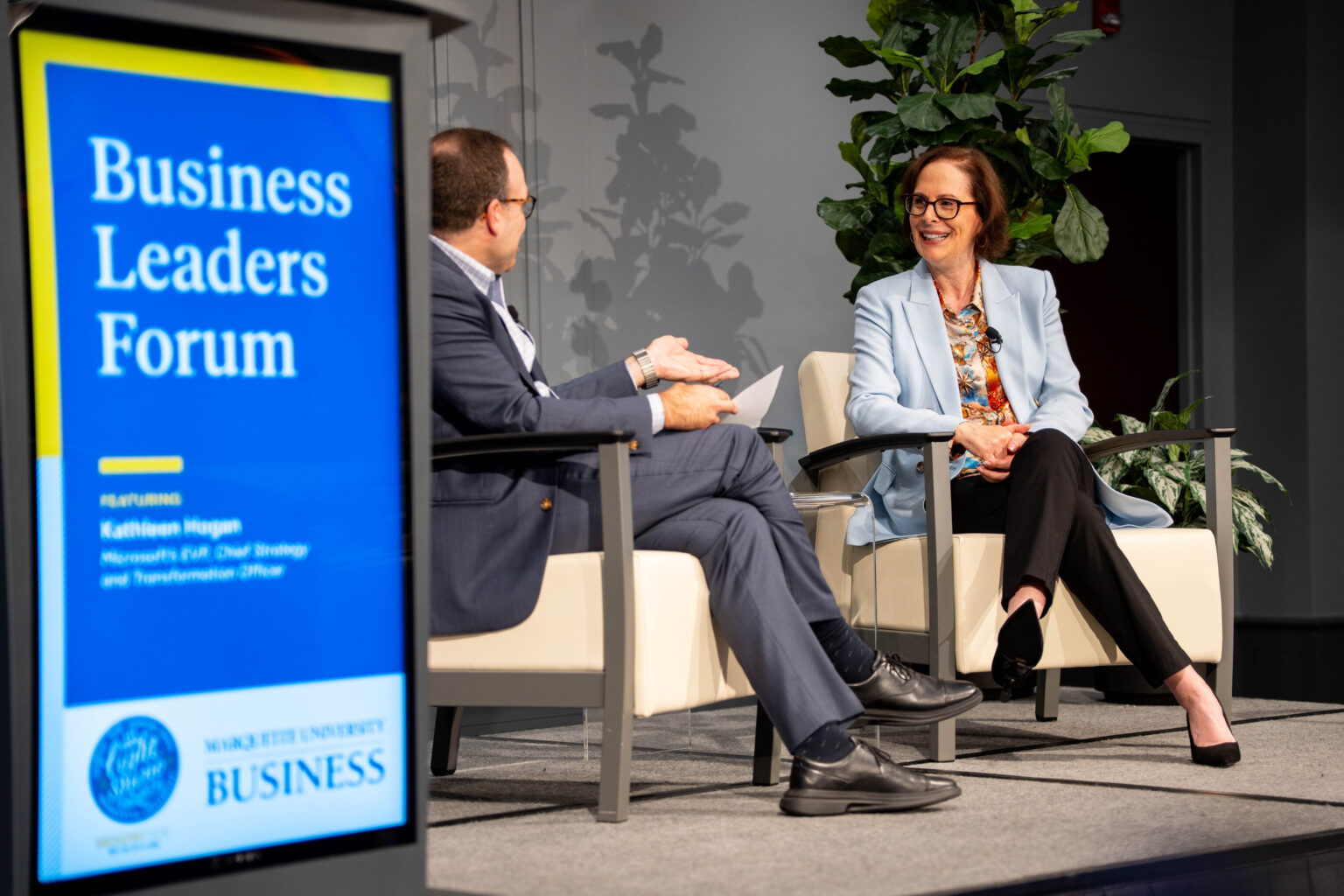
A late September visit to southeast Wisconsin felt like a trip back home for Kathleen Hogan. Originally from Brookfield, just 13 miles west of downtown Milwaukee, the Microsoft executive made a trip back to headline the 2026 Business Leaders Forum hosted by Marquette’s College of Business Administration.
On Sept. 29, Hogan arrived on campus and joined an eager audience — including her nephew, a current student at Marquette — to share her experience with strategic transformation and technology’s pace of change as Microsoft’s executive vice president and chief strategy and transformation officer.
“I never would have imagined this is the path I’d take,” Hogan said of her professional journey. “Growing up, I actually wanted to be a teacher, but there are many paths to happiness. You never know where your next opportunity will come from.”
Established in 1999, the Business Leaders Forum connects the Marquette community with nationally recognized business leaders. For over 25 years, this speaker series has provided the opportunity for students, alumni, faculty and area professionals to connect with executives shaping the business landscape, supporting Marquette Business’ approach to building practical knowledge into its rigorous curriculum.
“The Business Leaders Forum not only gives our students a rare glimpse into the minds of some of our nation’s most accomplished chief executives, but it also allows them to interact in meaningful ways with business leaders,” said Andrew DeGuire, James H. Keyes Dean of the College of Business Administration. “If we are to provide truly transformative education, we must give our students these rich and rewarding experiences.”
Business Leaders Forum attendees explore current trends, issues and practices in critical areas of industry alongside seasoned executives who care about developing the next generation of professionals. The annual event is made possible through a special endowment from the Kathleen and Frank Thometz Foundation.
Facilitated by Dean DeGuire, the discussion explored Hogan’s experience leading Microsoft’s enterprise-wide strategy and transformation agenda. She describes her work as mobilizing change and accelerating evolution across the company, propelling the organization toward an AI-powered, human-led structure.
“It’s about rolling out technology to help humans, not rolling out technology for technology’s sake,” Hogan said. “At Microsoft, we’re empowering people to achieve more. We’re not just showcasing tech — we’re showcasing people achieving their mission through its use. That perspective is important.”
When asked about implementing company-wide change, Hogan emphasized the importance of investing in people and continuous training. The best ROI comes from understanding the process from end to end and applying technology in a way that both streamlines processes and increases impact, she said.
“Business leaders often underestimate the difficulty of combining people, processes and technology,” Hogan said. “To create value, you need so much more than tech rollouts. You need to go slow to go fast, and leaders need to exemplify the exploration and adoption of the things they preach.”
Amid an evolving business landscape, Hogan shared four ways AI can be used to drive business strategy, including enriching the employee experience, reinventing customer engagement, reshaping business processes and bending the curve on innovation to produce better, faster outcomes.
“The conversation really isn’t about change management, it’s about change readiness because the world is always changing,” Hogan said. “So many organizations feel like they need to go back and redefine their culture before they can use AI in a meaningful way. Teams need to be able to experiment without the fear of failure and exercise agency in their roles.”
Hogan and DeGuire also shared the “Frontier Firm Playbook,” a resource emphasizing three recipes for AI transformation:
- Personal Acceleration – empowering specific roles with AI tools
- AI-Powered Process Redesign – changing entire workflows
- AI-First Possibility – exploring ways to redefine shared processes
Regardless of role or industry, the discussion expressed the importance of embodying a growth mindset and ensuring individuals’ values are aligned to the company’s purpose.
“The question is not only what’s possible, but what’s right,” DeGuire said. “All organizations need to acknowledge the fact that there are risks that come with artificial intelligence. We need to have open dialogue around it, both in business and in society.”
“Absolutely, and it emphasizes the importance of human agency,” Hogan answered. “Employees need to exercise agency to ensure AI is in service to them. Professionals need to understand how to prompt tools to get viable outputs, then evaluate those outputs to ensure they provide value.”
Tying the discussion back to Ignatian principles, closing remarks were offered by Rev. Jim Pribek, S.J., acting vice president of Mission and Ministry at Marquette.
“Love shows itself in deeds, not words. We must continue to put humans first,” Pribek said. “Thank you, Kathleen, for your thought leadership and insights. I think everyone will agree that you are a teacher after all.”