In 1783, two days before Christmas and four months after the Treaty of Paris officially ended the Revolutionary War, Gen. George Washington stood before Congress and voluntarily resigned as commander-in-chief of the Continental Army. It was a watershed moment in the founding of the American Republic. Washington surrendered his power to the civilian authority, ensuring the fledgling nation, recently freed from a monarch, would also not be run by a militaristic dictator. During his two terms as president, Washington never wavered in military subordination to the democratically elected state. He set a profound precedent that’s wobbled but held up throughout U.S. history, although a leading scholar of the dynamic believes a deeper appreciation would benefit us all.
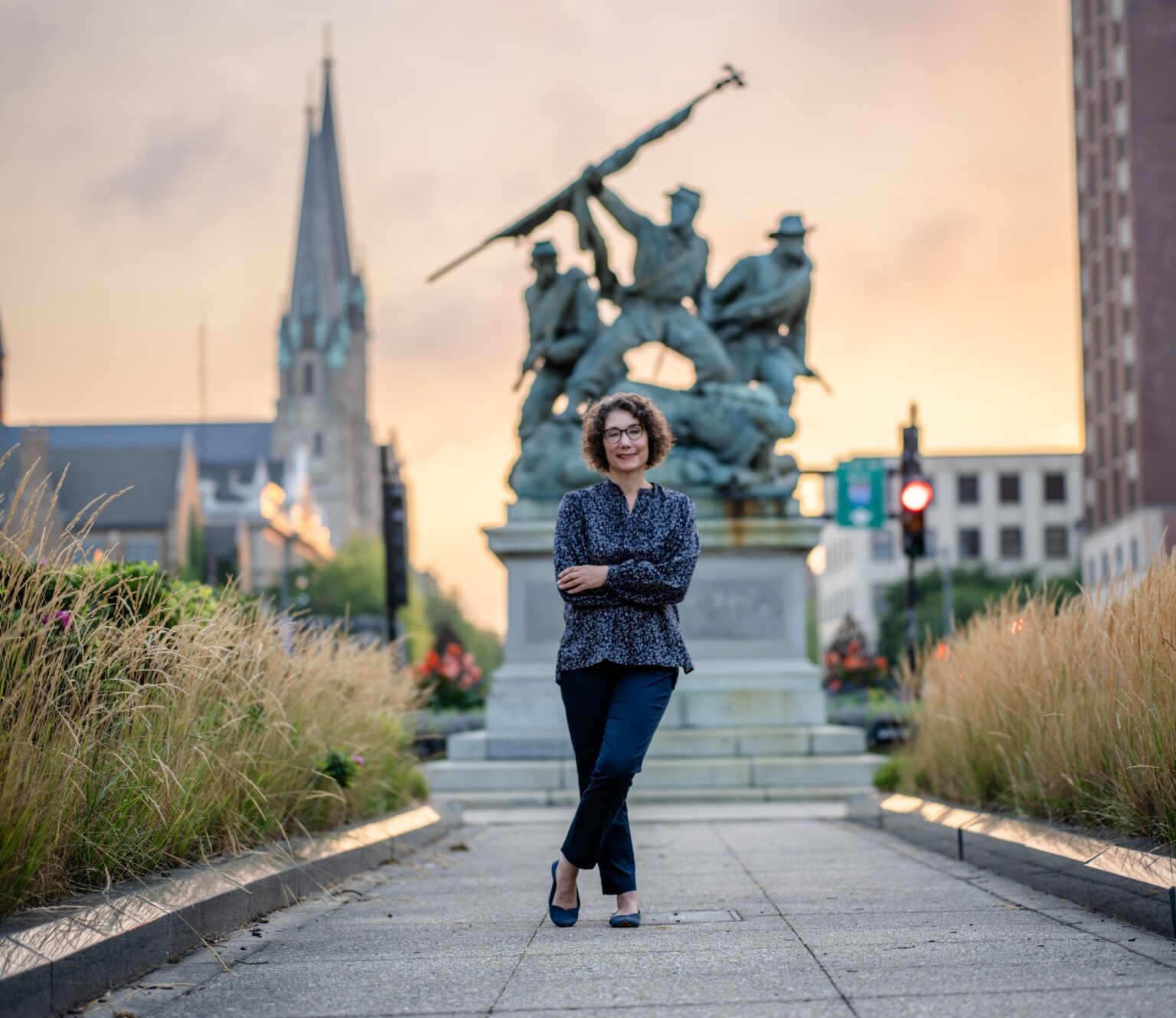
“I would like it if American citizens had more interest in what the military is doing abroad and the issues veterans face, and were part of an overall higher level of engagement between both sides, which is a theme that comes up repeatedly when I speak to military leaders,” says Dr. Risa Brooks, who is not only Marquette’s Allis Chalmers Professor of Political Science but also author of multiple books on civil-military relations, home and abroad. She has served as a senior fellow at West Point’s Modern War Institute and in other influential positions.
Ironically, at the outset of her academic career, Brooks knew little about the subject that has made her a widely cited rock star in her chosen field. Growing up in the San Francisco Bay Area with parents who didn’t serve in the armed forces, she had little exposure to the military. There was little career design when she enrolled in graduate study in political science at the University of California–San Diego and made a discovery. “I found these two institutions — the civilian state and the military — to be fascinating animals and wanted to understand them better,” says Brooks. “I found the civil-military relationship intellectually intriguing and important from a policy perspective.”
That budding interest ultimately led to Brooks becoming a sought-after expert around the world. She’s delivered high-level lectures in Denmark, Sweden and France, and in 2025, she served as the visiting Keough Chair of the Australian Army Research Centre. In that role, she gave a series of talks throughout the country, including at the 700-person Chief of Army Symposium at the Parliament House in Canberra.
At Marquette, Brooks was the 2024 recipient of the Lawrence G. Haggerty Award for Research Excellence, the university’s highest research honor. Her heavyweight status makes her a respected figure in the classroom and a trusted guide for students figuring out their place in an increasingly globalized world of ever-shifting hot spots. Her favorite course to teach is World Conflict and Security, which examines conflicts such as those in Iraq and Afghanistan, the Rwandan genocide, the ongoing crisis in Iran and the humanitarian interventions in wars spanning the globe.
In nominating Brooks for the Haggerty, departmental colleagues praised “how wonderful it is for Marquette students … to learn directly from a scholar who is shaping the discipline and whose work is assigned to undergraduate and graduate students across the country.”
Through her research, appearances and op-eds, Brooks’ influence extends beyond students and scholars, helping broader audiences understand essential facts about the U.S. military. She believes the long-standing institutions of American civilian oversight are well developed and strong, but ordinary citizens lead busy lives. They don’t have deep knowledge of the wars fought on the country’s behalf or the workings of the military’s trillion-dollar budget. “The U.S. armed forces are very diverse organizations made up of people from all walks of life, but there remains a lot of work to be done familiarizing Americans with them,” she says. “Asking real questions of service members about what they actually do is a good way for people to gain an understanding and honor the troops. And I find, generally, current service members and veterans welcome it.”
Relationships between societies and their militaries benefit from being two-way, she concludes. In her keynote delivered as a guest of Australia’s chief of army, she called for “respectful scrutiny,” a stance by which society appreciates the military’s role while contributing to its guidance. And for its part, she argued, the military positions itself for ultimate success when it wins people’s respect through its excellence and performance.

From the fall 2026 issue of Marquette Magazine
This and other stories from the fall edition of Marquette Magazine are now available online. Print copies are available on campus at the Zilber Hall security desk, AMU Information Center and outside Zilber Hall 235.