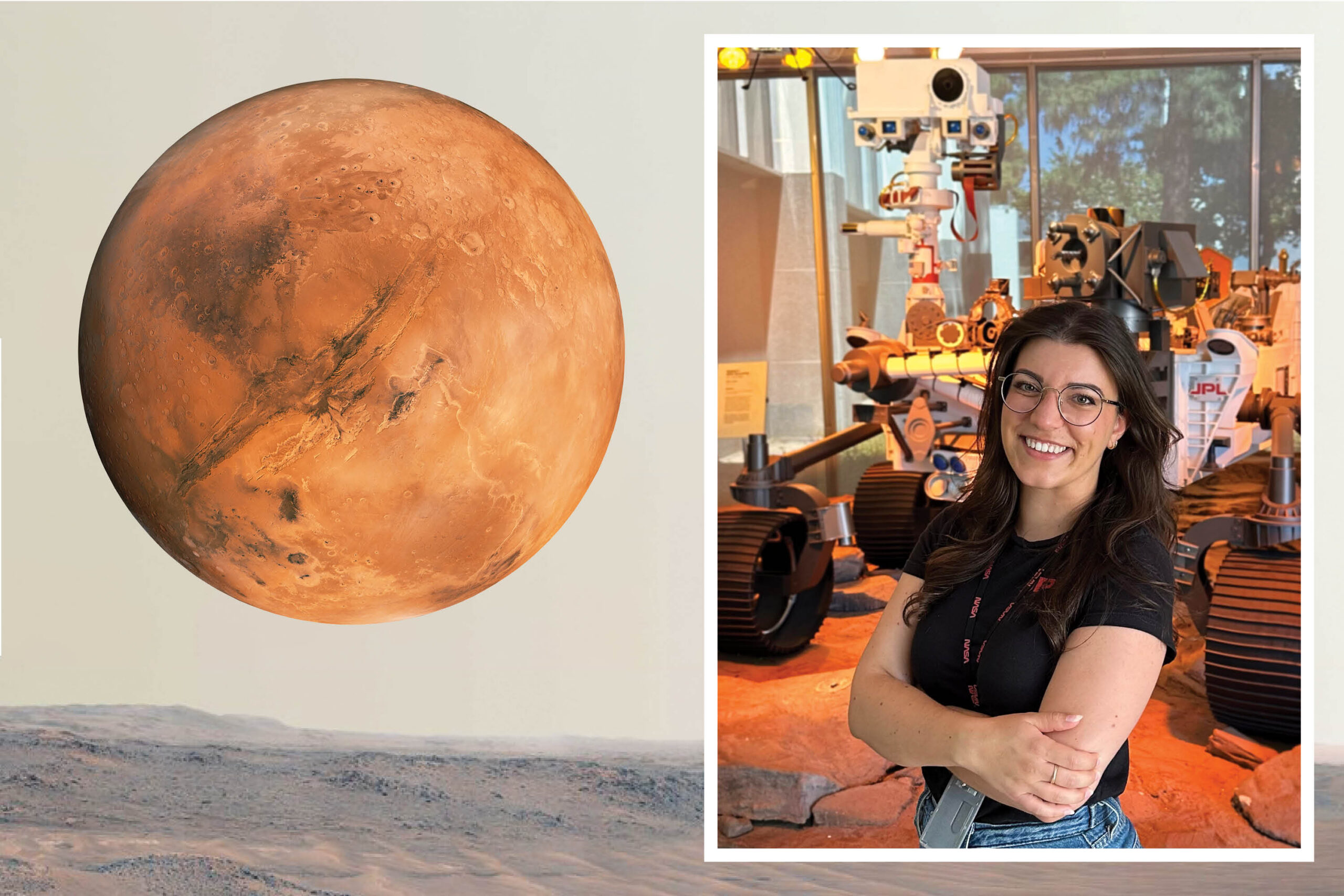
The image on Elise Rimsa’s computer monitor is one no other human has seen before.
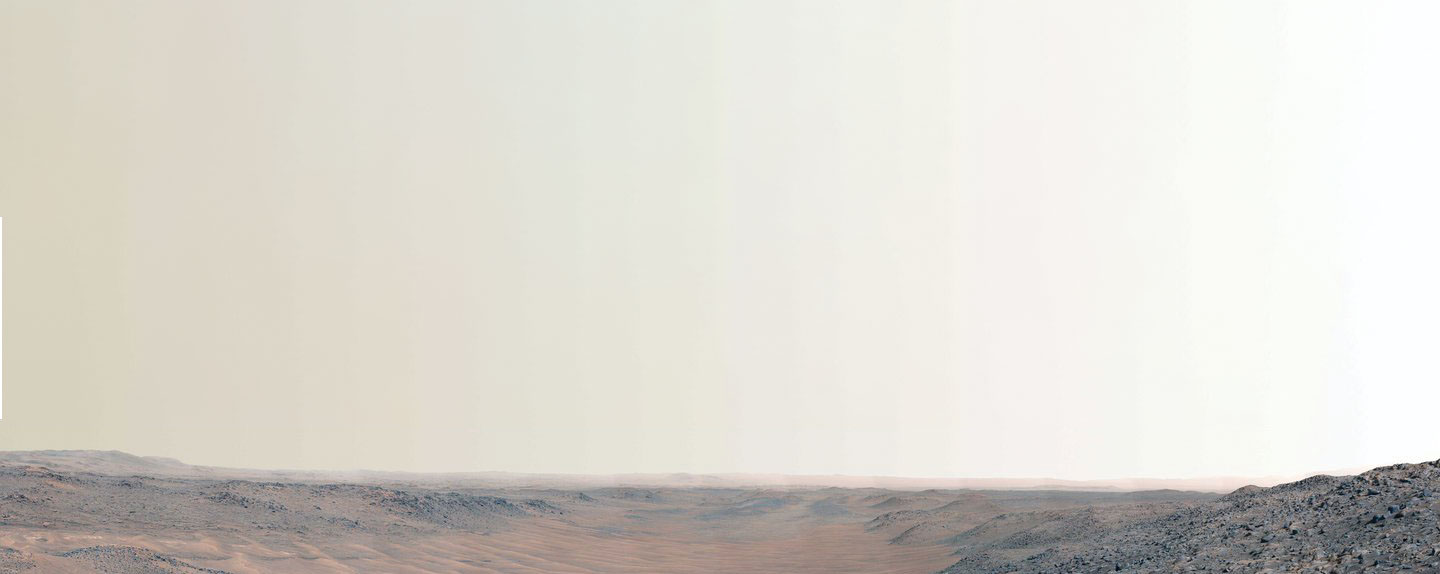
It’s a vast, brownish-red landscape of rolling hills and scattered rocks of differing sizes. The next image on the screen shows a dramatic grayscale vista with a dust devil swirling in the distance. From her desk in Southern California, Rimsa, Arts ’18, is visiting Mars again. It’s part of her routine collaborating with the engineers and scientists at NASA’s Jet Propulsion Laboratory, who explore outer space each day. “Some days I’m fully on Earth, some days I’m fully on Mars. Sometimes it’s a little of both,” Rimsa says.
As an instrument operator and data operations engineer, one of her assignments is commanding the engineering cameras aboard the Mars 2020 Perseverance rover roughly 140 million miles away. The feature-rich imaging system is crucial to the rover’s functioning on and around the red planet — from entry, descent and landing on the Martian surface to everyday navigation, hazard avoidance and sample collection. The images Rimsa and her team capture help inform rover planners and scientists for its next move.
“Space exploration is a huge team sport,” she says. It takes hundreds of people at JPL to manage the rover’s instruments and execute the Mars 2020 mission.
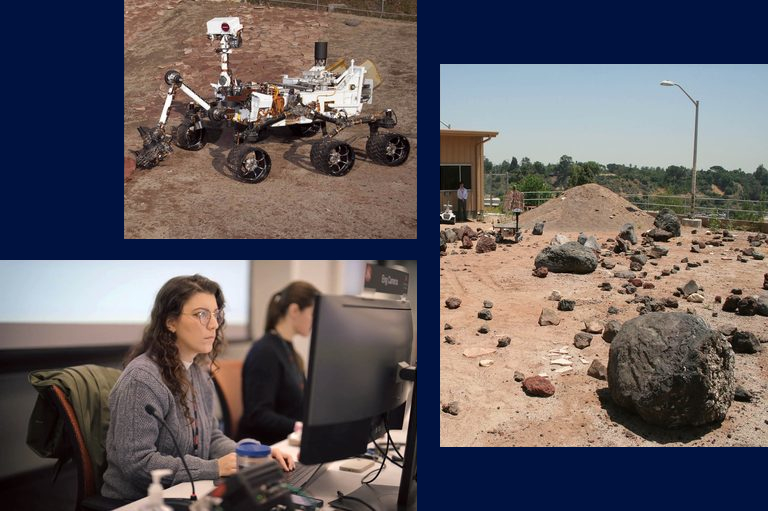
The goal of the mission, according to NASA, is to search for signs that life might have been present on the ancient Martian surface, collecting core samples of Martian rock and regolith (broken rock and soil) for potential pickup by a future mission that would bring them back to Earth for detailed study. “We’re pushing the boundaries and exploring what’s out there,” Rimsa says. “We’ve sent these robots and orbiters to explore for us in places humans can’t go yet, and I hope these missions will provide results and lessons learned that allow us to push the boundaries even further.”
It’s the kind of work children dream about when they look up at the night sky, as Rimsa did growing up in Illinois. Her interest in the universe and astrobiology — and her fandom of Star Wars and Star Trek — led her to major in physics with minors in astronomy and biology at Marquette. While pursuing her degree, she took part in undergraduate research with Dr. Karen Andeen, Clare Booth Luce Associate Professor of Physics, building and analyzing data from a prototype cosmic ray particle detector in collaboration with the IceCube Neutrino Observatory at the South Pole. “I loved being hands-on because physics can be very theoretical. I wanted to be more involved,” Rimsa says.
As a student at Marquette, she landed an internship at NASA’s Goddard Space Flight Center outside Washington, D.C., an experience that helped steer her toward aerospace engineering. She later completed another internship at Johnson Space Center in Houston while working toward a master’s in aerospace engineering sciences from the University of Colorado.
“Some days I’m fully on Earth, some days I’m fully on Mars. Sometimes it’s a little of both.”
Elise Rimsa, Arts ’18
Marquette students regularly pursue aerospace experiences through co-ops and internships, undergraduate research and the Marquette Rocketry student organization. Now, the Opus College of Engineering is adding a concentration to serve as a launching pad for careers like Rimsa’s. Through the new concentration in aerospace engineering, students will take Introduction to Aerospace, Intermediate Fluid Mechanics and additional elective coursework — all valuable educational experience for a field that the U.S. Bureau of Labor Statistics projects to grow 6 percent by 2034.
“While there are many pathways into the industry, studying aerospace engineering early gives a really valuable foundation to students looking to enter the field,” Rimsa says. “There’s been a new wave of public engagement and excitement about space exploration, and it definitely makes me hopeful for the future.”
Much of that excitement can be attributed to NASA’s Artemis II mission, which launched in April of this year and marked humanity’s return to lunar orbit for the first time in more than 50 years. The mission was also a key step toward a return to the moon and future missions to Mars, according to NASA. “We had a watch party at JPL for the Artemis II launch, and I just teared up. It was very inspiring,” Rimsa says. While her team doesn’t work directly with Artemis missions, she says, “You always feel connected to those major milestones.”
Rimsa and her team may not receive the notoriety of the Artemis astronauts, but their work hasn’t gone unnoticed. Since touching down in February 2021, the Perseverance rover has captured more than 1 million raw images of the Martian surface and atmosphere, which can be viewed on the NASA website. Images from the rover have been featured on network news shows and in national newspapers and gone viral on social media.
OFF-WORLD RECORD: On Oct. 11, 2026, NASA’s Perseverance rover surpassed the now decommissioned Opportunity rover’s 28.06 miles for total distance driven on a foreign surface.
“It’s cool when I’m doing the modeling for pictures we’re going to take, and it’s like, ‘Whoa, this is actually what it’s going to look like on Mars.’ It’s really rewarding to see those modeled images turn into real photos from the surface,” Rimsa says. “When anything is posted — like, ‘The rover took a selfie on Mars!’ — that’s a whole process that the team had to plan and execute.”
Some may see the images and say, “It’s just more dirt.” But each new reading and every new view from the Perseverance rover shows a previously unexplored part of the universe. The same can be said about Rimsa’s other role processing data from the Orbiting Carbon Observatory-3 (OCO-3), a NASA instrument on board the International Space Station that measures carbon dioxide in Earth’s atmosphere. Those readings inform our current lives on Earth and the relationship with our atmosphere, while the Mars rover’s operation explores the history and the environment of another world.
Rimsa says it can be easy to forget that she’s exploring an entirely foreign planet and processing data that scientists around the world rely on, but the breathtaking images and groundbreaking discoveries are a helpful reminder that she and the JPL team are part of the present and future of space endeavors. “Learning about other worlds scratches that itch of human curiosity,” she says. “Humans throughout history have explored, so it feels natural to do this. That’s really why I got into it in the first place — because I wanted to help do these things that no one has done before. We’re advancing our knowledge and learning more about our physical place in the universe. It’s exciting to contribute to the future of space exploration.”
MORE SPACE EAGLES: There are more Marquette alumni helping to take space missions to new heights. Read about them at mu.edu/mu-in-space.

From the fall 2026 issue of Marquette Magazine
The fall 2026 edition of Marquette Magazine is now available online. Copies are available on campus at the Zilber Hall security desk, AMU Information Center and outside Zilber Hall 235.