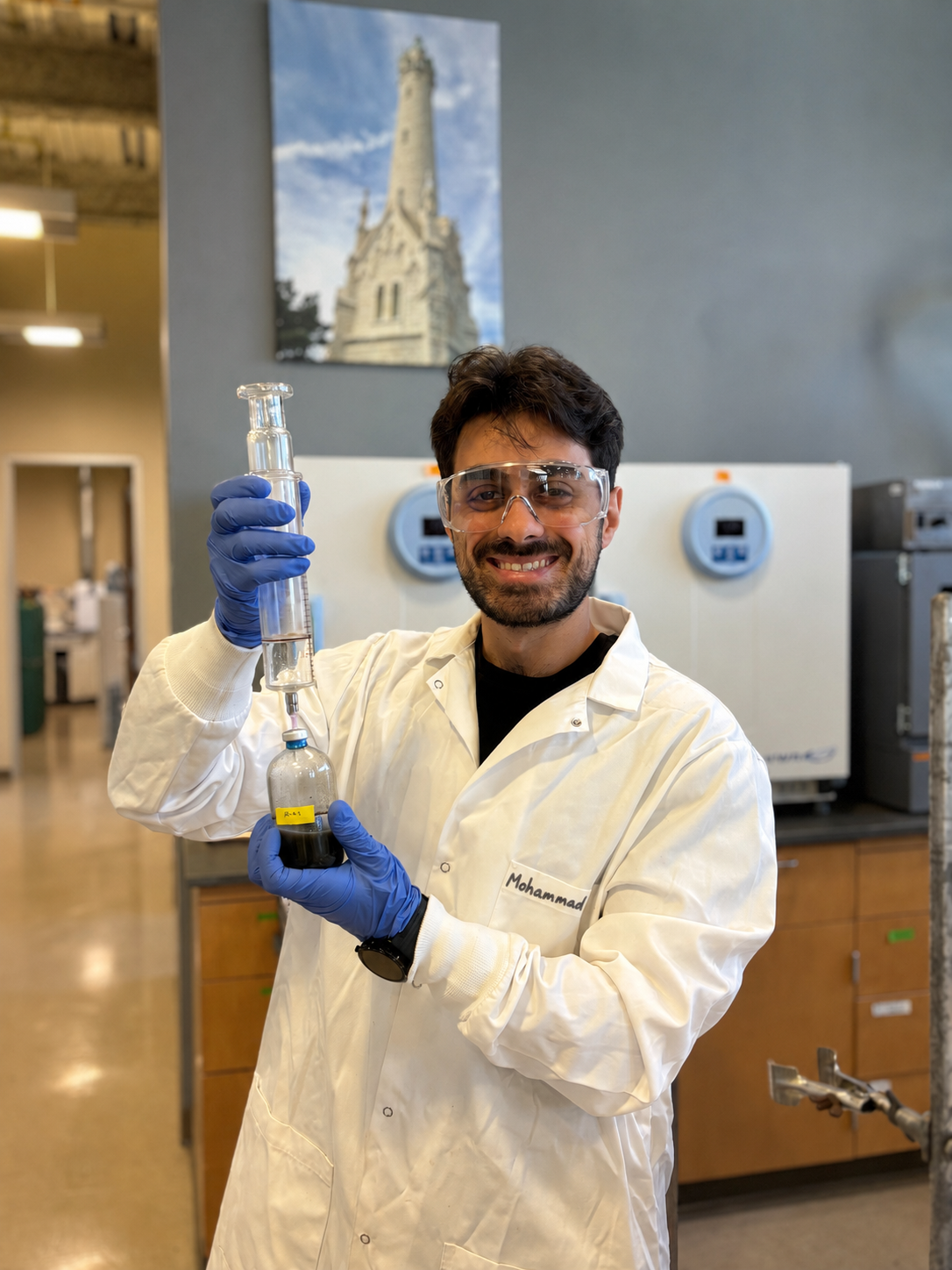
For Mohammad Tarawneh, choosing Marquette University meant choosing research his younger self would be proud of.
Born and raised in Jordan, he grew up in a region where water management is an important part of everyday life. Municipal water was typically supplied once or twice a week, with homes using rooftop storage tanks between supply periods. Growing up with that system gave him an early awareness of how water resources are managed and eventually helped shape his interest in environmental engineering.
“That experience taught me early on the importance of managing water sustainably,” he said.
While studying civil and environmental engineering as an undergraduate, he became interested in anaerobic biological wastewater treatment after learning that microorganisms could not only treat wastewater but also produce methane that could be used as a renewable energy source.
That interest eventually led him across the world to Marquette University and Dr. Daniel Zitomer, professor and chair of the Department of Civil, Construction and Environmental Engineering and director of the Water Quality Center. Drawn initially to Marquette by Dr. Zitomer’s research on anaerobic treatment, he now works alongside his adviser to develop new ways of treating wastewater that reduce energy consumption, lower operational costs, and create opportunities to recover renewable energy.
His research has also been supported by the Water Quality Center Graduate Student Fellowship, which provides funding for Ph.D. and M.S. students pursuing advanced research in environmental and water resources engineering to develop new technologies and protect human health and the environment.
Rethinking how wastewater is treated
Conventional wastewater treatment often relies on aeration — continuously pumping air into wastewater to provide oxygen to microorganisms that break down organic matter. The aeration process can account for up to 60% of a treatment plant’s energy use.
Instead, Mohammad and Dr. Zitomer work with anaerobic microorganisms, which can treat wastewater without oxygen while producing biogas containing methane. That methane can then be recovered and used as a renewable fuel for heat and electricity generation.
One challenge their research is working to overcome involves temperature. Conventional anaerobic systems are often operated at approximately 95 degrees Fahrenheit because the microorganisms become less active at lower temperatures. Wastewater, especially in colder climates, frequently falls below that temperature.
The research explores ways to overcome that limitation, including gradually adapting anaerobic microorganisms to lower temperatures and developing a new, low-energy reactor configuration in the laboratory. But its potential impact goes beyond lowering energy use.
Mohammad sees wastewater treatment as a process that does more than remove waste — one that can recover valuable resources and help connect water sustainability with renewable energy. With his sights set on the future, Mohammad notes that “in the long term, technologies that use less energy and cost less to operate could help make safe wastewater treatment more accessible, particularly in communities where limited resources are major barriers.”
Moving research beyond the lab
The research is part of Marquette’s broader work on water sustainability and resilience. Since 2021, Marquette researchers have collaborated with the U.S. Department of Defense and U.S. Army Corps of Engineers through the university’s In Defense of Water initiative.
Following the completion and defense of Mohammad’s dissertation, the research moved into its next stage: taking the technology beyond the laboratory.
With support from the Department of Defense and Army Corps of Engineers, the research team plans to moved forward with a pilot treatment system with the Milwaukee Metropolitan Sewerage District at a Milwaukee Wastewater treatment plant. The work falls under the grant In Defense of Water: Advanced Approaches to Enhance Water Sustainment, Resiliency, and Security, a project focused on developing technologies that strengthen water resources and water supply systems.
“This funding will allow our research team to move the technology from a laboratory-scale to pilot-scale at an operating wastewater treatment plant,” Mohammad said. “This is an important step because it will allow us to evaluate how well the technology performs when scaled up and operated under real-world conditions.”
The pilot marks an important transition for research that began at the bench scale and is now moving into real-world applications.
Research built through mentorship
Behind the technology is a student-faculty relationship that has shaped Mohammad’s experience at Marquette.
“Dr. Zitomer is the type of researcher and mentor I aspire to be. He is logical, patient and generous with his time.”
Mohammad Tarawneh
Mohammad recounts a time when one experiment did not go according to plan. Feeling stressed, overwhelmed and unsure how to move forward, he called his trusted adviser at 6 p.m. Dr. Zitomer immediately reassured him and reminded him that setbacks were a normal part of research. He then talked Mohammad through the problem logically and helped him determine his next steps. “His support has taught me not only how to approach research, but also how I hope to mentor others in the future,” Mohammad said.
With his dissertation and defense now complete, Mohammad is seeing years of laboratory research move into their next stage through the pilot treatment system. As the project moves into large-scale testing, the work he and Dr. Zitomer performed together is beginning a new chapter — one that could help bridge wastewater treatment, sustainability and renewable energy.