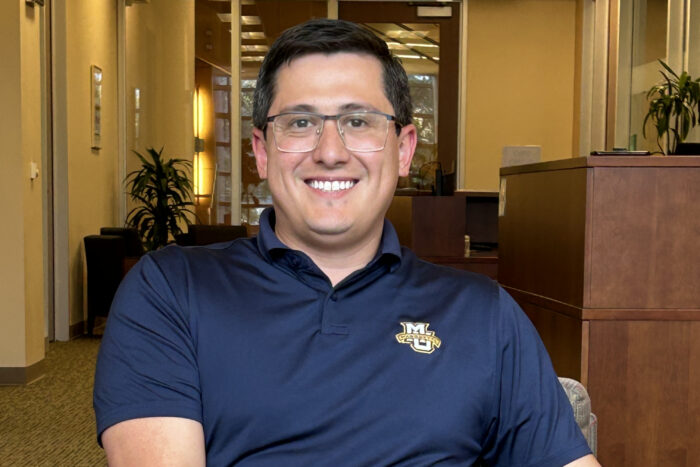
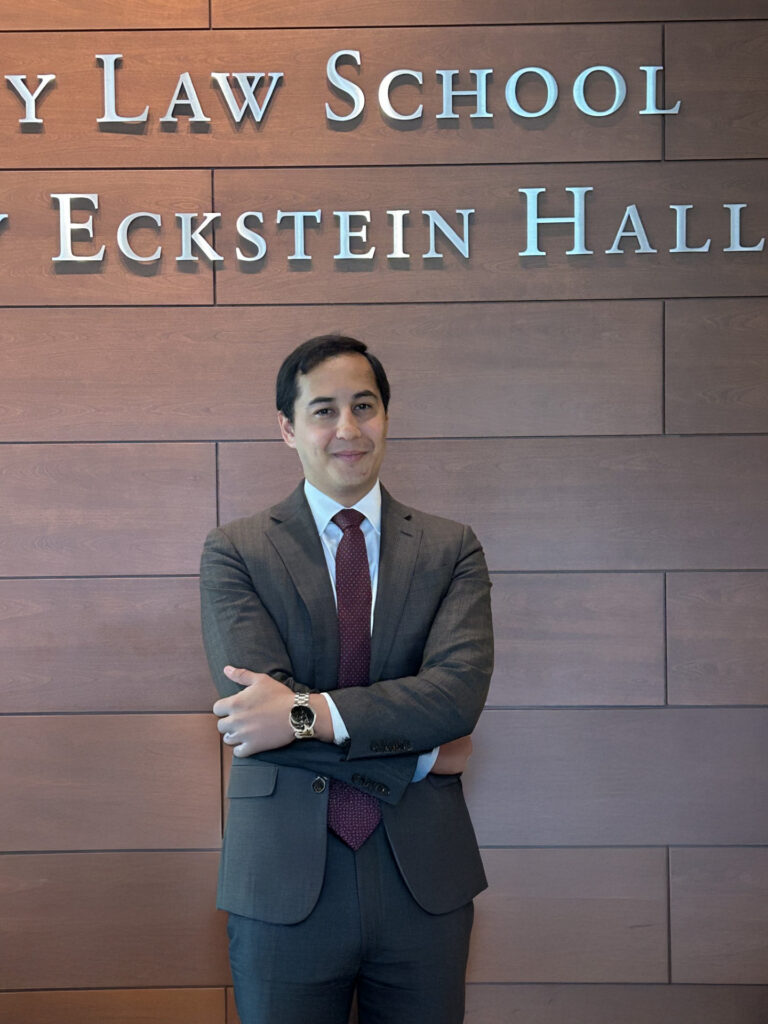
Why do criminal justice institutions make the decisions they do? And how much of those decisions are shaped by the way those institutions are designed? These are among the questions that drive the scholarship of Prof. José Girón, who joins Marquette University Law School this fall. Combining insights from criminal law, organizational theory, history, economics and comparative theory, his research explores how the structure of policing and criminal justice institutions influences their behavior — and, ultimately, the lives of the people they serve.
Born in Colombia, Girón brings a comparative perspective to questions that often go unexamined. “When you know how other countries’ institutions work, it is natural to wonder whether your institutions work better or worse.” By his own description, he is a “criminal law and organizational theory nerd” — a characterization that reflects both his intellectual curiosity and enthusiasm for the subject.
This fall, Girón will teach Criminal Law and Criminal Process, two foundational courses that sit at the heart of his scholarly interests. His approach to teaching reflects his broader commitment to asking difficult questions, challenging assumptions and encouraging students to think critically about how legal institutions operate and why they matter.
Girón was drawn to the Law School for both professional and personal reasons. On the academic front, he was impressed by the faculty’s intellectual engagement and curiosity. “Some of the hardest questions I fielded about my job talk paper were posed by Marquette professors,” he recalls. Outside the law school, he and his fiancée quickly fell in love with Milwaukee. “It’s a great city with world-class arts and culture offerings,” he says. “And it’s even greater when you can experience those offerings with people who strive to be — largely successfully — Midwestern nice.”
Before entering academia, Girón was an appellate litigator — a role he describes as both challenging and rewarding. Yet he found himself drawn to a different calling. “Practice was heaps of fun,” he says. “But your job is not always to find the truth. As a litigator, I had to search for whatever authority best advanced my clients’ interests.” Academia, by contrast, offered the opportunity to pursue questions wherever they might lead. “A dear friend once described me as ‘constitutionally oriented toward the truth,’” he says. “Academia allows me to strive toward the truth for truth’s sake.”
His decision was also deeply personal. Growing up in modest circumstances, he credits teachers and mentors with helping him imagine possibilities beyond what he thought was attainable. “I would not have gone to college, law school, a major law firm or Marquette without educators who saw something in me and encouraged me to be a better version of myself,” he reflects. “Now I will get paid to help students develop the same confidence and drive for excellence that made such a difference in my own life. It’s a dream come true.”
The best advice he received as a student continues to shape how he mentors others today: decide your own destination but seek help along the way. “Law can be prestige-obsessed,” he notes. “It’s easy to let others choose your goals for you, but that’s a quick way to be unhappy.” Instead, he encourages students to define success on their own terms while remaining open to guidance and support. “No one is an island. We are social creatures, and as we strive — and sometimes struggle — to forge our own paths, we should do so with the help of others.”
As he begins his career at Marquette, Girón has a message for the Law School community. To students, he offers reassurance: “I did not make it here on my own. And neither should you. I am here to help you on your way.” To colleagues, he promises to contribute to the intellectual and social life of the community they have built. And for alumni, he shares a lighter request: “Go Golden Eagles! Also, if anyone knows a good Colombian restaurant or a salsa dancing spot, please let me know. I am asking for a friend.”
Girón will join the Law School in the fall of 2026. Prior to joining Marquette, he was an associate in the Appellate & Supreme Court Practice Group at Covington & Burling in Washington, D.C., and previously clerked for Judge Stephanos Bibas on the U.S. Court of Appeals for the Third Circuit. His recent article on police decentralization appeared in the University of Pennsylvania Law Review. He earned his J.D. from Yale Law School, his B.A. in Philosophy from the University of Southern California and his A.A. from Miami Dade College.