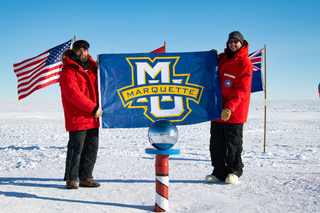
Before she taught students at Marquette, Dr. Karen Andeen worked on six different continents, including conducting research at the bottom of the globe.
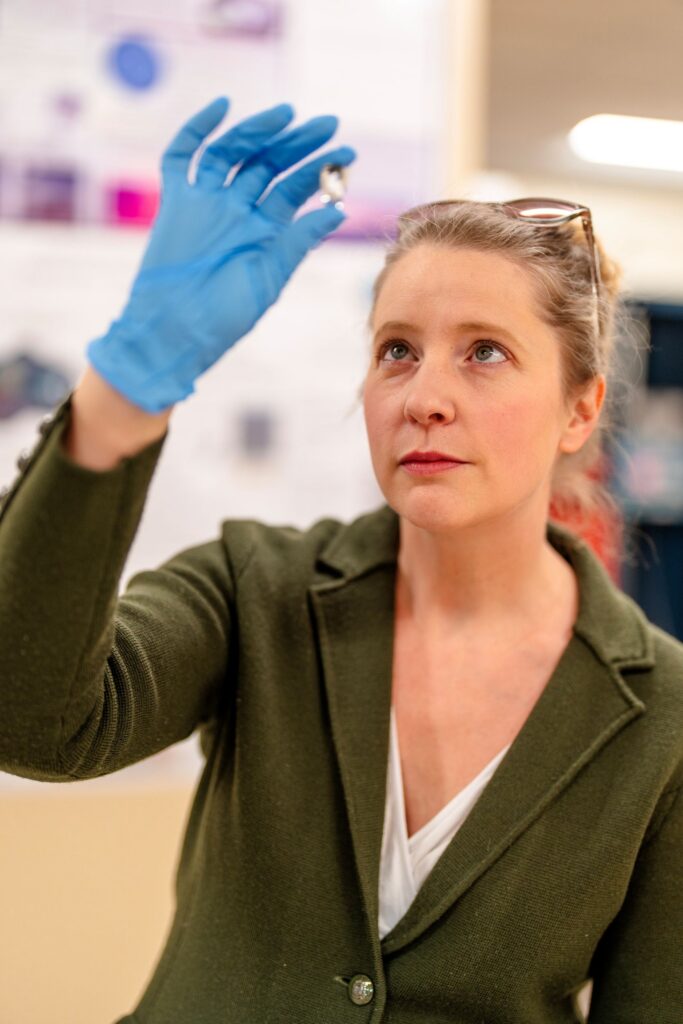
Prior to joining Marquette in 2015, Andeen worked on cosmic ray composition and energy spectrum at the IceCube Neutrino Observatory at the South Pole while earning her Ph.D.
The Clare Boothe Luce Associate Professor of Physics recently received the Association of Marquette University Women Nora Finnigan Werra Faculty Achievement Award and has been using it as a platform to help other women in STEM be recognized.
“I think the importance of this award is to show that someone who is a normal person, who doesn’t fit the present physics stereotype, can be a successful physicist,” Andeen, a mother of three, says. “Broadening the face of physics is important for the field. The award also highlights the mentoring work — which is often unseen and underappreciated — that so many of us do to support those around us.”
In this Q&A, Andeen shares more about her time at the southernmost point of the planet and the world of physics.
How did you get interested in physics?
When I grew up, I always wanted to be an explorer. One of my grade school teachers taught me all about how explorers found places and saw things no one from their culture had ever seen before, and then they mapped them. I was sad to realize that most places had already been discovered, but after taking classes with some amazing middle school and high school teachers, I knew I wanted to be a physics major. Those teachers made the subject so interesting and applicable to daily life, and the way they interwove in real-life stories made it exciting and fun to learn. I then realized that physics is where the newest maps of our universe are being created.
For many people, physics can be a difficult subject to understand. What is your technique for helping students and the public better understand why physics is so important?
I think it’s about building connections to everyday things: figuring out what makes people excited and showing them that it’s connected to physics. While teaching a larger class, it can become difficult to find one specific connection that all the students can relate to, but with enough analogies and interesting stories you hope that everyone can find a connection to at least one of them.
I think historical stories are especially important because it makes physics more approachable for people who might not look like the historical physicists we’re discussing but have faced similar challenges in their lives.
What is one experience from your time at the IceCube Neutrino Observatory that has stuck with you?
When you are at such a high altitude (approximately 10,000 feet) and wind chills around –60 degrees Fahrenheit, it comes with low oxygen, harsh environments, heavy gear and, in turn, makes everyone burn thousands of calories a day. When I was down there, I was wearing around 15 to 20 pounds of gear, and I had to eat around 6,000 calories a day — I started eating cookies for dessert after every meal, even after a full breakfast, just to have enough energy to make it to the next meal.
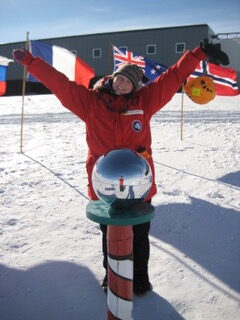
Also, even though it’s completely barren, there is a lot of danger when it comes to working in the South Pole. With limited oxygen, you forget things easily and sometimes do not think rationally. Injuries are more common than you would think, and although there is a doctor at the pole, when a serious injury or medical emergency occurs, you need to be airlifted to New Zealand. It can take 24 to 48 hours to get to a real hospital during the summer season at the pole (in winter, it takes weeks). It is actually faster for astronauts to reach a hospital from the International Space Station!
How do you hope the future of STEM education progresses, especially for women?
I hope that in 20 years no one will have to ask that question, but in terms of the next 20 years, I hope that high school STEM education becomes a more popular job for scientists — only about 35% of high school physics teachers actually have a degree in physics (compared to approximately 90% of high school biology teachers with a degree in biology). I think this could have a big impact on popularizing physics. I’d also like to see better pay for K-12 teachers in general, so that this career path seems more possible for scientists.
As a physicist, if you had one question you could have answered about the universe, what would that be?
I would like to know what actually happened before the Big Bang. There are many theories: which one (if any) is correct?
And something I wish was true in physics: It is a well-established fact in physics that the speed of light is our speed limit — we cannot travel faster than light speed. But if it were possible to somehow work around this fact, it would be really cool and would allow for things like fast interstellar travel — just like in the movies!