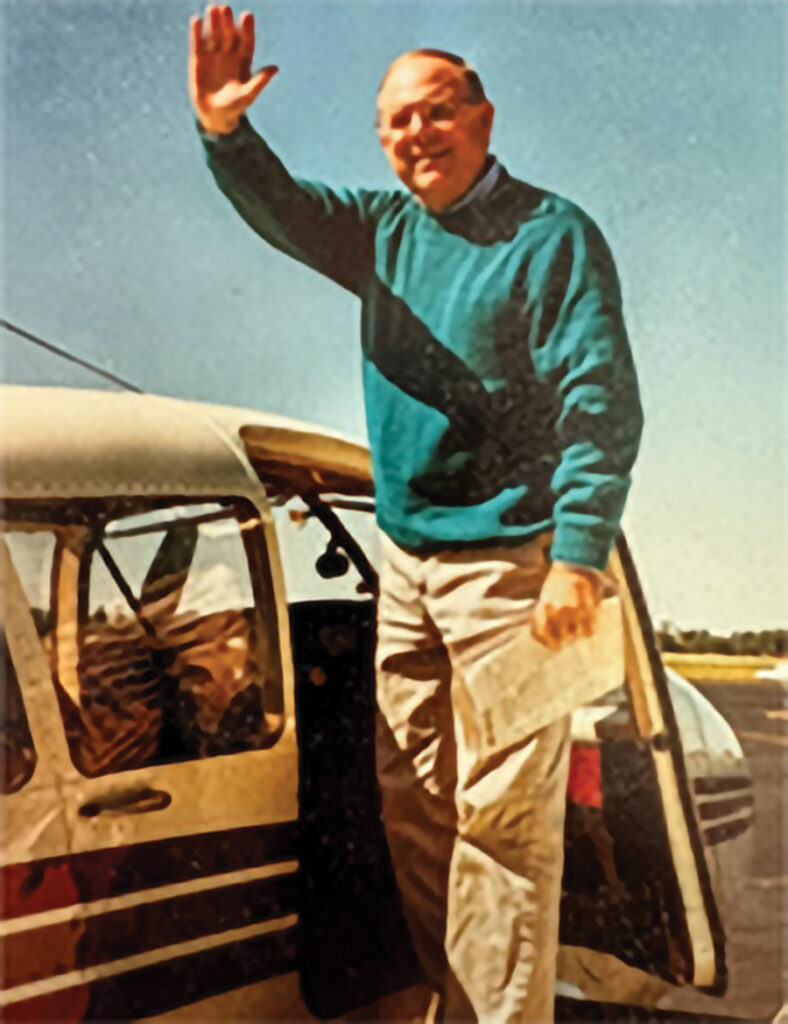
Louis J. Andrew, Jr., L’66, became much involved in the advancement of Marquette Law School some 30 years after graduation—and remained so for the next three decades. Today, the Law School is home to the Andrew Center for Restorative Justice, established in 2022 with the generous support of Louis and his wife, Suzanne Bouquet Andrew, Sp ’66. In remarks at a gathering after a funeral Mass for Louie Andrew at the Cathedral of St. John the Evangelist in Milwaukee on November 24, 2025, Dean Joseph D. Kearney remembered this alumnus and friend.
My connection with Louie Andrew began with Dean Howard Eisenberg, who recruited me to join the Marquette Law School faculty in 1997. That was only about a year after Howard had caused Louie to renew his own connection with his alma mater: In remembering Howard after his death in 2002, Louie would write that he (Louie) “really had not been involved with anything at the Law School” since graduating some 30 years earlier, in 1966, but that Howard inspired him and Sue. It was a great privilege for me, as a junior faculty member, that Howard introduced me to Louie and that the group of us would go to the occasional Milwaukee Brewers game together, as a beginning connection. I continue to have the master scorecard that Louie had created and of which he made a gift to me, including the magnanimous inscription, “Go White Sox.”
Louie’s connection with Marquette Law School in the ensuing years came to include Janine Geske and, eventually, Mike Gousha, among many others. It expanded to encompass restorative justice, the possibility of a law school building project, and just about anything else whereby the Law School might grow and develop. Louie had a remarkable habit of engaging with people, seeking to learn from them, and, often in the most indirect way possible (and always in the least showy way), of teaching them things. I learned an extraordinary amount from Louie, and I know this to be true of many others.
This past weekend, I went to my “wayback machine,” as I sometimes call my old emails. With some people, I could reconstruct very large portions of our work together by going through our back-and-forth emails. I knew this not to be the case with Louie, with whom the in-person connection was central. (How he could be present so consistently at Marquette Law School—for example, as chair of the Law School Advisory Board and as a member of the steering committee during the Eckstein Hall building project—from Fond du Lac, I had and have no idea, but we may leave that aside.)
Yet, in my lookback yesterday, I was struck by one of the first emails that he sent me (this was in 1999). He included references to my wife, Anne, and how lucky the legal profession in Milwaukee was to have her; to his daughter, Sara, “now a junior in the business school” at Marquette, who was enjoying it “very much”; and to his fundraising work with Howard for the Law School. Here, though, from that email, is what was especially occupying Louie’s attention on Saturday, January 23, 1999:
Today I am spending the day plotting a route on a map through France. I was invited to go on a race in a vintage car race from London to Monte Carlo.
The race starts next Saturday. I am the navigator in our car. The course is a very intricate route thru the north and east sides of France going through the mountains. I’ll tell you about it when I am back. We are driving a 1927 Packard owned by my friend. No heater in the car.
I learned a good deal about Louie in that exchange, reflecting, as it did, an interest in my family, in his own family, in the advancement of Marquette Law School—and in some (if I may) unusual pastime or venture, with a friend, that would make for an interesting experience and from which he might learn something.
Learning is what Louie wrote about in an essay that he contributed to the Marquette Law Review, remembering Dean Eisenberg shortly after his death, in 2002:
I learned about the Chicago Cubs [I didn’t say that everything that Louie learned was good], I learned about Judaism, I learned about dedication and giving, I learned about Phyllis and his family, I learned about what it takes to make a law school tick, I learned about warmth and humor, I learned about success without bragging, I learned about St. Ignatius, I learned about the dedication of Father Wild, I learned about university politics, I learned about wonderful students, I learned about clear, passionate writing, I learned about leadership, I learned about goodness, and I learned what pro bono really means.
Here’s what I would say: Of all the many extraordinary people with whom I have had the privilege to work, I don’t know that I have ever worked with anyone who embraced learning, or set himself up to learn new things, more than did
Louie Andrew.
And yet, all along, it was also we who were learning from Louie. Permit me to relate one other thing that Louie said in his brief essay about Howard: “We all talk about what contribution one person can make in his lifetime to the betterment of the world. This is [someone] who really showed how this can be done.” From my own experiences (and, I have an idea, many of yours), I would conclude that Louie was not just a student or learner but, in his own gently inquiring and instructive way, a teacher. Let us all look forward to applying many of his lessons in times yet to come. Thank you.
This article was first featured in the Summer 2026 issue of Marquette Lawyer Magazine.